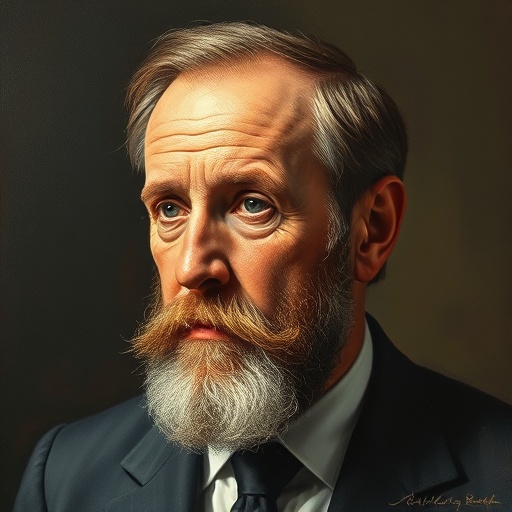
Niels Bohr — "The very nature of our subject, quantum physics, forces us to realize that we ar…"
The very nature of our subject, quantum physics, forces us to realize that we are suspended in language.
The very nature of our subject, quantum physics, forces us to realize that we are suspended in language.
Click any product to generate a realistic preview. Up to 3 at a time.
* Initial load can take up to 90 seconds — revising the preview in another color is nearly instant.
"The problem is not to make things simple, but to make them understandable."
"The best weapon of a dictatorship is secrecy, but the best weapon of a democracy should be the weapon of openness."
"The opposite of a correct statement is a false statement. But the opposite of a profound truth may well be another profound truth."
"The goal of science is to explain the world, not to describe it."
"I often say that there is no quantum world. There is only an abstract quantum physical description. It is wrong to think that the task of physics is to find out how nature is. Physics concerns what we…"
Similar to previous quote, often paraphrased in discussions of quantum philosophy.
Date: Approx. 1950s
EducationalFound in 1 providers: grok
1 source checked
Bohr is saying we cannot step outside language to describe reality directly. Our words were built to describe everyday objects and experiences, so when we try to talk about strange quantum phenomena, we are stuck using concepts that do not quite fit. We are not observers looking at nature from the outside but participants trapped inside a web of human vocabulary that shapes what we can even think or say about it.
Bohr spent decades wrestling with how to communicate quantum behavior that defied classical intuition. His complementarity principle argued that particles and waves are two linguistic pictures humans need because no single description captures reality. Famous for endless philosophical discussions at his Copenhagen institute, he cared as much about the wording of physics as the mathematics, insisting that physics is about what we can say about nature, not nature itself.
Bohr worked during the early twentieth century upheaval when Einstein, Heisenberg, Schrodinger, and Born were overturning Newtonian certainty. The Copenhagen interpretation emerged in the 1920s and 1930s amid fierce debates about measurement, observers, and reality. Philosophers like Wittgenstein were simultaneously arguing language sets the limits of thought, and logical positivism was peaking. Bohr's remark captures that moment when science and philosophy collided over whether human concepts could ever fully grasp the subatomic world.
AI-generated insights based on extensive research and information for context. Factual errors? Email [email protected].
Your cart is empty