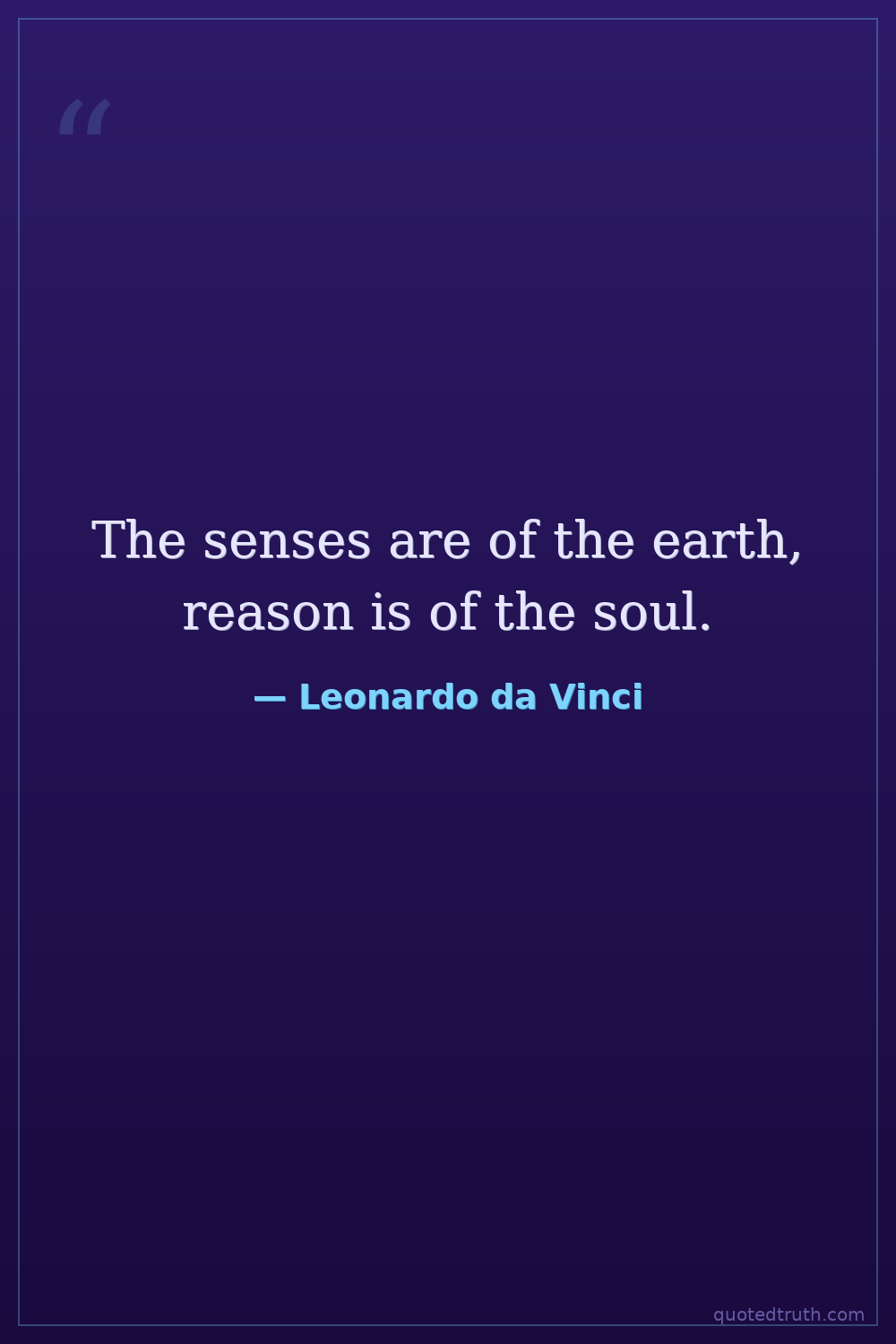
Leonardo da Vinci — "The senses are of the earth, reason is of the soul."
The senses are of the earth, reason is of the soul.
The senses are of the earth, reason is of the soul.
Click any product to generate a realistic preview. Up to 3 at a time.
* Initial load can take up to 90 seconds — revising the preview in another color is nearly instant.
"Where the spirit does not work with the hand, there is no art."
"It is better to imitate ancient than modern work."
"Obstacles cannot crush me. Every obstacle yields to stern resolve."
"The works of nature are such that they do not exist without cause."
"I have offended God and mankind because my work didn't reach the quality it should have."
Found in 1 providers: grok
1 source checked
Physical senses bind us to the material world—what we touch, see, hear, taste, and smell. But reason belongs to a higher plane, to the soul. The quote draws a hierarchy: sensory experience is earthly and finite, while rational thought transcends the body and connects us to something deeper and enduring. To truly understand the world, one must move beyond mere perception toward principled, reflective reasoning that grasps underlying truth.
Da Vinci spent decades filling notebooks with direct observation—dissecting corpses, studying water flow, sketching birds mid-flight. He trusted the senses as knowledge's starting point. Yet he believed nature obeyed mathematical laws only reason could uncover. This tension defined him: an empiricist treating sensory data as raw material, and a philosopher seeking rational principles behind it. He embodied the duality this quote describes—grounded in earthly observation yet driven by a soul-level hunger for deeper understanding.
The Italian Renaissance, shaped by Neoplatonism through Marsilio Ficino and Florence's Platonic Academy, revived the classical idea that the soul's rational faculty could ascend toward divine truth. Medieval Christianity had long positioned the immortal soul above the corrupt body. Early humanists meanwhile championed reason as God's greatest gift to mankind. Da Vinci lived at this confluence—when elevating reason over sensory experience was simultaneously a philosophical stance and a quiet challenge to scholastic tradition.
AI-generated insights based on extensive research and information for context. Factual errors? Email [email protected].
Your cart is empty