What it means
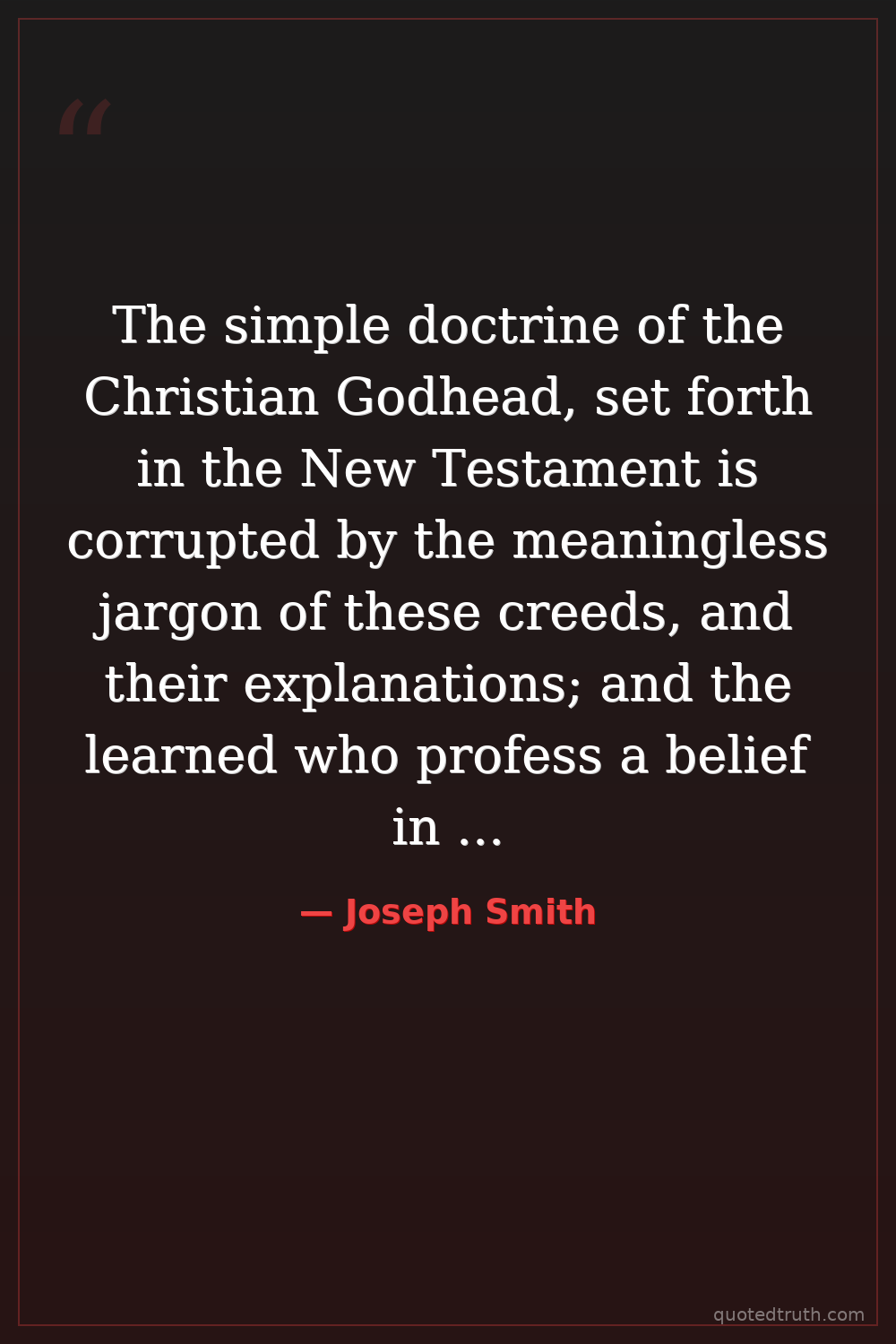
The quote argues that the New Testament's teachings about God were originally simple and straightforward, but centuries of formal church creeds and theological debate have buried them under incomprehensible jargon. Those creeds, Smith claims, imported ideas from ancient pagan Greek philosophy rather than scripture. Educated theologians who defend these doctrines are spiritually adrift, following man-made complexity instead of plain biblical truth.
Relevance to Joseph Smith
Smith founded the LDS Church on the claim that original Christianity had been lost through apostasy and needed restoration. His 1820 First Vision — where he reportedly saw God and Jesus as two separate beings — directly contradicted Trinitarian creeds. He taught a non-Trinitarian Godhead throughout his ministry, arguing the Nicene Creed blended Greek philosophy into Christianity. This quote reflects his core theological mission of cutting through institutional religion.
The era
Smith lived during the Second Great Awakening (1790s–1840s), when America buzzed with competing Christian revivals and denominations arguing over doctrine. Restorationist movements like the Campbellites similarly challenged creedal orthodoxy. Enlightenment thought had pushed educated Americans to question formal theology, while frontier communities craved direct, accessible religion. Smith's attack on learned theologians' jargon resonated with ordinary believers suspicious of educated clergy and institutional religion.
AI-generated insights based on extensive research and information for context. Factual errors? Email [email protected].