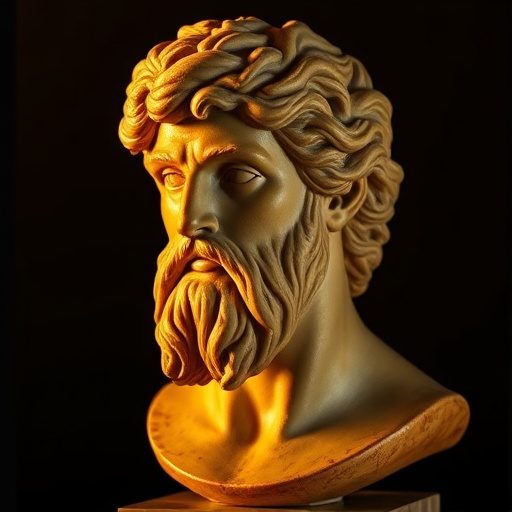
Pythagoras — "The soul of man is immortal and that it changes into other kinds of animals."
The soul of man is immortal and that it changes into other kinds of animals.
The soul of man is immortal and that it changes into other kinds of animals.
Click any product to generate a realistic preview. Up to 3 at a time.
* Initial load can take up to 90 seconds — revising the preview in another color is nearly instant.
"None can be free who is a slave to, and ruled by, his passions."
"The highest goal of music is to connect one's soul to their Divine Nature, not entertainment."
"Stop! Don't hit it! It's the soul of a friend of mine. I knew it when I heard it cry."
"There is geometry in the humming of the strings."
"A man is never free unless he is master of himself."
Greek philosopher and mathematician whose school in Croton combined geometry (the Pythagorean theorem), number-mysticism, and a religious-vegetarian way of life. Closely associated with Thales of Miletus (earlier pre-Socratic and the first philosopher). For an intellectual contrast, see Heraclitus, pre-Socratic Greek philosopher of flux — Heraclitus called Pythagoras 'the chief of swindlers' — among the founding insults of the philosophical-rivalry tradition. Their 'all is flux' vs 'all is number' poles still organize the philosophy of mathematics today (Platonist vs anti-realist).
A core tenet of metempsychosis, or transmigration of souls, central to Pythagorean thought and a reason for vegetarianism.
Date: c. 570 – c. 495 BC
ShockingFound in 1 providers: grok
1 source checked
Every person has a soul that never dies. When the body stops working, the soul doesn't vanish, it simply moves into a new living creature and starts another life. That creature might be another human or an animal, and the cycle keeps repeating. Death is not an ending but a transfer, and the being you are today may have lived many previous lives in very different bodies.
Pythagoras founded a secretive brotherhood in southern Italy that treated the soul's transmigration as a central teaching. Followers ate no meat and avoided harming animals because any creature might house a former friend's soul. He claimed to remember his own past lives. Though remembered today for geometry and number theory, his community blended mathematics, music, ritual purity, and this reincarnation doctrine into one complete way of living.
In the sixth century BCE, Greek thinkers were breaking from Homeric views of a gloomy, shadowy afterlife in Hades. Mystery cults like the Orphics promoted similar ideas of a divine soul cycling through bodies, and Pythagoras likely drew on Egyptian and Eastern influences during his travels. This was a period when philosophy, religion, and early science were undivided, so a mathematician teaching reincarnation was perfectly ordinary rather than contradictory.
AI-generated insights based on extensive research and information for context. Factual errors? Email [email protected].
Your cart is empty