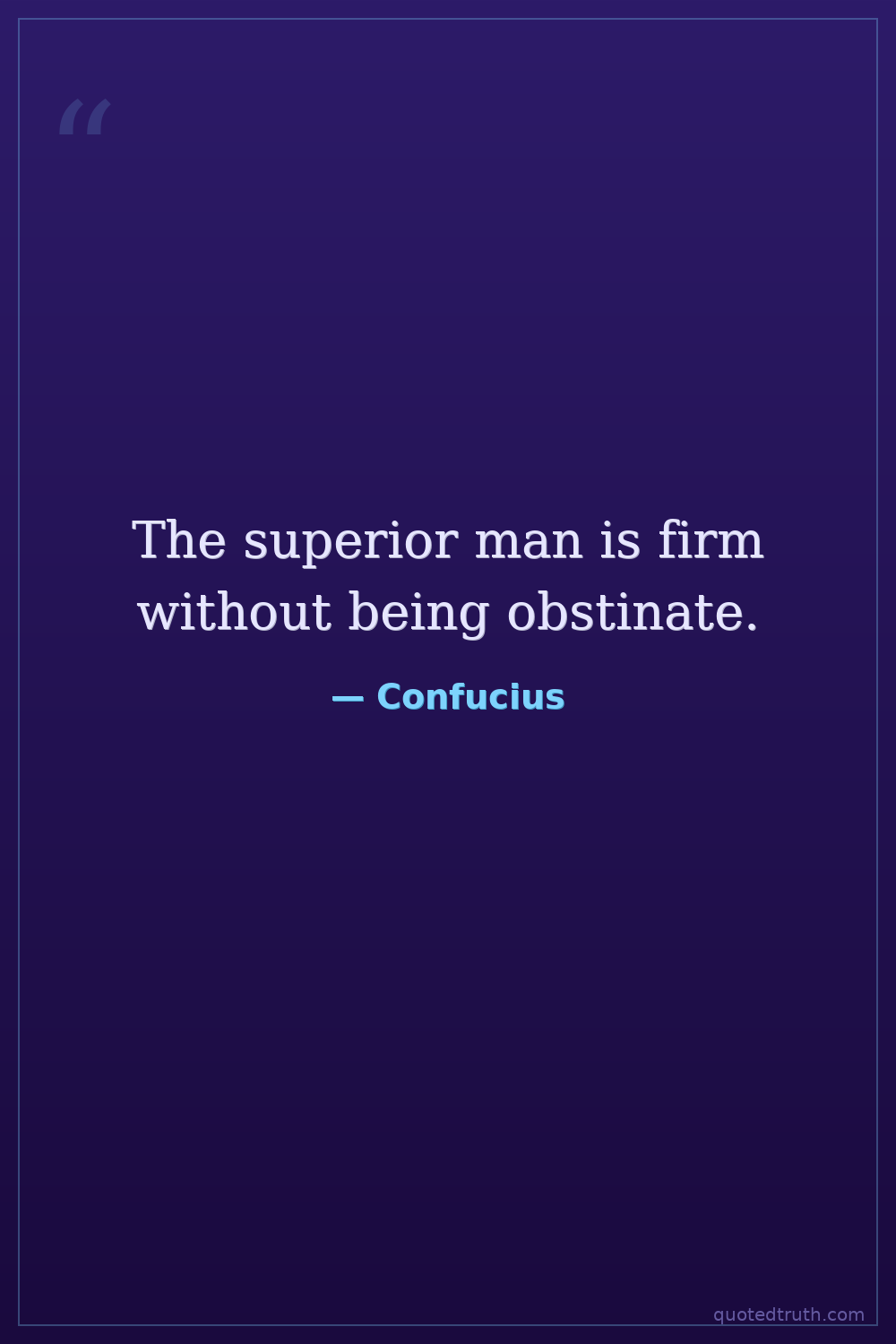
Confucius — "The superior man is firm without being obstinate."
The superior man is firm without being obstinate.
The superior man is firm without being obstinate.
Click any product to generate a realistic preview. Up to 3 at a time.
* Initial load can take up to 90 seconds — revising the preview in another color is nearly instant.
"To govern means to rectify. If you lead the people with correctness, who will dare not to be correct?"
"The man who asks a question is a fool for a minute, the man who does not ask is a fool for life."
"If a man in the morning hear the right way, he may die in the evening hear regret."
"Before you embark on a journey of revenge, dig two graves."
"The gentleman understands integrity; the petty person knows about profit."
Chinese philosopher and teacher whose teachings (compiled by his students in the Analects) became the foundational ethical framework of East Asian civilization for 2,500 years. Closely associated with Mencius (his most-influential follower a century later). For an intellectual contrast, see Laozi, near-contemporary Chinese sage and Tao Te Ching author — Confucius systematized social order through ritual and family hierarchy; Laozi's Taoist effortless-action philosophy argued such systems were the disease, not the cure. The two founding poles of Chinese moral philosophy — every East Asian moral tradition since has positioned itself between them.
The standard scholarly entry points to Confucius's work: Philip J. Ivanhoe (Georgetown, Chinese philosophy) — Confucian Moral Self Cultivation (2000); Edward Slingerland (UBC, Asian Studies) — Effortless Action: Wu-wei as Conceptual Metaphor (2003); Tu Weiming (Harvard, Confucian scholar) — Confucian Thought: Selfhood as Creative Transformation (1985). These are the works graduate seminars cite when teaching Confucius.
Analects 15.16 (often translated as 'The gentleman is not obstinate')
Date: c. 5th century BCE
WisdomFound in 1 providers: grok
1 source checked
A person of strong character holds steady to principles and commitments without becoming rigid or closed-minded. Firmness means resolve and integrity under pressure, while obstinacy is stubbornness that refuses new evidence or reasonable counsel. The ideal is a flexible backbone: stay grounded in core values, but remain willing to listen, revise, and adapt when circumstances or better arguments genuinely call for it.
Confucius built his ethics around the junzi, the 'superior' or exemplary person, contrasting steady virtue with petty stubbornness. As a teacher who traveled among warring states seeking rulers who would heed his counsel, he prized moral resolve paired with responsiveness to ritual, learning, and wise advice. His willingness to revise judgments about disciples, yet never abandon ren and li, embodies the firm-not-obstinate balance.
Confucius lived during the late Spring and Autumn period (551-479 BCE), as Zhou authority collapsed into feuding states and rival schools debated how to restore order. Rulers oscillated between rigid legalist force and opportunistic shifts of alliance. Against that backdrop, urging leaders to be firm without obstinacy spoke directly to courts where stubborn tyrants ignored counsel and fickle ones betrayed covenants, offering a middle path rooted in cultivated character.
AI-generated insights based on extensive research and information for context. Factual errors? Email [email protected].
Your cart is empty