Confucius — "To govern means to rectify. If you lead the people with correctness, who will da…"
To govern means to rectify. If you lead the people with correctness, who will dare not to be correct?
To govern means to rectify. If you lead the people with correctness, who will dare not to be correct?
Click any product to generate a realistic preview. Up to 3 at a time.
* Initial load can take up to 90 seconds — revising the preview in another color is nearly instant.
"I will not be afflicted that men do not know me; I will be afflicted that I do not know men."
"To be fond of learning is near to wisdom. To practice with vigor is near to benevolence. To have the feeling of shame is near to courage. He who knows these three things knows how to cultivate his own…"
"Study the past if you would define the future."
"You cannot open a book without learning something."
"Learning without thought is labor lost; thought without learning is perilous."
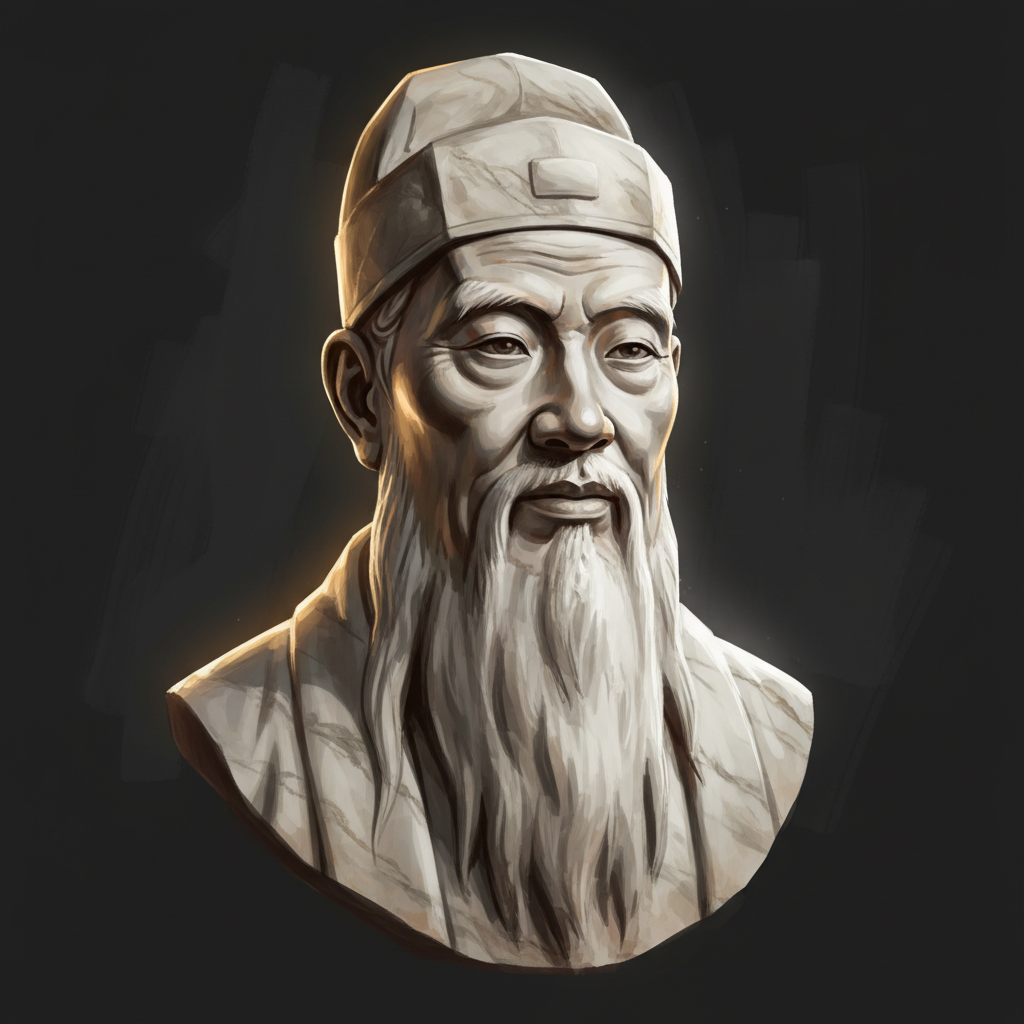
Chinese philosopher and teacher whose teachings (compiled by his students in the Analects) became the foundational ethical framework of East Asian civilization for 2,500 years. Closely associated with Mencius (his most-influential follower a century later). For an intellectual contrast, see Laozi, near-contemporary Chinese sage and Tao Te Ching author — Confucius systematized social order through ritual and family hierarchy; Laozi's Taoist effortless-action philosophy argued such systems were the disease, not the cure. The two founding poles of Chinese moral philosophy — every East Asian moral tradition since has positioned itself between them.
The standard scholarly entry points to Confucius's work: Philip J. Ivanhoe (Georgetown, Chinese philosophy) — Confucian Moral Self Cultivation (2000); Edward Slingerland (UBC, Asian Studies) — Effortless Action: Wu-wei as Conceptual Metaphor (2003); Tu Weiming (Harvard, Confucian scholar) — Confucian Thought: Selfhood as Creative Transformation (1985). These are the works graduate seminars cite when teaching Confucius.
Found in 1 providers: grok
1 source checked
Leadership is fundamentally about setting things straight, starting with yourself. When a leader consistently acts with integrity, honesty, and moral uprightness, the people they govern naturally follow that example. Authority flows from personal character rather than force or rules. If those at the top behave correctly, subordinates have no cover for misbehavior and will align themselves accordingly. Good governance is therefore moral self-discipline visible to everyone.
Confucius spent his career advising rulers and training officials, arguing that virtuous leadership, not harsh law, stabilized society. He held minor government posts in the state of Lu and traveled seeking a ruler who would adopt his ethical model. This saying captures his signature doctrine of rule by moral example, where a junzi governs through self-cultivation. It reflects his lifelong conviction that personal rectitude radiates outward to reform society.
Confucius lived during the late Spring and Autumn period around 551 to 479 BCE, when the Zhou dynasty's central authority was collapsing and rival states waged constant war. Feudal lords ignored ritual, ministers assassinated kings, and corruption spread. Against this chaos, competing schools debated how to restore order. Confucius's answer, that rulers must embody virtue rather than merely wield punishment, challenged realpolitik dominating the era and offered a moral alternative to coercive statecraft later crystallized by Legalists.
AI-generated insights based on extensive research and information for context. Factual errors? Email [email protected].
Your cart is empty