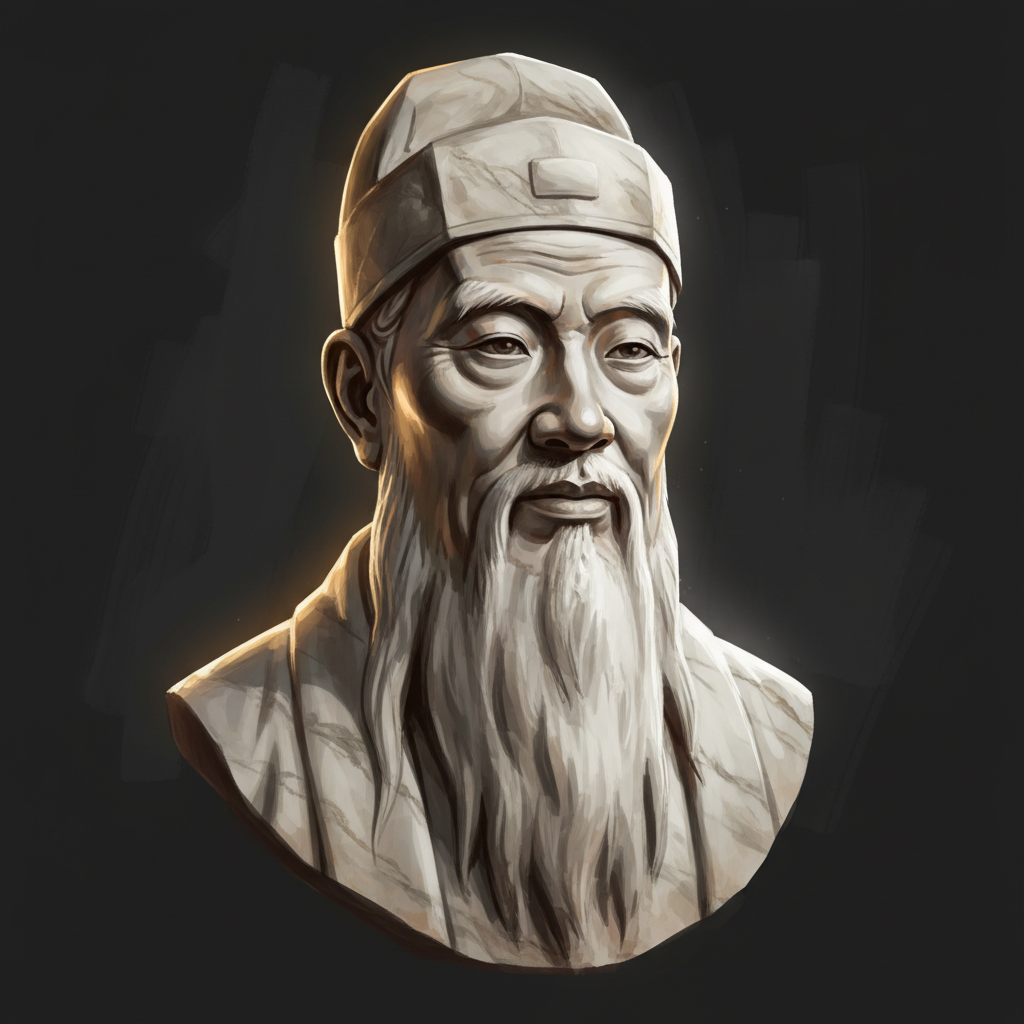
Confucius — "The superior man is modest in his speech, but exceeds in his actions."
The superior man is modest in his speech, but exceeds in his actions.
The superior man is modest in his speech, but exceeds in his actions.
Click any product to generate a realistic preview. Up to 3 at a time.
* Initial load can take up to 90 seconds — revising the preview in another color is nearly instant.
"The superior man, in the world, does not set his mind either for anything, or against anything; what is right he will follow."
"If a man in the morning hear the right way, he may die in the evening hear regret."
"It does not matter how slowly you go as long as you do not stop."
"Hold faithfulness and sincerity as first principles. Then no friends will be unlike yourself."
"When he eats, the gentleman does not seek to stuff himself. In his home he does not seek luxury. He is diligent in his work and cautious in his speech. He associates with those who possess the Way, an…"
Chinese philosopher and teacher whose teachings (compiled by his students in the Analects) became the foundational ethical framework of East Asian civilization for 2,500 years. Closely associated with Mencius (his most-influential follower a century later). For an intellectual contrast, see Laozi, near-contemporary Chinese sage and Tao Te Ching author — Confucius systematized social order through ritual and family hierarchy; Laozi's Taoist effortless-action philosophy argued such systems were the disease, not the cure. The two founding poles of Chinese moral philosophy — every East Asian moral tradition since has positioned itself between them.
The standard scholarly entry points to Confucius's work: Philip J. Ivanhoe (Georgetown, Chinese philosophy) — Confucian Moral Self Cultivation (2000); Edward Slingerland (UBC, Asian Studies) — Effortless Action: Wu-wei as Conceptual Metaphor (2003); Tu Weiming (Harvard, Confucian scholar) — Confucian Thought: Selfhood as Creative Transformation (1985). These are the works graduate seminars cite when teaching Confucius.
Found in 3 providers: grok,deepseek,gemini
3 sources checked
Genuine excellence shows through deeds, not words. A person of true character avoids boasting, self-promotion, or making grand promises, instead letting consistent action prove their worth. They under-promise and over-deliver. Talking yourself up invites scrutiny and sets expectations you may fail to meet, while quiet competence followed by visible results earns lasting respect. Restraint in speech paired with effort in conduct is the mark of integrity.
Confucius built his philosophy around ren (humaneness) and li (proper conduct), insisting moral cultivation be demonstrated daily rather than declared. As a teacher who traveled seeking rulers who would practice virtue rather than merely preach it, he repeatedly warned against 'glib tongues' and clever talkers. The junzi, or superior person, was his ideal: someone whose character was visible through action. He himself was remembered as reserved in speech but tireless in study and ritual practice.
During the Spring and Autumn period (roughly 551-479 BCE), the Zhou dynasty was fracturing into warring states where smooth-talking court advisors and scheming ministers thrived through rhetoric and flattery. Rulers were often swayed by persuasive speech rather than competent governance, and broken oaths between states were common. Confucius developed his ethics as a direct response to this crisis of trust, urging a return to sincerity, ritual propriety, and demonstrated virtue over the empty eloquence dominating political life.
AI-generated insights based on extensive research and information for context. Factual errors? Email [email protected].
Your cart is empty