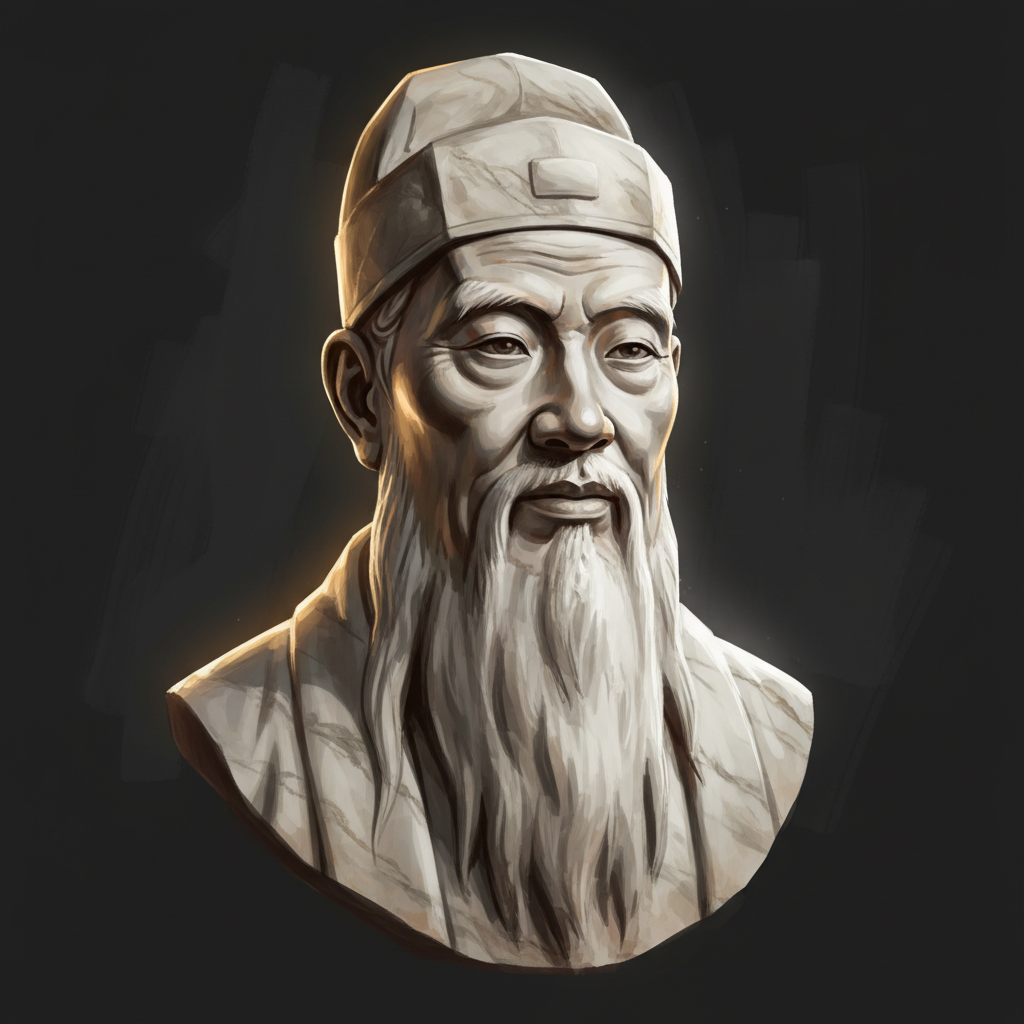
Confucius — "The superior man is satisfied and composed; the inferior man is always full of d…"
The superior man is satisfied and composed; the inferior man is always full of distress.
The superior man is satisfied and composed; the inferior man is always full of distress.
Click any product to generate a realistic preview. Up to 3 at a time.
* Initial load can take up to 90 seconds — revising the preview in another color is nearly instant.
"The faults of a man are characteristic of his class. It is by observing a man's faults that one may know his virtue."
"Is humanity far away? Whenever I want the virtue of humanity, it comes at once."
"Respect yourself and others will respect you."
"He who speaks without modesty will find it difficult to make his words good."
"If a man does not say 'What shall I do? What shall I do?', I can do nothing with him."
Chinese philosopher and teacher whose teachings (compiled by his students in the Analects) became the foundational ethical framework of East Asian civilization for 2,500 years. Closely associated with Mencius (his most-influential follower a century later). For an intellectual contrast, see Laozi, near-contemporary Chinese sage and Tao Te Ching author — Confucius systematized social order through ritual and family hierarchy; Laozi's Taoist effortless-action philosophy argued such systems were the disease, not the cure. The two founding poles of Chinese moral philosophy — every East Asian moral tradition since has positioned itself between them.
The standard scholarly entry points to Confucius's work: Philip J. Ivanhoe (Georgetown, Chinese philosophy) — Confucian Moral Self Cultivation (2000); Edward Slingerland (UBC, Asian Studies) — Effortless Action: Wu-wei as Conceptual Metaphor (2003); Tu Weiming (Harvard, Confucian scholar) — Confucian Thought: Selfhood as Creative Transformation (1985). These are the works graduate seminars cite when teaching Confucius.
Found in 1 providers: deepseek
1 source checked
A person of strong character stays calm and content regardless of circumstances, drawing stability from inner principles rather than external outcomes. A person of weak character, by contrast, lives in constant anxiety, worry, and dissatisfaction because they chase status, wealth, or approval they cannot control. The difference isn't luck or wealth but the cultivated ability to remain centered when life shifts around you.
Confucius built his entire philosophy around the junzi, the 'superior person' who cultivates virtue through self-discipline, learning, and ritual propriety. Having spent years traveling state to state seeking a ruler who would adopt his teachings, facing rejection and poverty, he embodied this composure personally. His emphasis on inner moral cultivation over outward success reflects both his lived disappointments and his conviction that character, not circumstance, defines a worthy life.
Confucius lived during the late Spring and Autumn period (551-479 BCE), when the Zhou dynasty was fracturing and rival states warred constantly. Social hierarchies were collapsing, officials were corrupt, and violence was routine. Amid this chaos, many sought fortune through scheming or force. Confucius offered a radical alternative: stability came not from political maneuvering but from ethical self-cultivation, making his distinction between the composed junzi and the anxious petty man deeply countercultural.
AI-generated insights based on extensive research and information for context. Factual errors? Email [email protected].
Your cart is empty