What it means
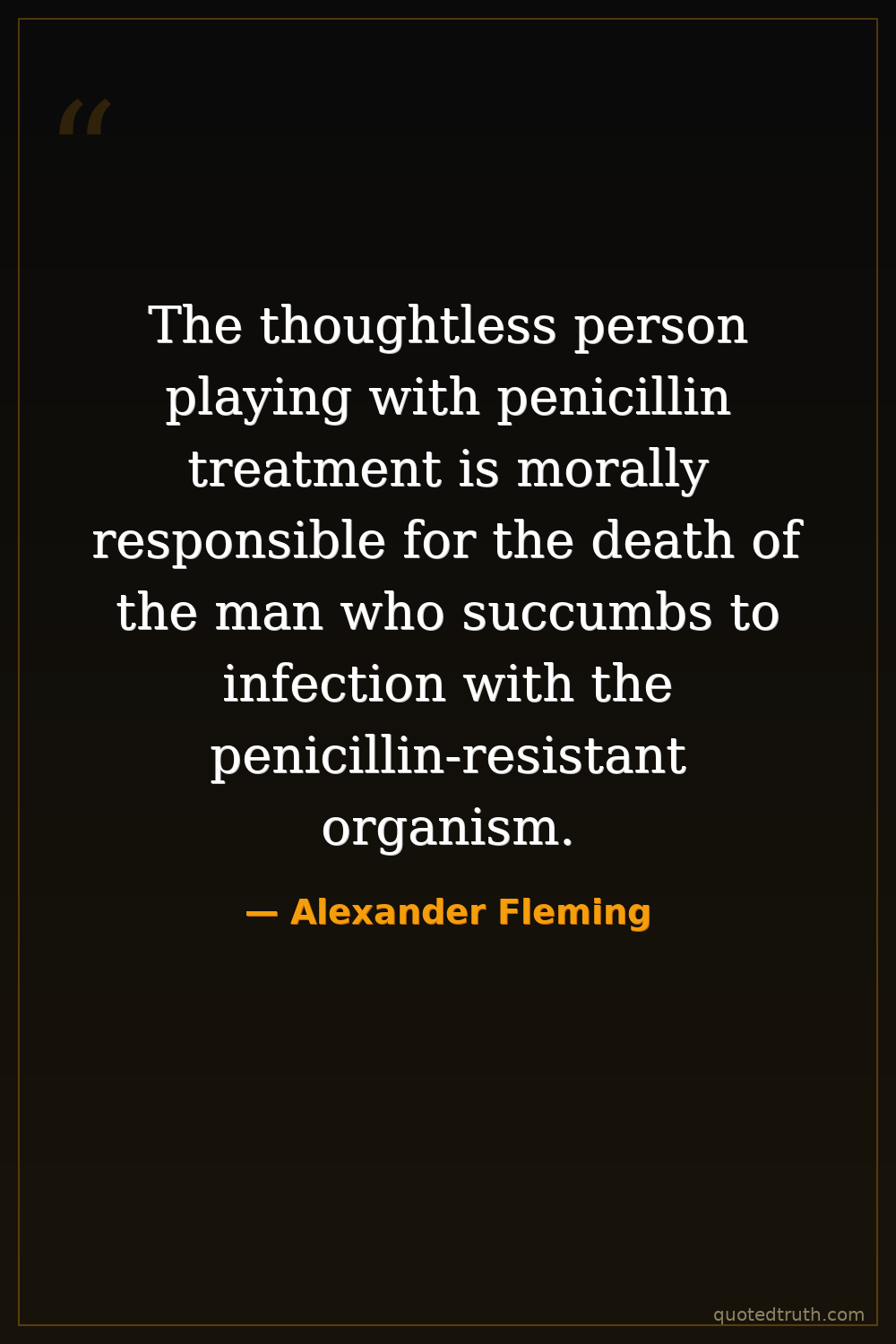
Careless use of penicillin — underdosing, stopping treatment early, or prescribing it unnecessarily — allows bacteria to evolve resistance. Those resistant strains then spread and kill patients for whom penicillin would otherwise work. Fleming argues this isn't an innocent mistake: the person who misuses the drug directly causes those downstream deaths. Moral responsibility for antibiotic resistance falls on anyone who treats a life-saving drug as trivial rather than as something to be used precisely and deliberately.
Relevance to Alexander Fleming
Fleming discovered penicillin in 1928 and warned explicitly about resistance in his 1945 Nobel Prize acceptance speech — a rare case of a scientist anticipating his own discovery's undoing. As a bacteriologist who spent his career studying how microbes respond to their environment, he understood that bacteria would exploit weak or incomplete antibiotic exposure. Having watched patients die from bacterial infections before antibiotics existed, he felt a personal obligation to protect the drug's effectiveness for those who would need it most.
The era
Penicillin was mass-produced for Allied troops in World War II, then released to civilians around 1945 and immediately celebrated as a miracle cure. In many countries it was sold over the counter without a prescription. Fleming delivered this warning in his Nobel lecture that same year, as hospitals were already observing resistant Staphylococcus strains. Post-war euphoria around antibiotics was so intense that caution was largely ignored — a pattern that seeded the antibiotic resistance crisis medicine now faces globally.
AI-generated insights based on extensive research and information for context. Factual errors? Email [email protected].