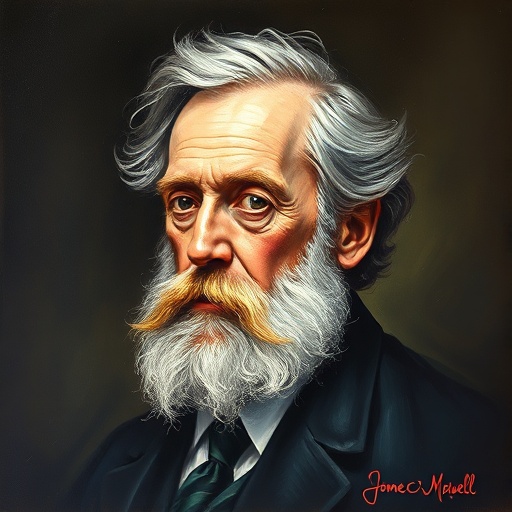
James Clerk Maxwell — "The true Logic for this world is the Calculus of Probabilities, which takes acco…"
The true Logic for this world is the Calculus of Probabilities, which takes account of the magnitude of the probability.
The true Logic for this world is the Calculus of Probabilities, which takes account of the magnitude of the probability.
Click any product to generate a realistic preview. Up to 3 at a time.
* Initial load can take up to 90 seconds — revising the preview in another color is nearly instant.
"I have been thinking about the nature of things, and I have come to the conclusion that there is a good deal of it."
"The only way to avoid error is to have no ideas at all."
"The greatest discoveries of science have always been the discovery of our ignorance."
"I saw a rat today in the college garden, and I thought how much more pleasant it would be to be a rat than a professor."
"The world may be utterly crazy, and life may be labour in vain; But I'd rather be silly than lazy, and would not quit life for its pain."
Philosophical statement on the nature of logic and reality.
Date: Undated, but reflects his scientific approach.
GeneralFound in 1 providers: gemini
1 source checked
Real-world reasoning cannot rely on strict true-or-false logic because most situations involve uncertainty and incomplete information. Instead, the right tool for making sense of reality is probability theory, which measures how likely something is rather than declaring it simply true or false. Good thinking weighs the strength of evidence and acts on the most probable outcome, accepting that certainty is rare and degrees of belief matter more than absolutes.
Maxwell worked at the frontier of physics where exact answers gave way to statistics, especially in his kinetic theory of gases, which described molecular behavior through probability distributions rather than tracking individual particles. A devout Presbyterian and rigorous mathematician, he embraced uncertainty as a feature of nature, not a flaw in knowledge. This quote captures his conviction that scientific truth comes from weighing likelihoods, mirroring how he modeled electromagnetism and thermodynamics through probabilistic reasoning.
During the mid-19th century, science was shifting from deterministic Newtonian certainty toward statistical thinking. Maxwell and Boltzmann were pioneering statistical mechanics, while Quetelet applied probability to social data and Darwin introduced variation and chance into biology. Laplace's probability work was being revived and extended. Industrial society generated vast data on mortality, insurance, and manufacturing, forcing thinkers to reason about populations and likelihoods rather than individual certainties, making probability the defining logic of the age.
AI-generated insights based on extensive research and information for context. Factual errors? Email [email protected].
Your cart is empty