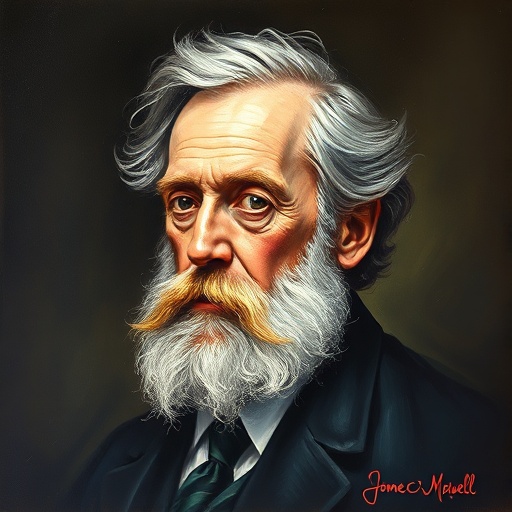
James Clerk Maxwell — "The world may be utterly crazy, and life may be labour in vain; But I'd rather b…"
The world may be utterly crazy, and life may be labour in vain; But I'd rather be silly than lazy, and would not quit life for its pain.
The world may be utterly crazy, and life may be labour in vain; But I'd rather be silly than lazy, and would not quit life for its pain.
Click any product to generate a realistic preview. Up to 3 at a time.
* Initial load can take up to 90 seconds — revising the preview in another color is nearly instant.
"I am not a great mathematician, but I can do a little."
"Every existence above a certain rank has its singular points; the higher the rank the more of them. At these points, influences whose physical magnitude is too small to be taken account of by a finite…"
"The human mind is seldom satisfied, and is certainly never exercising its highest functions, when it is doing the work of a calculating machine."
"The only way of discovering the extent of the laws of nature is to try to transcend them."
"The present state of science is such that we cannot hope to explain all the phenomena of nature by means of a few simple laws."
Found in 1 providers: gemini
1 source checked
Even if the world makes no sense and our efforts lead nowhere, giving up is worse than pressing on. The speaker admits existence can feel absurd and painful, but chooses active foolishness over passive defeat. Suffering and futility are real, yet quitting forfeits the one thing within our control: the decision to keep engaging. Better to look ridiculous still trying than to surrender to despair and inaction.
Maxwell wrote verse throughout his life alongside his physics, blending wry humor with Presbyterian conviction. He pressed on through his mother's early death, ridicule at Edinburgh Academy where classmates called him 'Dafty', and chronic stomach cancer that killed him at 48. His willingness to look 'silly'—pursuing color photography, Saturn's rings, and field equations others dismissed—reflects exactly this ethic of persistent, cheerful labor against apparent futility.
Victorian Britain wrestled with a crisis of meaning as Darwin's 1859 Origin and biblical criticism shook inherited certainties. Industrialization bred both progress-worship and existential weariness, captured in Tennyson, Arnold, and Carlyle. Scientists like Maxwell occupied the fault line, expanding natural knowledge while many peers drifted toward agnosticism. His insistence on perseverance through absurdity echoes the era's muscular-Christian response to doubt: keep working, keep believing, refuse the fashionable despair.
AI-generated insights based on extensive research and information for context. Factual errors? Email [email protected].
Your cart is empty