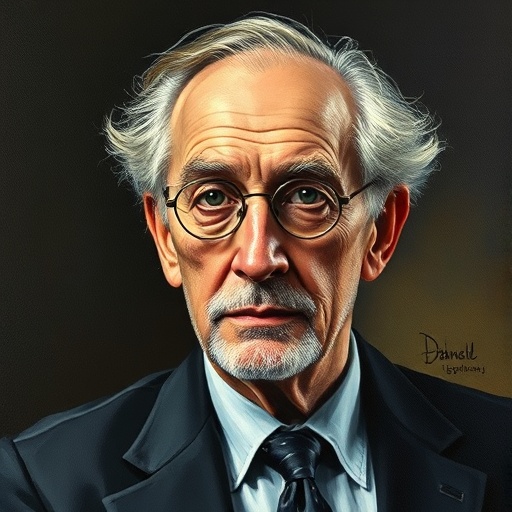
Francis Crick — "The ultimate aim of the modern movement in biology is in fact to explain all bio…"
The ultimate aim of the modern movement in biology is in fact to explain all biology in terms of physics and chemistry.
The ultimate aim of the modern movement in biology is in fact to explain all biology in terms of physics and chemistry.
Click any product to generate a realistic preview. Up to 3 at a time.
* Initial load can take up to 90 seconds — revising the preview in another color is nearly instant.
"If you are not a little bit mad, you will never discover anything new."
"The belief that we have immortal souls is a superstition."
"No important discovery is ever made without a 'mad' guess."
"The origin of life is a scientific problem."
"If you want to understand life, you have to understand DNA."
Found in 2 providers: grok,deepseek
2 sources checked
Biology's complexity — growth, reproduction, thought, disease — ultimately reduces to physical and chemical processes. There's no mysterious 'life force' separate from science's other laws. Every cellular mechanism, genetic instruction, and evolutionary adaptation can, in principle, be explained through atoms, molecules, and their interactions. The ambition is total unification: one coherent scientific framework governing both the inanimate and the living, with no special exemptions for biological phenomena.
Crick trained as a physicist before pivoting to biology, embodying this conviction personally. His 1953 co-discovery of DNA's double helix with James Watson proved heredity was pure molecular chemistry — the deepest mystery of life reduced to base-pairs and hydrogen bonds. A committed materialist, Crick explicitly rejected vitalism throughout his career. He later turned to neuroscience, applying the same reductionist drive to consciousness, seeking to explain awareness itself as neural chemistry.
Crick worked during biology's molecular revolution — the 1950s through 1980s — when the discipline was being rebuilt from the atom up. The genetic code was cracked in the 1960s, enzyme mechanisms explained biochemically, and the central dogma established. Vitalism, the belief that life needed a non-physical force, had finally collapsed. Physics, chemistry, and biology were merging into biochemistry and molecular biology, making Crick's reductionist program not just philosophy but an active, winning research strategy.
AI-generated insights based on extensive research and information for context. Factual errors? Email [email protected].
Your cart is empty