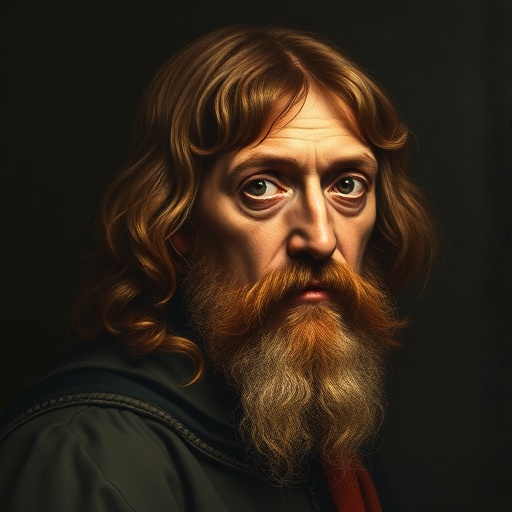
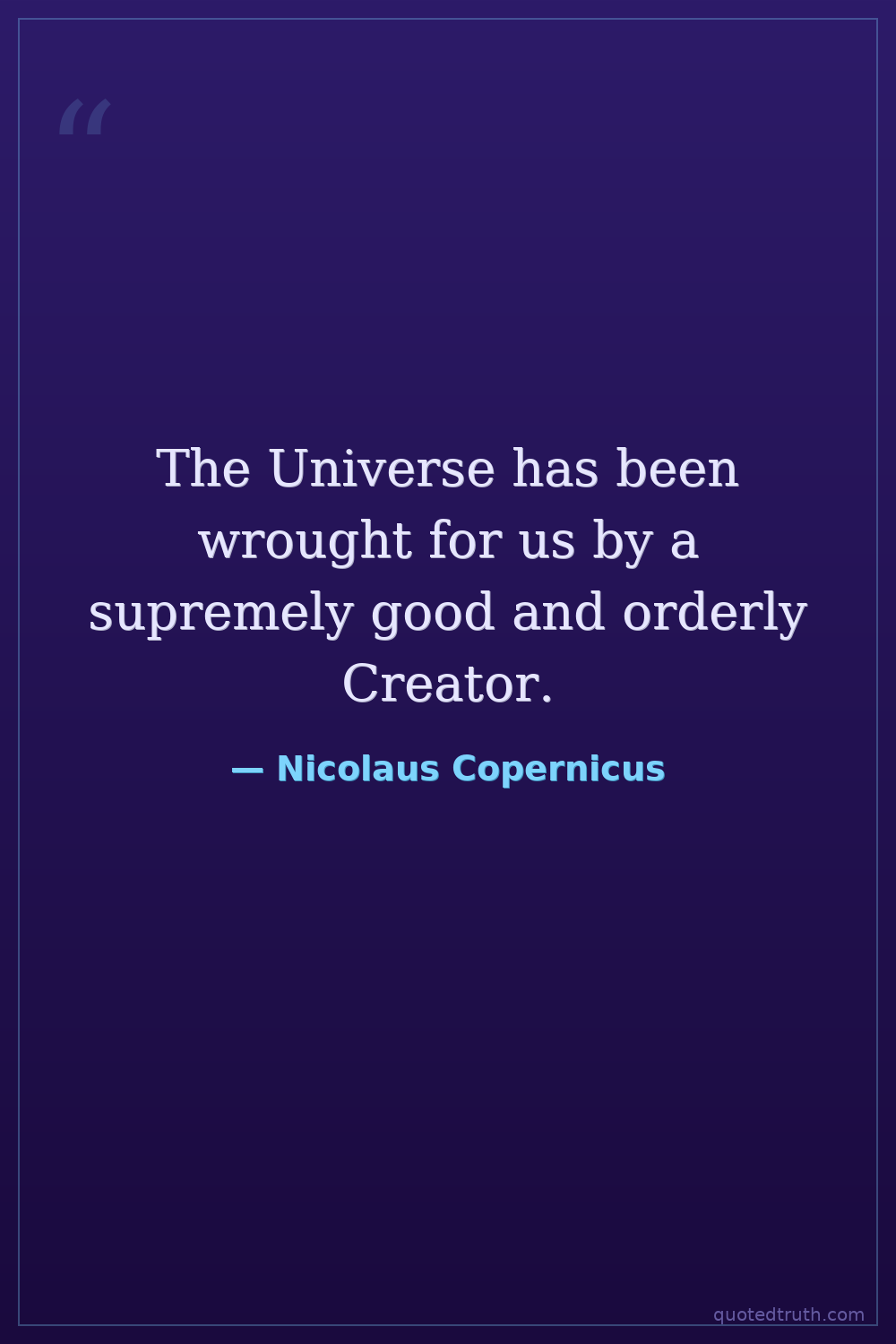
Nicolaus Copernicus — "The Universe has been wrought for us by a supremely good and orderly Creator."
The Universe has been wrought for us by a supremely good and orderly Creator.
The Universe has been wrought for us by a supremely good and orderly Creator.
Click any product to generate a realistic preview. Up to 3 at a time.
* Initial load can take up to 90 seconds — revising the preview in another color is nearly instant.
"The Sun, the Moon, and the Earth, are all parts of one great system."
"Astronomy is written for astronomers."
"For the universe, wrought for us by the best and most orderly Workman of all, is a wonderful work."
"It is enough if the hypotheses save the phenomena."
"But if anyone desires to judge these things not ignorantly but with skill and knowledge, he will find that what I have undertaken is in harmony with the best authorities, and that it is in no way oppo…"
A theological statement reflecting his belief in divine creation.
Date: Approximate, likely from 'De revolutionibus'
Art & CreativityFound in 2 providers: gemini,deepseek
2 sources checked
The universe was deliberately shaped by a benevolent, rational God who built it with purpose and order. The cosmos isn't random chaos but a structured, mathematically elegant system crafted with humanity in mind. The word 'wrought' — meaning made with skill — emphasizes intentional craftsmanship. This expresses confidence that the universe's harmony, its predictable patterns and discoverable laws, reflects the goodness and intelligence of a Creator who made it knowable.
Copernicus was a devout Catholic canon who served the Church his entire life while quietly revolutionizing astronomy. When he published De Revolutionibus in 1543, placing the Sun at the cosmos's center, he framed heliocentrism as revealing God's more elegant, rational design. He believed the Creator's mathematical order demanded the simplest, most harmonious model. His faith and science were inseparable — displacing Earth honored, not defied, the orderly Creator.
Copernicus worked during the Renaissance, when natural philosophy and Christian theology were deeply intertwined. The Catholic Church dominated European intellectual life, and challenging Ptolemaic geocentric cosmology risked accusations of heresy. Scholars legitimized scientific inquiry by framing it as reading 'God's Book of Nature.' Invoking a divine, orderly Creator wasn't mere piety — it was strategic framing. Copernicus even dedicated De Revolutionibus to Pope Paul III, seeking Church acceptance for his radical heliocentric model.
AI-generated insights based on extensive research and information for context. Factual errors? Email [email protected].
Your cart is empty