What it means
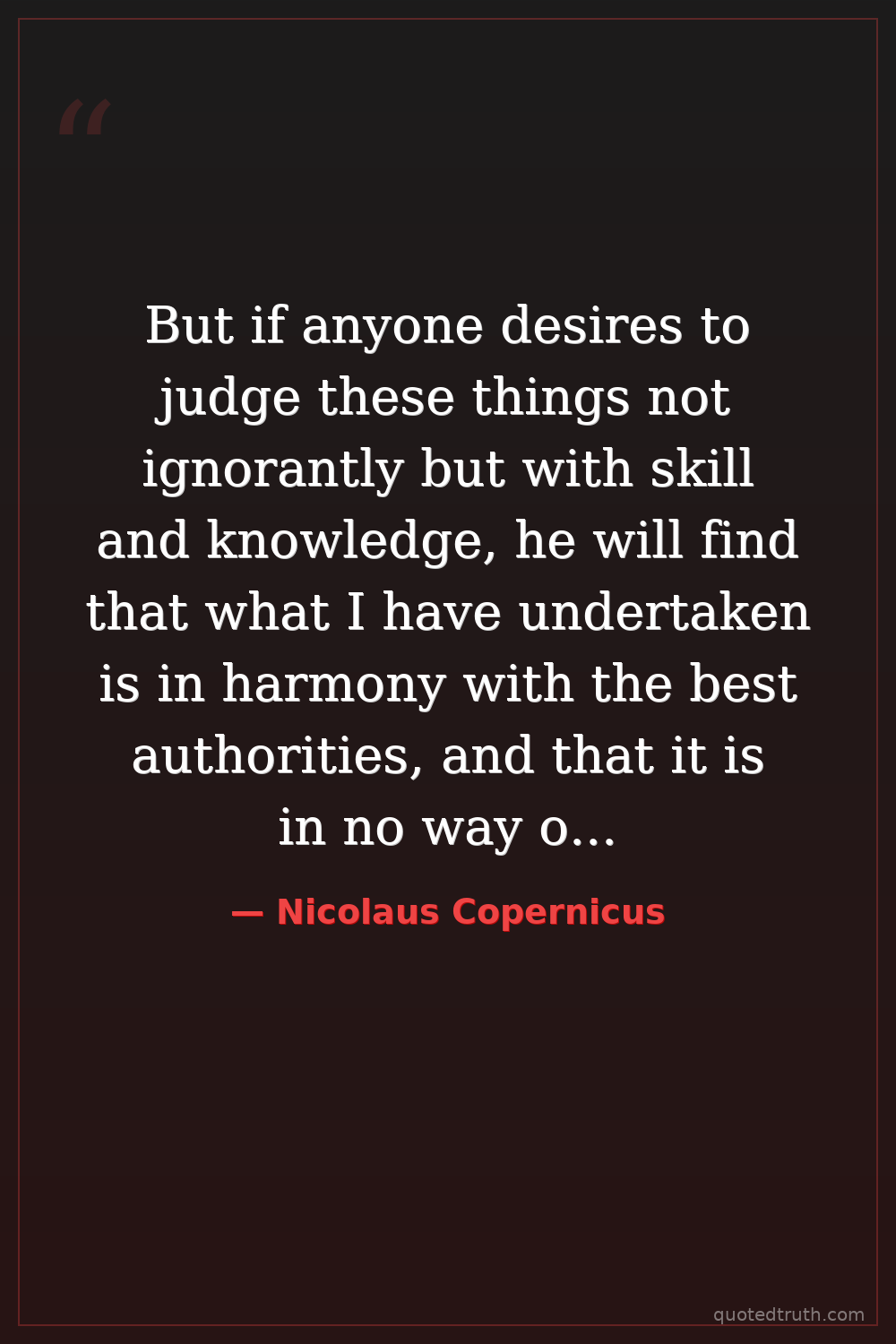
Judge my work with expertise, not ignorance, and you will find it aligns with respected classical authorities while posing no threat to Scripture. Copernicus is preemptively defending his sun-centered universe against two attacks: dismissal by the uneducated and condemnation by the religious. He asks to be evaluated on scholarly grounds while reassuring readers his astronomy does not contradict the Bible.
Relevance to Nicolaus Copernicus
Copernicus was a Catholic canon — a church official — whose livelihood and safety depended on ecclesiastical approval. He spent over thirty years privately developing his heliocentric model before publication, acutely aware of potential backlash. He dedicated De Revolutionibus to Pope Paul III precisely to shield himself. This quote reflects his lifelong caution: a man who revolutionized cosmology while desperately trying to avoid being branded a heretic.
The era
In 1543, Europe was fracturing along religious lines — the Protestant Reformation had split Christianity, and the Catholic Church was defending doctrinal authority fiercely. The Ptolemaic cosmos, with Earth at its center, felt scripturally ordained. Any challenge risked heresy accusations. Copernicus published as he lay dying, likely delaying to avoid confrontation. Within decades, Galileo would face the Inquisition for defending these same ideas, validating Copernicus's fears entirely.
AI-generated insights based on extensive research and information for context. Factual errors? Email [email protected].