Zoroaster — "The universe is a battleground between the forces of good and evil, and each hum…"
The universe is a battleground between the forces of good and evil, and each human being must choose a side.
The universe is a battleground between the forces of good and evil, and each human being must choose a side.
Click any product to generate a realistic preview. Up to 3 at a time.
* Initial load can take up to 90 seconds — revising the preview in another color is nearly instant.
"For the wise, the truth is clear; for the foolish, it is hidden."
"The Lie-demon shall be bound, and the Good Mind shall be unbound."
"The one who does not kill the serpent is himself a serpent."
"In the radiance of righteousness, we shall learn self-knowledge and righteous thinking."
"A reflective, contented mind is the best possession."
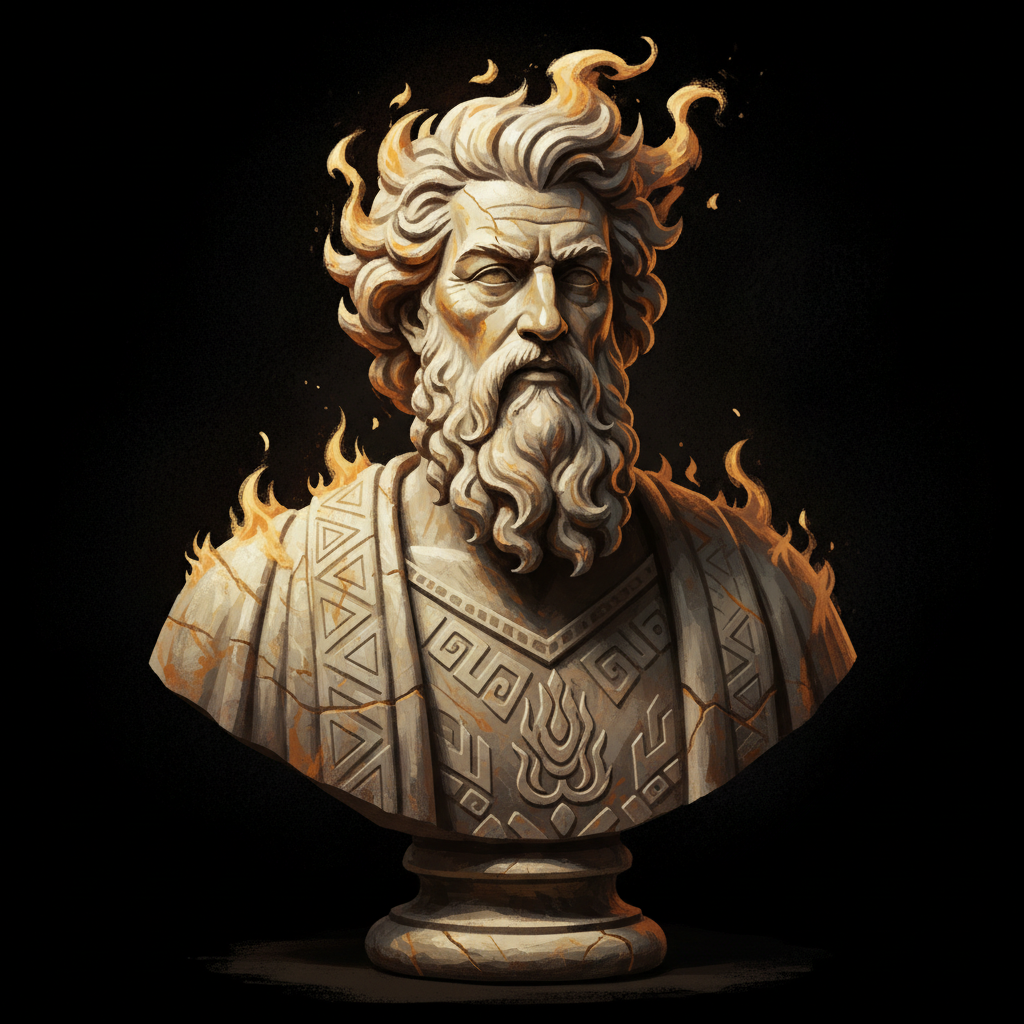
Iranian prophet who founded Zoroastrianism, the first major religion of cosmic dualism between good (Ahura Mazda) and evil (Angra Mainyu). Closely associated with The Buddha (near-contemporary Eastern moral-cosmological revolutionary). For an intellectual contrast, see Friedrich Nietzsche, German philosopher of 'beyond good and evil' — Nietzsche appropriated Zarathustra's name for Thus Spoke Zarathustra (1883) precisely to invert the original's moral cosmology — the historical Zoroaster founded the good-versus-evil framework Nietzsche's character announces the end of.
Found in 1 providers: gemini
1 source checked
Reality is structured as an ongoing cosmic conflict between goodness and wickedness, and neutrality is not an option. Every person, through their daily thoughts, words, and actions, is actively enlisting on one side or the other. Life is fundamentally a moral decision rather than a passive experience, and the choices you make ripple outward into the larger struggle shaping the world's fate.
Zoroaster founded one of history's earliest ethical monotheistic religions, teaching that Ahura Mazda (good) opposes Angra Mainyu (evil) and that humans possess free will to align with truth (asha) or deception (druj). As a priest-prophet reforming older Iranian polytheism, he preached personal moral responsibility summarized as 'good thoughts, good words, good deeds,' exactly the choosing-a-side framework this saying expresses.
Zoroaster lived in ancient Persia, likely between 1500 and 1000 BCE, among pastoral Indo-Iranian tribes practicing ritualistic polytheism with cattle raids and warrior cults. Amid tribal violence and priestly corruption, his dualistic ethical vision was revolutionary, reframing cosmic order as moral rather than ceremonial. This teaching later shaped the Achaemenid Empire and profoundly influenced Judaism, Christianity, and Islam's concepts of heaven, hell, judgment, and the devil.
AI-generated insights based on extensive research and information for context. Factual errors? Email [email protected].
Your cart is empty