What it means
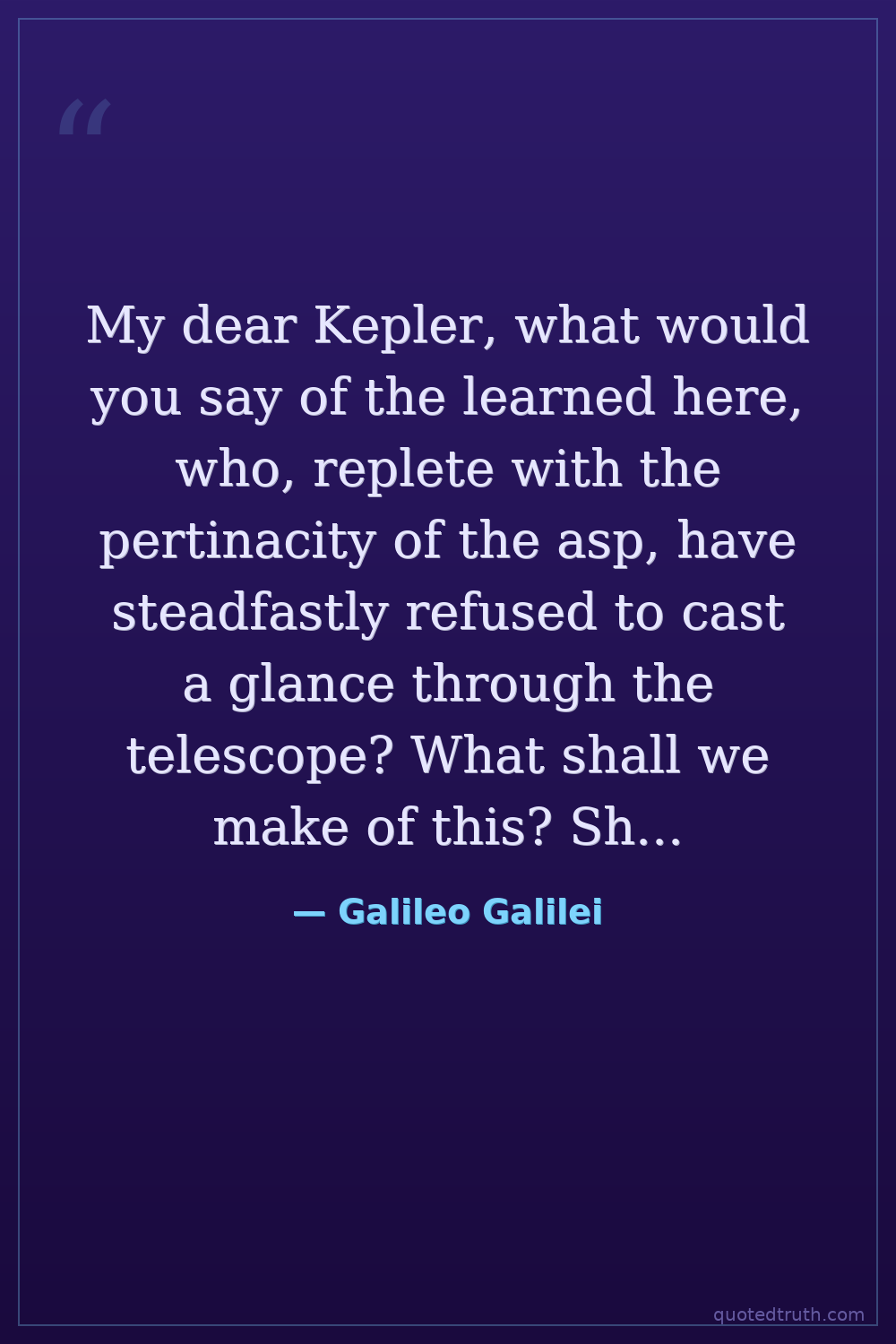
Galileo expresses bitter frustration that educated men, clinging to established belief with serpentine stubbornness, refused to simply look through the telescope and examine the evidence themselves. He frames their willful ignorance as so absurd it's unclear whether to respond with laughter or tears. The core message: no argument, however brilliant, can reach a mind that refuses to engage with observable reality on its own terms.
Relevance to Galileo Galilei
Galileo built his scientific legacy on telescopic observation — discovering Jupiter's moons, Venus's phases, and sunspots that supported heliocentrism. His adversaries were philosophers and clerics trained in Aristotelian logic who distrusted instruments. This letter to fellow heliocentrist Kepler captures his defining struggle: not merely convincing opponents with argument, but getting them to acknowledge empirical evidence at all. He would later face the Inquisition for these very observations.
The era
In early 17th-century Europe, Aristotelian natural philosophy and Ptolemaic geocentrism were institutional orthodoxy enforced by the Catholic Church. The telescope was new and its reliability disputed — could lenses deceive? Scholars who looked risked confronting evidence contradicting Scripture and facing heresy accusations. Refusing to look was partly intellectual cowardice, partly genuine skepticism about instrument-mediated observation, and partly self-preservation in an era when the Inquisition actively prosecuted religious deviance.
AI-generated insights based on extensive research and information for context. Factual errors? Email [email protected].