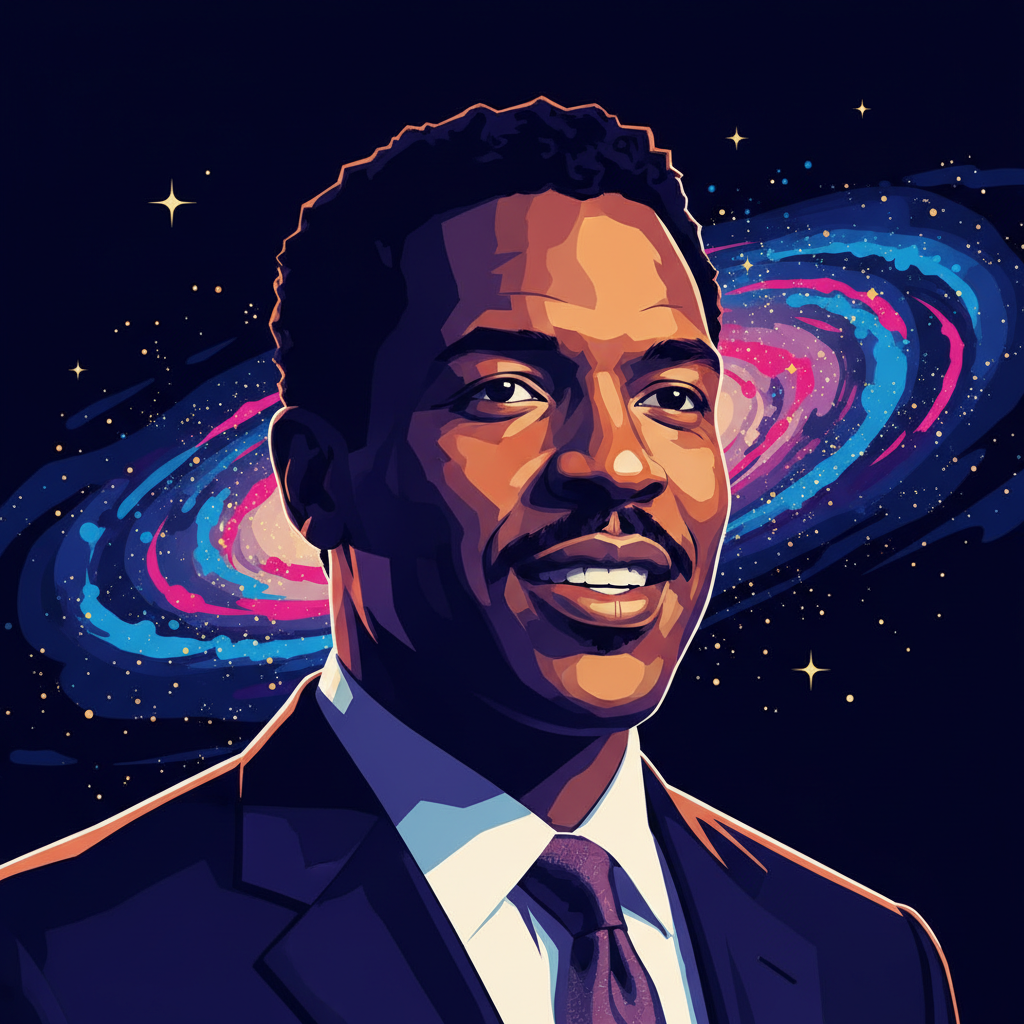
Neil deGrasse Tyson — "The universe is full of answers. You just have to know how to ask the questions."
The universe is full of answers. You just have to know how to ask the questions.
The universe is full of answers. You just have to know how to ask the questions.
Click any product to generate a realistic preview. Up to 3 at a time.
* Initial load can take up to 90 seconds — revising the preview in another color is nearly instant.
"The universe is expanding, and so should our minds."
"If you are not in awe of the universe, you are not living."
"The problem with society is not lack of knowledge, but the illusion of knowledge."
"No offense to anyone, but if you're an adult and you're still believing in Santa Claus, I'm concerned for you."
"The universe is not fair. It just is."
American astrophysicist, Hayden Planetarium director, and Cosmos: A Spacetime Odyssey host who carries the Carl Sagan public-science mantle. Closely associated with Bill Nye (fellow science communicator) and Brian Greene (theoretical physicist and string-theory popularizer). For an intellectual contrast, see Ken Ham, founder of Answers in Genesis and the Creation Museum — Ham's career has been organized around defending biblical 6-day creationism — exactly the science-education position Tyson's mainstream-science communication is structured to refute.
Found in 1 providers: grok
1 source checked
Reality contains all the knowledge we could ever need, but discovery depends on framing the right questions. Curiosity alone isn't enough — you need intellectual discipline to query the world precisely enough that it yields its secrets. Knowledge isn't passively received; it's extracted through rigorous inquiry. The universe doesn't withhold answers out of secrecy; it simply waits for questions sharp enough to unlock them. Asking well is the core skill of science.
Tyson has spent his career democratizing science through StarTalk Radio, the Hayden Planetarium, and books like Astrophysics for People in a Hurry. His entire public mission is teaching not just facts but scientific thinking — how to interrogate evidence and wonder productively. He frequently frames the scientific method as a discipline against self-deception. This quote captures his core belief that curiosity, properly directed through rigorous questioning, is humanity's most powerful tool for understanding reality.
Tyson rose to cultural prominence during the 2010s and early 2020s, when science literacy faced pressure from viral misinformation, climate denial, and anti-vaccine movements. Social media amplified shallow takes over careful reasoning. His emphasis on asking better questions rather than accepting easy answers was a direct counterweight to that environment, recasting rigorous inquiry as a civic virtue and positioning the scientific method as a defense against a culture increasingly hostile to nuance and evidence.
AI-generated insights based on extensive research and information for context. Factual errors? Email [email protected].
Your cart is empty