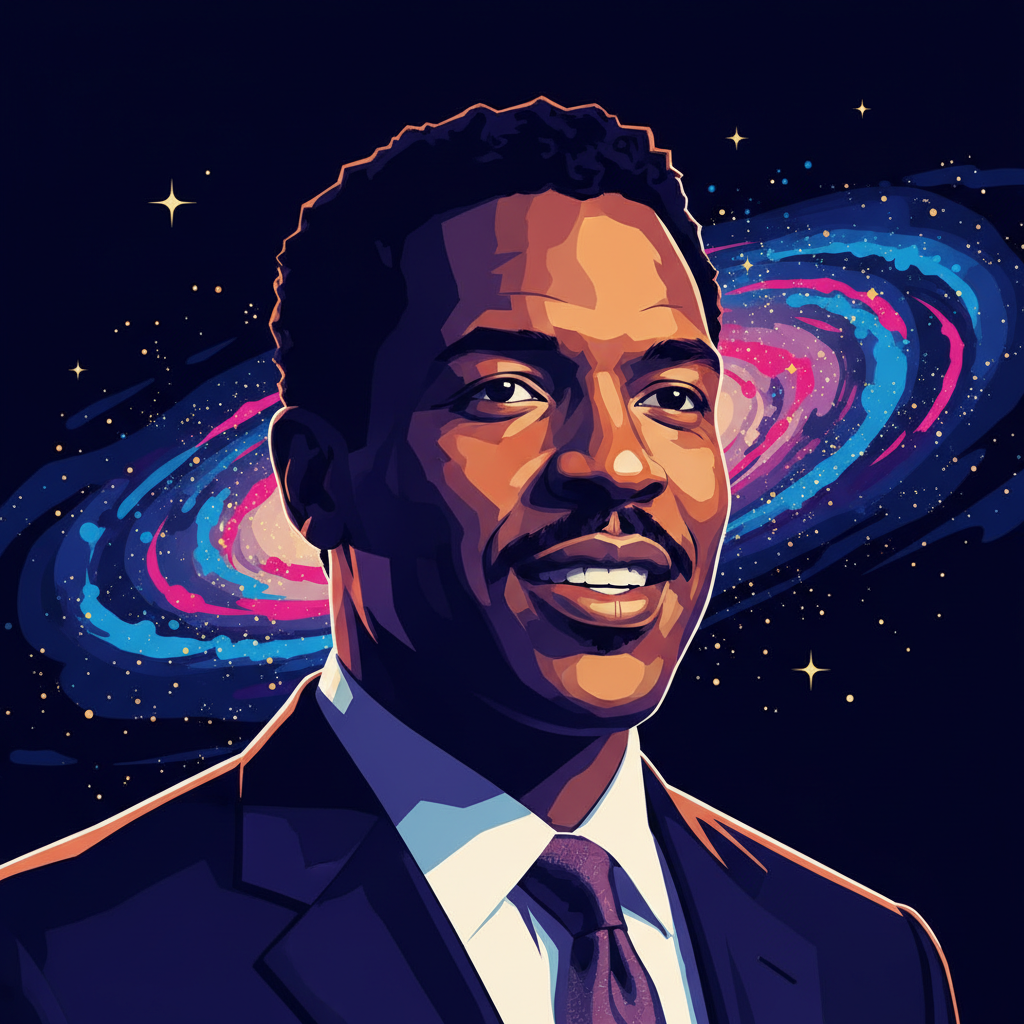
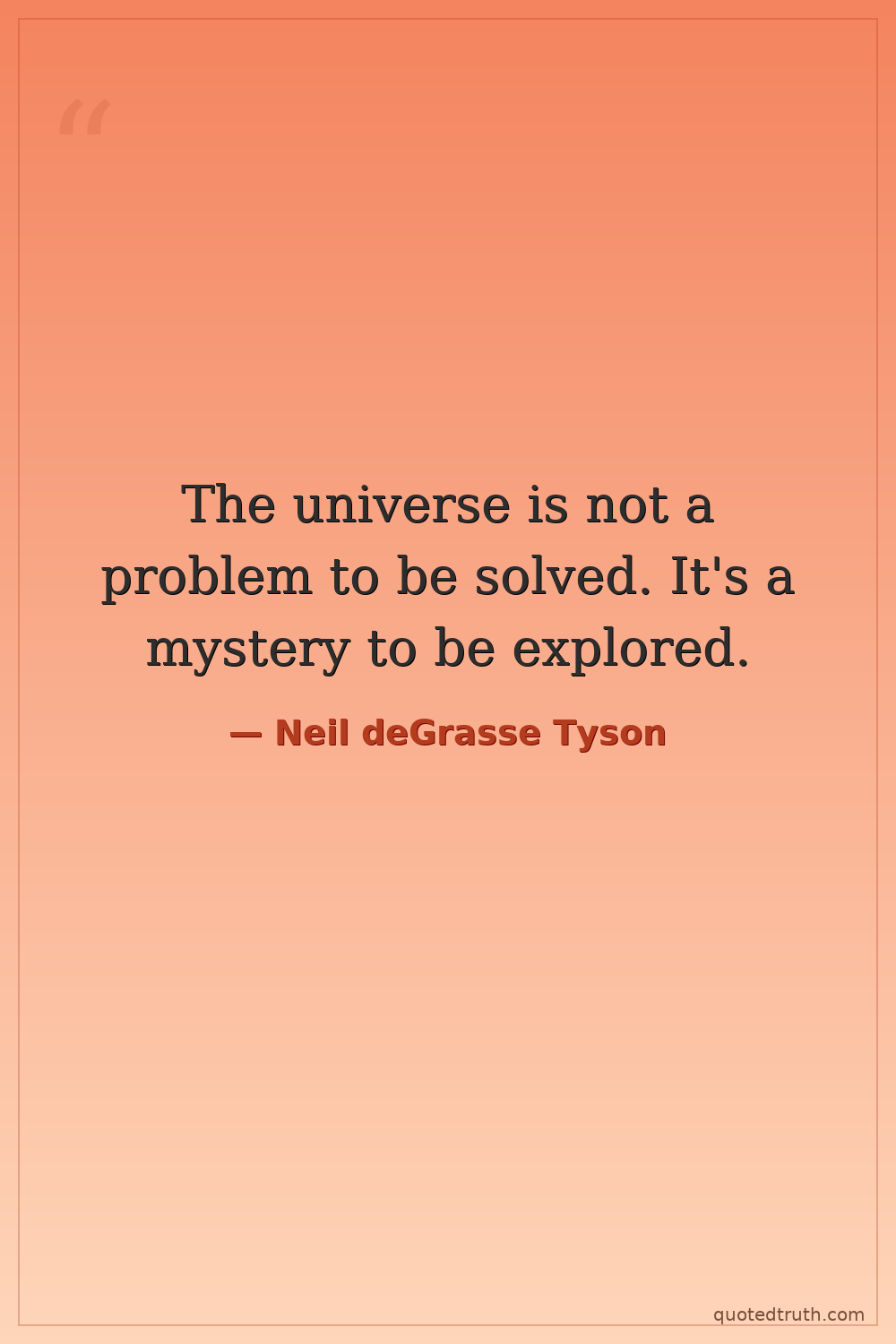
Neil deGrasse Tyson — "The universe is not a problem to be solved. It's a mystery to be explored."
The universe is not a problem to be solved. It's a mystery to be explored.
The universe is not a problem to be solved. It's a mystery to be explored.
Click any product to generate a realistic preview. Up to 3 at a time.
* Initial load can take up to 90 seconds — revising the preview in another color is nearly instant.
"Imagine a world where people are judged not by the color of their skin, but by the content of their character, and where the content of their character is measured by how much science they know."
"There are no bad ideas in science, just bad experiments."
"We spend the first year of a child's life teaching it to walk and talk and the rest of its life telling it to sit down and shut up. Is it any wonder the world is in the mess it's in?"
"The universe is a grand and glorious place, and it's all ours to explore."
"The universe is a place of wonder. And we are all part of that wonder."
American astrophysicist, Hayden Planetarium director, and Cosmos: A Spacetime Odyssey host who carries the Carl Sagan public-science mantle. Closely associated with Bill Nye (fellow science communicator) and Brian Greene (theoretical physicist and string-theory popularizer). For an intellectual contrast, see Ken Ham, founder of Answers in Genesis and the Creation Museum — Ham's career has been organized around defending biblical 6-day creationism — exactly the science-education position Tyson's mainstream-science communication is structured to refute.
Found in 1 providers: grok
1 source checked
Science isn't just about finding solutions to immediate problems—it's about embracing uncertainty and wonder. The cosmos isn't a puzzle with a final answer but an endless invitation to curiosity. Exploration itself has value apart from its outcomes. Understanding the universe doesn't end when we solve something; it deepens the more we look, revealing that better questions matter more than tidy conclusions.
Tyson has spent his career as director of the Hayden Planetarium and host of StarTalk and Cosmos: A Spacetime Odyssey translating astrophysics into public wonder. He explicitly models himself after Carl Sagan, whose legacy was inspiring curiosity over certainty. Tyson consistently argues that not knowing something is the doorway to discovery—that humility before the cosmos is a strength, not a weakness—making this a direct statement of his professional ethos.
Tyson emerged as science communicator during an era of tension between utilitarian STEM—science as economic engine and problem-solving machine—and pure curiosity-driven research. With SpaceX, Blue Origin, and NASA's Artemis program commercializing space, and the James Webb Space Telescope revealing unprecedented cosmic depths, the impulse to exploit the universe intensified. Climate change further pushed science toward crisis response. This framing reclaims exploration as inherently meaningful beyond any practical return.
AI-generated insights based on extensive research and information for context. Factual errors? Email [email protected].
Your cart is empty