Leonardo da Vinci — "The water that you touch in a river is the last of that which has passed, and th…"
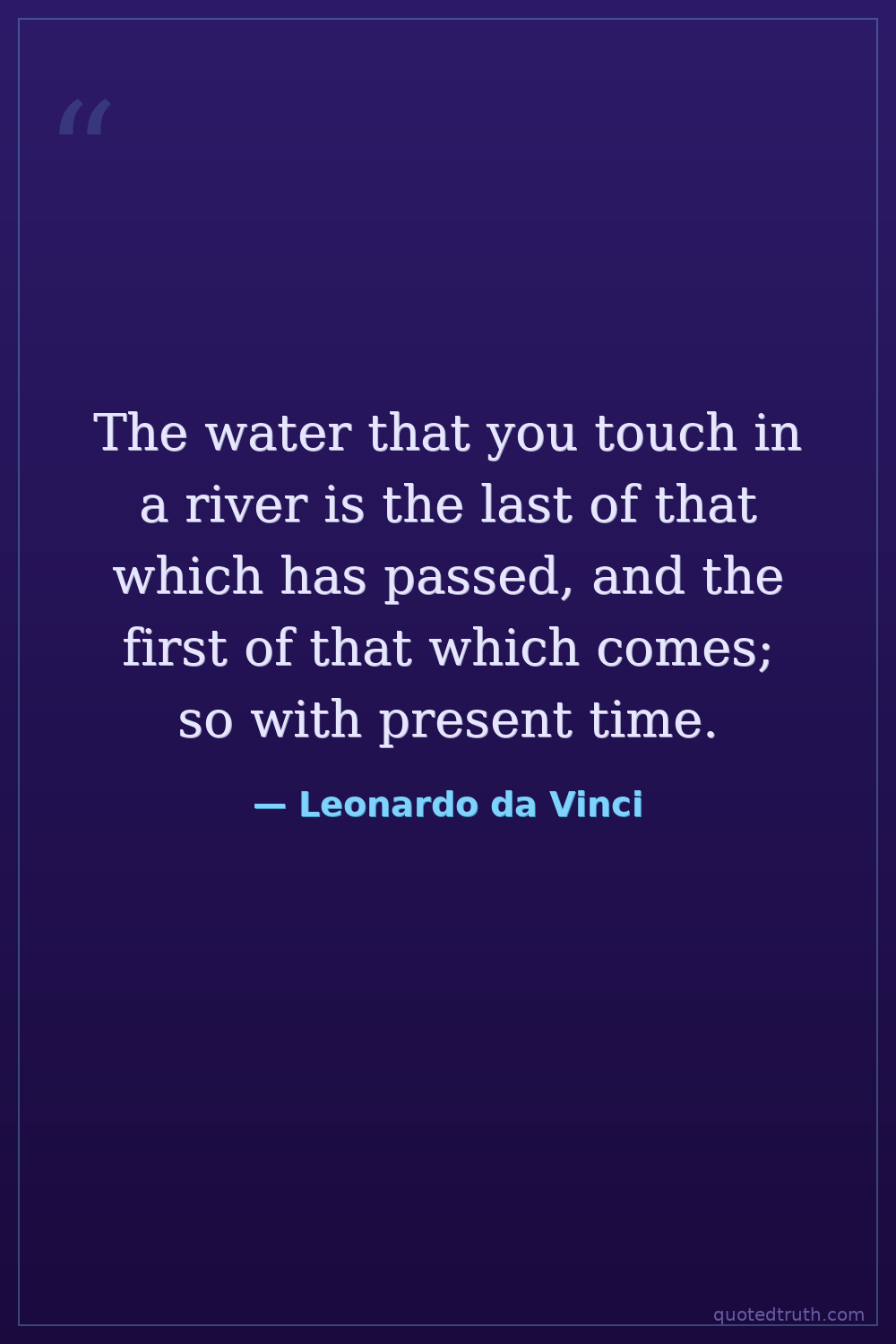
The water that you touch in a river is the last of that which has passed, and the first of that which comes; so with present time.
The water that you touch in a river is the last of that which has passed, and the first of that which comes; so with present time.
Click any product to generate a realistic preview. Up to 3 at a time.
* Initial load can take up to 90 seconds — revising the preview in another color is nearly instant.
"Every action needs to be prompted by a motive."
"The act of procreation and anything that has any relation to it is so disgusting that human beings would soon die out if it were not a traditional custom and if there were no pretty faces and sensuous…"
"The sun does not see its shadow."
"The greatest good is that which is chosen in preference to all others."
"The true artist is a man who believes in himself and is not afraid to stand alone."
Found in 1 providers: grok
1 source checked
The present moment is paradoxical — it simultaneously marks the end of everything that came before and the beginning of everything that follows. Just as the river water you touch has already journeyed from its source and is already moving onward, 'now' is never truly fixed. It exists only as the razor-thin boundary between past and future, making the present a point of perpetual, unstoppable transition.
Leonardo filled thousands of notebook pages documenting fluid dynamics, river currents, and hydraulic systems across decades of study. He engineered canals for Milan and Florence, watching water as both a practical force and a philosophical mirror. His habit was extracting universal laws from close natural observation — the same method he applied to anatomy, optics, and flight. This quote shows that habit turned inward, onto time itself.
The Italian Renaissance of the late 1400s and early 1500s was recovering ancient Greek philosophy, including Heraclitean ideas about constant flux and impermanence. Humanists were shifting focus from purely theological concerns toward earthly, empirical experience. Massive canal and hydraulic engineering projects across Milan and Florence made water management a civic obsession. Time itself was being reconsidered as scholars challenged medieval frameworks with observation-based thinking.
AI-generated insights based on extensive research and information for context. Factual errors? Email [email protected].
Your cart is empty