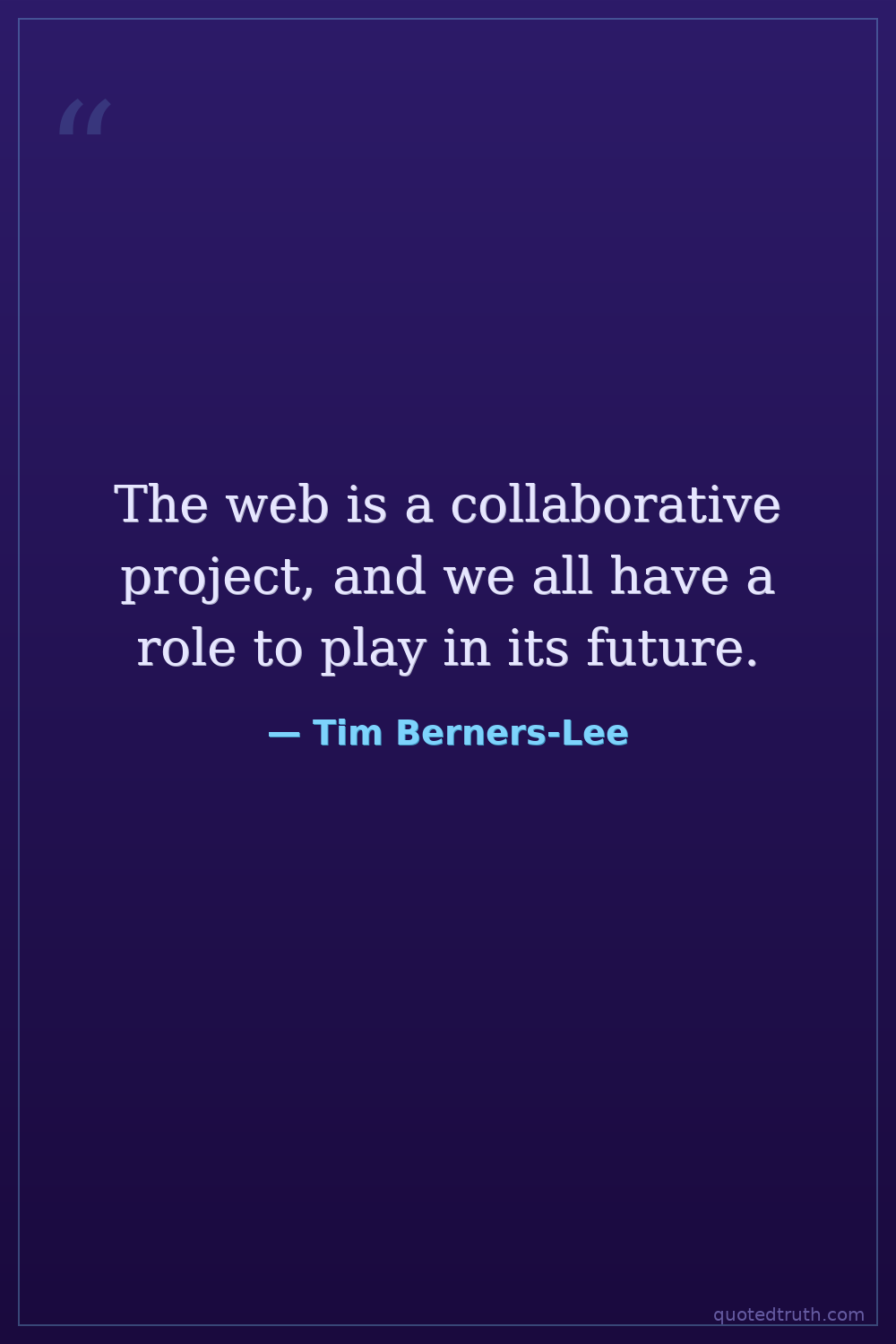
Tim Berners-Lee — "The web is a collaborative project, and we all have a role to play in its future…"
The web is a collaborative project, and we all have a role to play in its future.
The web is a collaborative project, and we all have a role to play in its future.
Click any product to generate a realistic preview. Up to 3 at a time.
* Initial load can take up to 90 seconds — revising the preview in another color is nearly instant.
"The web should be a place where people can be themselves, not just perform for others."
"The original idea of the web was that it should be a collaborative space where you can communicate and collaborate. That's not what happened. It became a read-only medium, and then it became a read-wr…"
"I never intended for the web to be a surveillance tool. That's a perversion of its original purpose."
"I’m not happy with the way the web has developed in some ways."
"I was very much into the idea of a universal workspace, where any information could be linked to any other information. This was an idea I had from when I was a kid, really. I was playing with trains …"
British computer scientist who invented the World Wide Web at CERN in 1989 and founded the W3C, championing open web standards. Closely associated with Vint Cerf (TCP/IP co-creator and 'father of the internet') and Marc Andreessen (Mosaic browser creator and Netscape co-founder). For an intellectual contrast, see Mark Zuckerberg, Facebook (Meta) founder — Zuckerberg's walled-garden Facebook is the canonical contemporary opposite of Berners-Lee's open-web vision; Berners-Lee's Solid project and 'recapture the web' essays are explicitly written as a rebuttal to the platform-monopoly model Facebook pioneered.
Found in 1 providers: grok
1 source checked
The World Wide Web is not owned or controlled by any single company, government, or individual. It belongs to everyone who uses it, builds on it, and shapes it. Every user, developer, content creator, and policymaker contributes to what the web becomes. Its direction depends on shared participation rather than top-down decisions, meaning the choices we make about openness, access, and standards today determine whether it remains a public good tomorrow.
Berners-Lee invented the web in 1989 at CERN and deliberately released it royalty-free in 1993, refusing to patent or monetize it. He founded the W3C to govern standards collaboratively and later launched the Solid project and Contract for the Web to push decentralization and user rights. This quote captures his lifelong insistence that the web's creator cannot dictate its future alone—a conviction rooted in his choice to give away what could have made him one of the richest people alive.
Berners-Lee's era spans the web's birth through its corporate consolidation. When he built it, the internet was academic and open. By the 2000s and 2010s, a handful of platforms—Google, Facebook, Amazon—captured most traffic, data, and advertising revenue, raising alarms about surveillance, misinformation, and walled gardens. Net neutrality fights, GDPR, and debates over AI training data all intensified during his active advocacy years, making his call for shared stewardship a direct response to centralization pressures threatening the original open web.
AI-generated insights based on extensive research and information for context. Factual errors? Email [email protected].
Your cart is empty