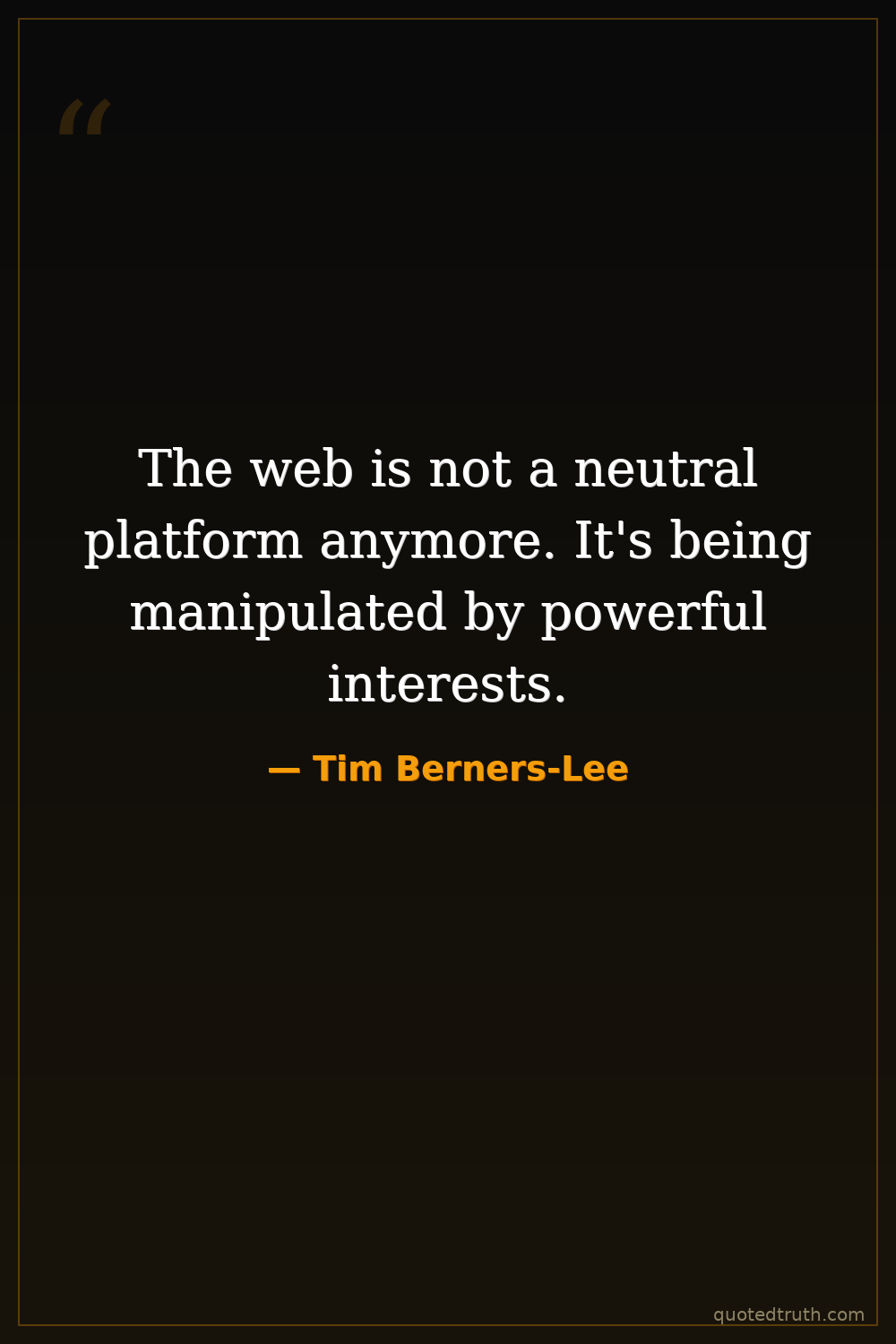
Tim Berners-Lee — "The web is not a neutral platform anymore. It's being manipulated by powerful in…"
The web is not a neutral platform anymore. It's being manipulated by powerful interests.
The web is not a neutral platform anymore. It's being manipulated by powerful interests.
Click any product to generate a realistic preview. Up to 3 at a time.
* Initial load can take up to 90 seconds — revising the preview in another color is nearly instant.
"Centralization of the web gives too much power to a few companies. This is dangerous."
"The web is a tool for empowerment, but it can also be used for oppression."
"I’m not a fan of the way some companies use the web to manipulate people."
"The web is broken, and we need to fix it."
"The web should be a place where people can collaborate, not just consume."
British computer scientist who invented the World Wide Web at CERN in 1989 and founded the W3C, championing open web standards. Closely associated with Vint Cerf (TCP/IP co-creator and 'father of the internet') and Marc Andreessen (Mosaic browser creator and Netscape co-founder). For an intellectual contrast, see Mark Zuckerberg, Facebook (Meta) founder — Zuckerberg's walled-garden Facebook is the canonical contemporary opposite of Berners-Lee's open-web vision; Berners-Lee's Solid project and 'recapture the web' essays are explicitly written as a rebuttal to the platform-monopoly model Facebook pioneered.
Found in 1 providers: grok
1 source checked
Power and wealth have corrupted the web's founding promise of open, equal access. What began as a decentralized space where any voice could reach any audience has become dominated by platforms that filter, prioritize, and monetize information according to profit motives and political pressures. Surveillance capitalism, algorithmic curation, and regulatory capture mean that what users see, share, and believe is increasingly shaped not by their own choices but by a handful of powerful gatekeepers.
Berners-Lee invented the web at CERN in 1989 and deliberately gave it away patent-free, insisting it belong to no one. He founded the W3C to maintain open standards and the Web Foundation to protect access rights globally. His Contract for the Web, launched in 2019, directly targeted surveillance and manipulation. This quote reflects the core tension of his career: watching a creation built on radical openness be captured by the very concentration of power he designed it to circumvent.
From 2016 onward, the internet's dark side became undeniable: Cambridge Analytica's data harvesting swayed elections, Facebook's algorithm amplified outrage for engagement, and authoritarian governments weaponized social platforms for censorship and surveillance. Net neutrality fights exposed ISP power over content. A handful of tech monopolies controlled the infrastructure billions relied on. The open, participatory web Berners-Lee envisioned in 1989 had been consolidated into privately owned attention economies optimizing for profit, not public good.
AI-generated insights based on extensive research and information for context. Factual errors? Email [email protected].
Your cart is empty