Tim Berners-Lee — "The web is not just a technology; it's a social construct. We need to think abou…"
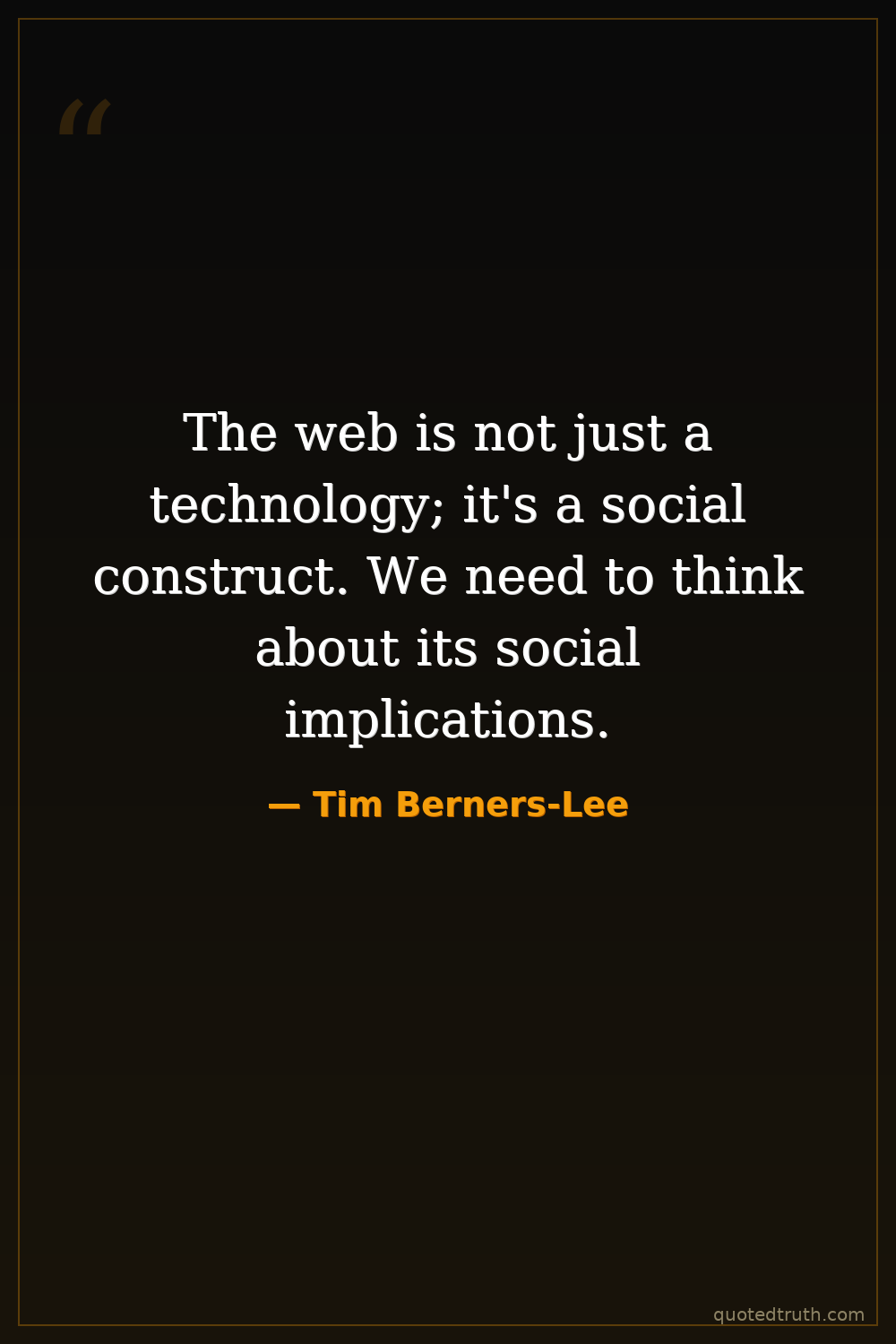
The web is not just a technology; it's a social construct. We need to think about its social implications.
The web is not just a technology; it's a social construct. We need to think about its social implications.
Click any product to generate a realistic preview. Up to 3 at a time.
* Initial load can take up to 90 seconds — revising the preview in another color is nearly instant.
"I never intended for the web to be a surveillance tool. That's a perversion of its original purpose."
"We need to fight for the right to privacy online. It's a fundamental human right."
"The web was supposed to be a force for good."
"I'm constantly surprised by what people do with the web."
"We need to educate people about the dangers of the web, as well as its benefits."
British computer scientist who invented the World Wide Web at CERN in 1989 and founded the W3C, championing open web standards. Closely associated with Vint Cerf (TCP/IP co-creator and 'father of the internet') and Marc Andreessen (Mosaic browser creator and Netscape co-founder). For an intellectual contrast, see Mark Zuckerberg, Facebook (Meta) founder — Zuckerberg's walled-garden Facebook is the canonical contemporary opposite of Berners-Lee's open-web vision; Berners-Lee's Solid project and 'recapture the web' essays are explicitly written as a rebuttal to the platform-monopoly model Facebook pioneered.
Found in 1 providers: grok
1 source checked
The web is more than wires and code — it is a shared human system shaped by the people who build and use it. Its design choices determine who gets access, who gets heard, and who holds power. Treating it as purely technical ignores how it reshapes relationships, democracy, and society. We must ask not just 'can we build this?' but 'what kind of world does this create?'
Berners-Lee invented the web in 1989 at CERN but deliberately made it royalty-free, believing open access serves humanity over profit. He founded the W3C to keep standards open and later launched the Web Foundation to fight for digital rights and net neutrality. His sustained campaigns against surveillance capitalism, data monopolies, and misinformation prove this quote is not rhetoric — it is his lifelong operating philosophy.
By the 2000s and 2010s the web had shifted from an academic tool to infrastructure shaping elections, economies, and culture. Facebook, Google, and Twitter concentrated enormous power over information. Snowden's 2013 revelations exposed mass government surveillance online. Filter bubbles, Arab Spring organizing, and viral misinformation all demonstrated that web architecture carries profound political consequences — validating Berners-Lee's insistence that its social dimensions require deliberate, public governance.
AI-generated insights based on extensive research and information for context. Factual errors? Email [email protected].
Your cart is empty