What it means
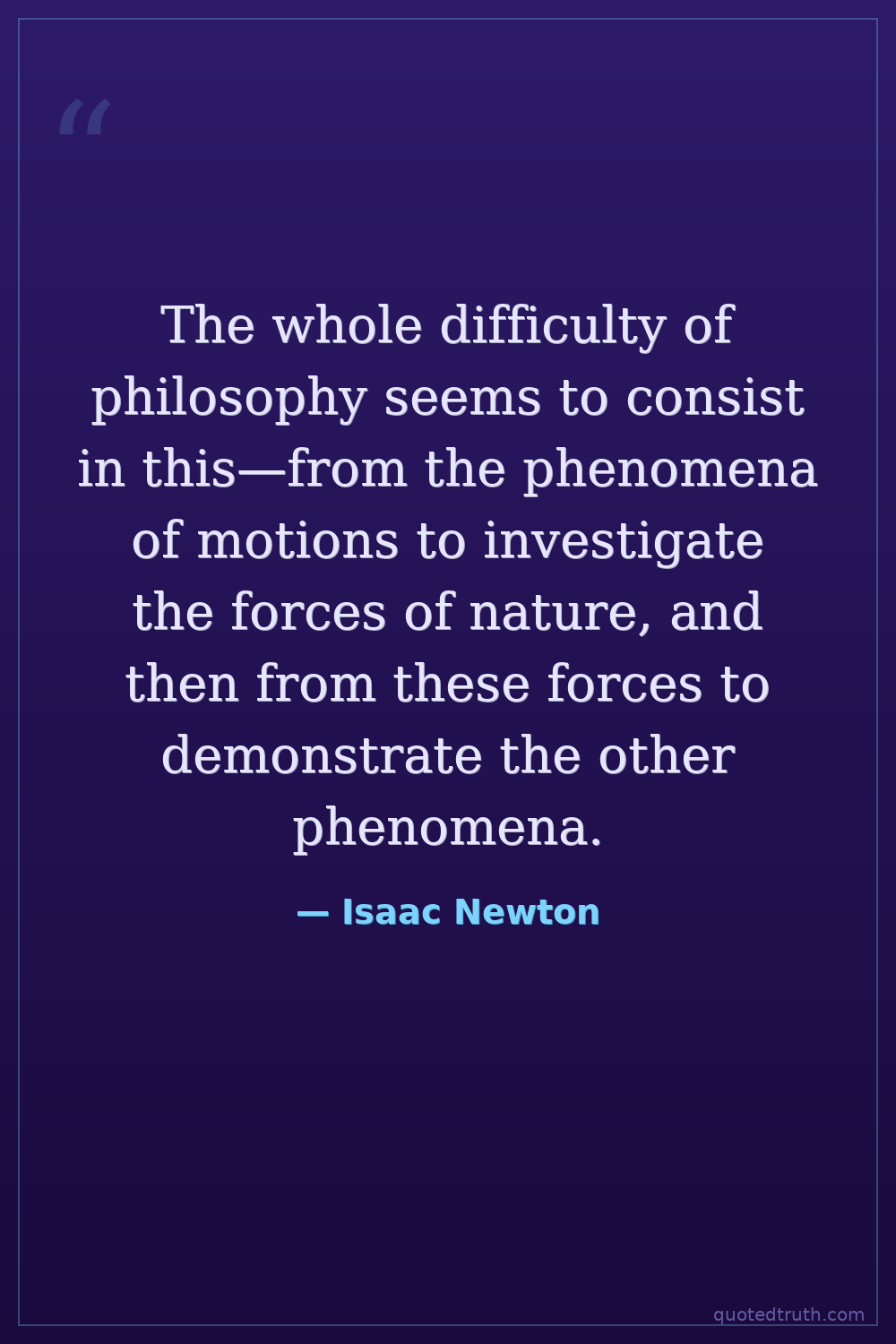
Science's central challenge, as Newton frames it, is a two-step loop: observe what moves and how, then reason backward to uncover what forces drive that motion. Once those forces are identified, use them to predict other behaviors not yet observed. It is the foundation of the scientific method—induction from evidence to principle, then deduction from principle to new discoveries—described centuries before we had that vocabulary.
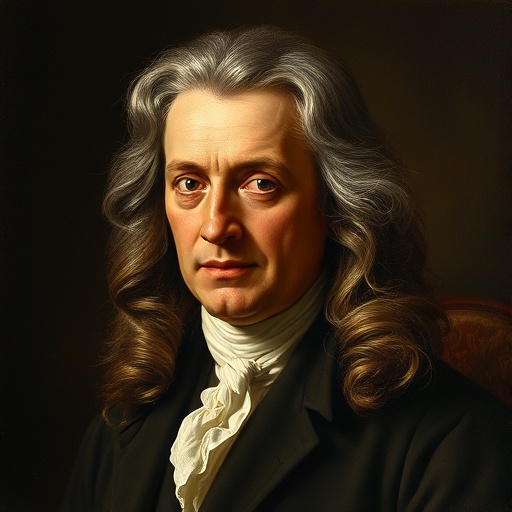
Relevance to Isaac Newton
Newton literally executed this method in his masterwork, the Principia Mathematica. He started from observed planetary motions—Kepler's documented orbital regularities—and worked backward to universal gravitation as their cause. He then used that single force law to mathematically derive the tides, comet trajectories, and Earth's shape. His career in optics followed the same structure: light's behavior led to the force of refraction, which explained the spectrum.
The era
In the 17th century, European natural philosophy was overthrowing Aristotelian explanations—which described the world in terms of qualities and purposes—with mathematical, force-based accounts. Descartes had tried to explain motion through vortices and contact forces alone. Newton's generation faced urgent questions: can nature's hidden mechanisms be known at all? His quote stakes a position: yes, through rigorous mathematical inference from motion to force, not speculation.
AI-generated insights based on extensive research and information for context. Factual errors? Email [email protected].