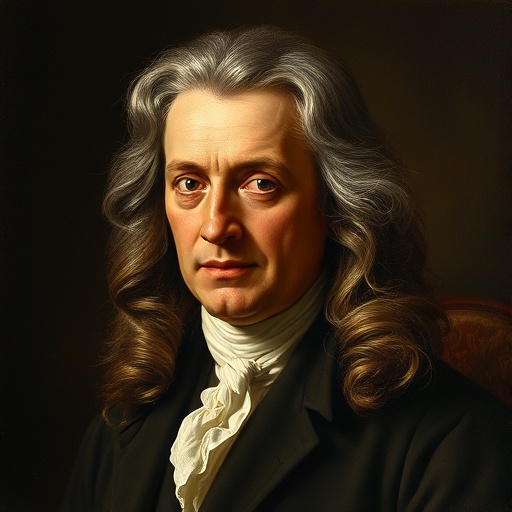
Isaac Newton — "I was born in the year of the comet."
I was born in the year of the comet.
I was born in the year of the comet.
Click any product to generate a realistic preview. Up to 3 at a time.
* Initial load can take up to 90 seconds — revising the preview in another color is nearly instant.
"Can it be by accident that all birds beasts and men have their right side and left side alike shaped (except in their bowels) and just two eyes and no more on either side the face & just two ears on e…"
"To explain all nature is too difficult a task for any one man or even for any one age."
"The true way of considering a thing is by its causes."
"Opposition to godliness is atheism in profession and idolatry in practice. Atheism is so senseless."
"I do not define time, space, place, and motion, as being well known to all."
Referring to the Great Comet of 1618, though he was born in 1642. This is likely a poetic or symbolic statement rather than literal.
Date: Uncertain, possibly a personal reflection.
Self-DeprecatingFound in 1 providers: grok
1 source checked
A statement of cosmic coincidence used to mark one's birth as significant. The speaker claims their arrival aligned with a rare celestial event — a comet — implying destiny or special purpose. In modern terms, it is like saying born under a lucky star, suggesting that extraordinary origins foreshadow an extraordinary life. It frames the self as part of something larger than ordinary human circumstance, connecting personal identity to the movements of the universe.
Newton was born Christmas Day 1642, a year marked by celestial events and the onset of England's Civil War. His life's work — explaining planetary motion, cometary orbits, and universal gravity — gave him an intimate relationship with the heavens. Edmund Halley later used Newton's laws to predict a famous comet's return. Newton also privately studied alchemy and biblical prophecy, revealing a man who genuinely believed cosmic patterns carried meaning that reached beyond mathematics alone.
In Newton's early modern era, comets terrified populations as divine omens warning of plague, war, or royal death. The year 1642 also saw the English Civil War begin, stoking apocalyptic anxiety across the nation. Natural philosophy was only beginning to challenge deep superstition. Newton's own discoveries would eventually explain cometary paths as governed by natural law, stripping them of prophetic terror — a revolution he paradoxically embodied while privately maintaining strong beliefs in biblical prophecy.
AI-generated insights based on extensive research and information for context. Factual errors? Email [email protected].
Your cart is empty