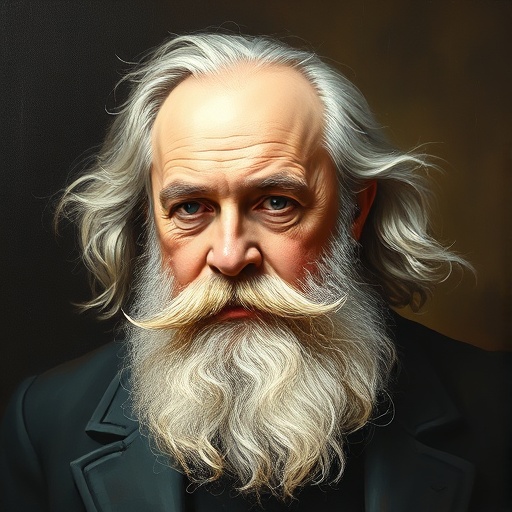
Dmitri Mendeleev — "The whole essence of science is to make predictions."
The whole essence of science is to make predictions.
The whole essence of science is to make predictions.
Click any product to generate a realistic preview. Up to 3 at a time.
* Initial load can take up to 90 seconds — revising the preview in another color is nearly instant.
"To protect the Russian borders from enemies, I would surround the whole country with a continuous wall of vodka."
"I have always been convinced that the universe is governed by laws that are discoverable through observation and experiment."
"The future of the Russian nation lies in the hands of the schoolmaster and the priest."
"Why do they [Americans] quarrel, why do they hate Negroes, Indians, even Germans, why do they not have science and poetry commensurate with themselves, why are there so many frauds and so much nonsens…"
"The future of Russia is in its oil and its people."
Found in 1 providers: grok
1 source checked
Science is not just about collecting facts or describing what exists. Its real purpose is to forecast what will happen, what we will find, or what must be true but hasn't been observed yet. A theory proves its worth when it correctly anticipates results before they are measured. Explanation alone is cheap; prediction that survives testing is the hard currency that separates genuine science from mere classification or storytelling.
Mendeleev embodied this principle when he built the periodic table in 1869. Rather than just cataloguing known elements, he left deliberate gaps and predicted the properties of undiscovered elements he called eka-aluminium, eka-boron, and eka-silicon. When gallium, scandium, and germanium were later found matching his forecasts almost exactly, his table transformed from a clever chart into a triumph of predictive chemistry.
Mendeleev worked in late 19th-century Russia, an age when chemistry was shifting from descriptive natural history to rigorous theoretical science. Industrialization demanded reliable materials, and the race to discover new elements was intense across Europe. Positivism celebrated verifiable laws, while Darwin's recent work had shown predictive frameworks could unify vast bodies of data. In this climate, a theory that merely organized knowledge was insufficient; successful prediction was the new standard of scientific legitimacy.
AI-generated insights based on extensive research and information for context. Factual errors? Email [email protected].
Your cart is empty