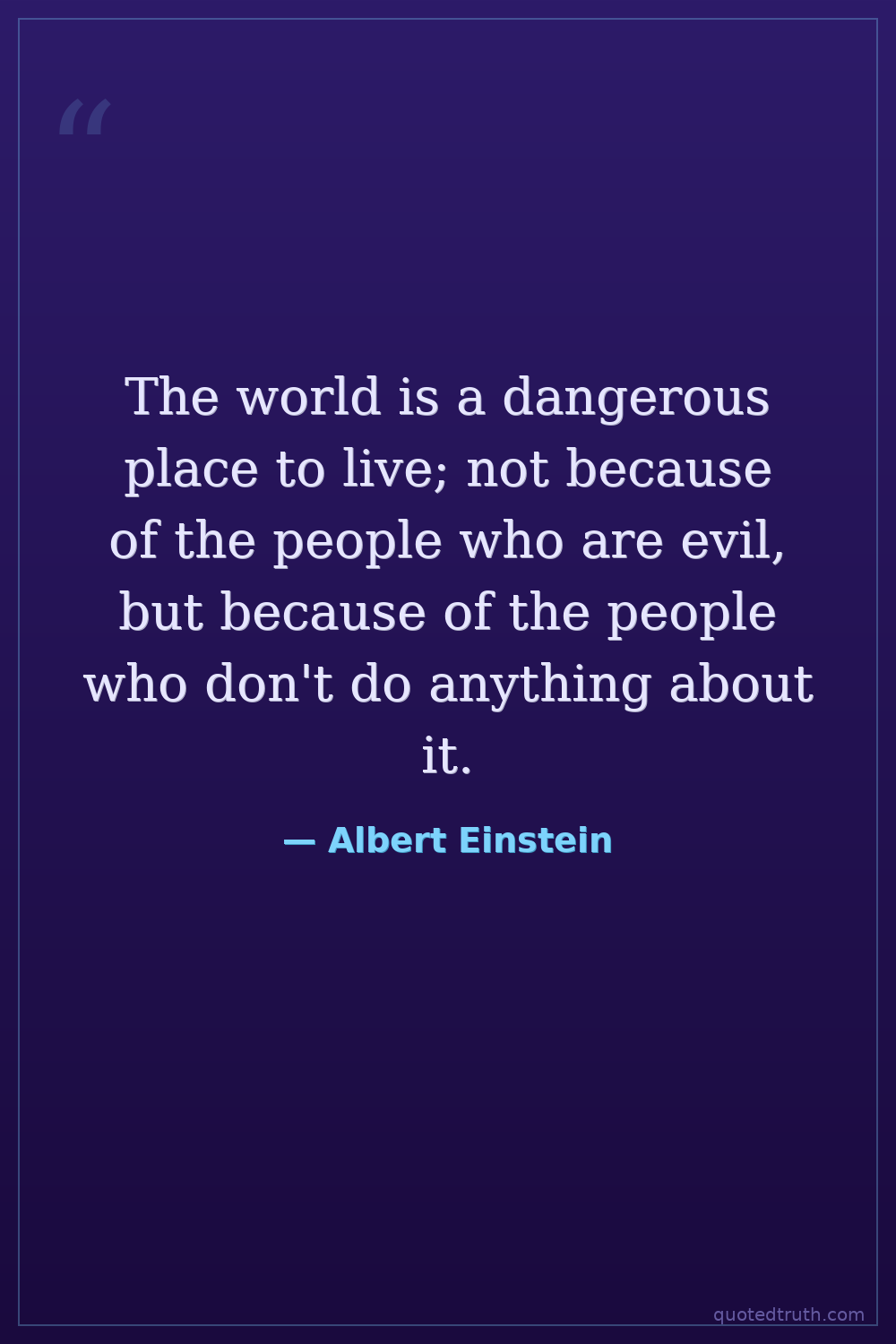
Albert Einstein — "The world is a dangerous place to live; not because of the people who are evil, …"
The world is a dangerous place to live; not because of the people who are evil, but because of the people who don't do anything about it.
The world is a dangerous place to live; not because of the people who are evil, but because of the people who don't do anything about it.
Click any product to generate a realistic preview. Up to 3 at a time.
* Initial load can take up to 90 seconds — revising the preview in another color is nearly instant.
"Reality is merely an illusion, albeit a very persistent one."
"I am enough of an artist to draw freely upon my imagination. Imagination is more important than knowledge. Knowledge is limited. Imagination encircles the world."
"Great spirits have always encountered violent opposition from mediocre minds."
"It is not the critic who counts; not the man who points out how the strong man stumbles, or where the doer of deeds could have done them better. The credit belongs to the man who is actually in the ar…"
"The only way to escape the corrupting influence of praise is to go on working."
Attributed, exact source elusive, common variant of a known sentiment.
Date: Undetermined
Life & DeathFound in 1 providers: grok
1 source checked
Passive bystanders — not active wrongdoers — are civilization's greatest threat. Evil needs complicity through inaction to flourish. The real danger isn't that bad actors exist; it's that ordinary people witness injustice and choose silence over resistance. Moral neutrality enables harm just as surely as causing it. Every individual carries a burden to act, because choosing not to is itself a choice, and that choice has consequences for everyone around them.
Einstein fled Nazi Germany in 1933, watching colleagues and institutions stay silent as antisemitic laws stripped Jews of rights, then lives. He became a relentless public intellectual — opposing nuclear weapons he'd helped make possible, championing civil rights, co-signing the Russell-Einstein Manifesto. His own survival depended on others acting; his activism was a direct response to witnessing what mass moral abdication produces at civilizational scale.
Einstein lived through WWI, the rise of fascism, the Holocaust, and the nuclear age's birth. The 1930s–40s showed catastrophically how ordinary citizens, institutions, and foreign governments looked away as genocide unfolded. Post-WWII Nuremberg trials and Hannah Arendt's later 'banality of evil' framework reinforced his insight — systematic atrocities depend on the indifference of the many, not solely the cruelty of the few who orchestrate them.
AI-generated insights based on extensive research and information for context. Factual errors? Email [email protected].
Your cart is empty