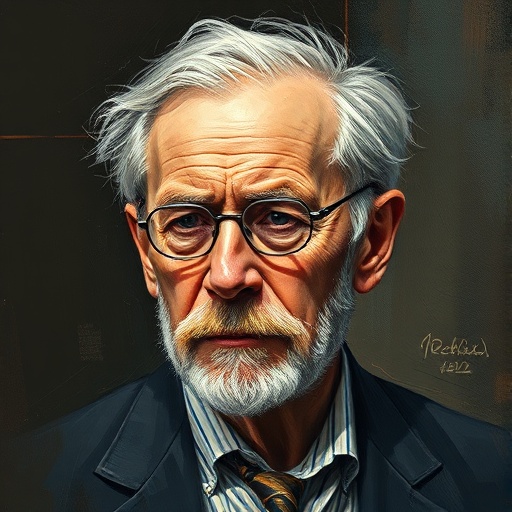
Erwin Schrodinger — "The world is a puzzle, and we are here to solve it."
The world is a puzzle, and we are here to solve it.
The world is a puzzle, and we are here to solve it.
Click any product to generate a realistic preview. Up to 3 at a time.
* Initial load can take up to 90 seconds — revising the preview in another color is nearly instant.
"The quantum mechanical description of reality is certainly incomplete."
"The problem of the 'thing in itself' is not a problem that can be solved by science. It is a philosophical problem."
"The world is not a collection of independent objects, but a single, indivisible whole."
"Quantum mechanics is a wonderful theory. But it is not the last word."
"We are all part of the same cosmic dance."
Austrian physicist who shared the 1933 Nobel for the wave equation that bears his name and the famous cat thought-experiment. Closely associated with Werner Heisenberg (matrix-mechanics rival who reached the same physics by different math) and Albert Einstein (his pen-pal on quantum interpretation). For an intellectual contrast, see Niels Bohr, Danish physicist and architect of the Copenhagen interpretation — Schrödinger's cat thought-experiment was specifically designed to ridicule Bohr's 'observer-dependent reality' reading of quantum mechanics — Schrödinger thought the Copenhagen interpretation was absurd; the cat was meant as reductio ad absurdum.
Found in 1 providers: grok
1 source checked
Reality is not self-evident but structured like an intricate problem demanding active intellectual engagement. Humans aren't passive observers of existence — we're driven to decode underlying patterns, find hidden order, and push understanding further. Curiosity isn't optional; it's our fundamental purpose. Every answered question reveals deeper questions, making the pursuit itself the point rather than any final complete solution.
Schrödinger spent his career dismantling comfortable assumptions about physical reality. His 1926 wave equation revealed quantum mechanics' probabilistic, counterintuitive foundations. His famous cat thought experiment exposed how measurement collapses superposition — reality resisting simple resolution. His book 'What is Life?' crossed into biology, exemplifying his belief that no puzzle respects disciplinary boundaries. He embodied restless, cross-domain problem-solving throughout his life.
Schrödinger worked during the 1920s-1930s quantum revolution, when Newtonian certainty collapsed entirely. Einstein's relativity had already fractured classical physics; now Heisenberg's uncertainty principle and quantum superposition suggested reality itself was fundamentally indeterminate. Scientists genuinely debated whether objective physical reality existed independently of observation. This radical instability made puzzle-solving not merely intellectual sport but an existential necessity for understanding what the universe actually is.
AI-generated insights based on extensive research and information for context. Factual errors? Email [email protected].
Your cart is empty