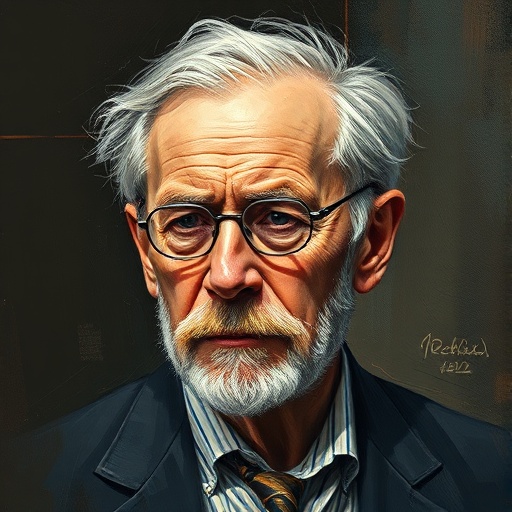
Erwin Schrodinger — "The world is not made of atoms, it is made of stories."
The world is not made of atoms, it is made of stories.
The world is not made of atoms, it is made of stories.
Click any product to generate a realistic preview. Up to 3 at a time.
* Initial load can take up to 90 seconds — revising the preview in another color is nearly instant.
"The number of children born to a marriage ought to be limited, and that a man who has already had some children should be sterilized."
"The world is not to be understood by reason alone. It is also to be understood by intuition and feeling."
"The total number of minds in the universe is one."
"If we were to take the wave function to be a complete description of reality, then the living and dead cat would indeed be equally real."
"The fundamental laws of physics are statistical. They do not determine precisely what will happen, but only the probability of what will happen."
Austrian physicist who shared the 1933 Nobel for the wave equation that bears his name and the famous cat thought-experiment. Closely associated with Werner Heisenberg (matrix-mechanics rival who reached the same physics by different math) and Albert Einstein (his pen-pal on quantum interpretation). For an intellectual contrast, see Niels Bohr, Danish physicist and architect of the Copenhagen interpretation — Schrödinger's cat thought-experiment was specifically designed to ridicule Bohr's 'observer-dependent reality' reading of quantum mechanics — Schrödinger thought the Copenhagen interpretation was absurd; the cat was meant as reductio ad absurdum.
Attributed, a popular quote, but its direct attribution to Schrodinger is debated.
Date: Unknown
GeneralFound in 1 providers: grok
1 source checked
Raw physical matter alone doesn't define reality — what matters is narrative, connection, and interpretation. The quote challenges the reductionist view that atoms are the fundamental unit of existence, arguing instead that meaning emerges from relationships, sequences of cause and effect, and the frameworks through which humans experience the world. Reality is ultimately constructed through the stories we tell about it, not the particles beneath.
Schrödinger's wave mechanics replaced hard particle-trajectories with probability waves, making matter more a description than a thing. His cat paradox exposed how observation shapes reality, blending physics with philosophy. In 'What is Life?' he extended quantum thinking into biology and consciousness. He studied Eastern philosophy, especially Vedanta, which framed existence as unified awareness — precisely the spirit of prioritizing story and meaning over atomic mechanism.
Schrödinger worked during quantum mechanics' founding decades (1920s–30s), when Newtonian certainty collapsed into probability clouds and observer-dependent realities. Einstein's relativity had already made space and time relational. Two World Wars forced thinkers to question whether scientific progress alone supplied meaning. Physicists became reluctant philosophers, and the atom — once modernity's great explanatory triumph — began to feel insufficient as a foundation for understanding human existence.
AI-generated insights based on extensive research and information for context. Factual errors? Email [email protected].
Your cart is empty