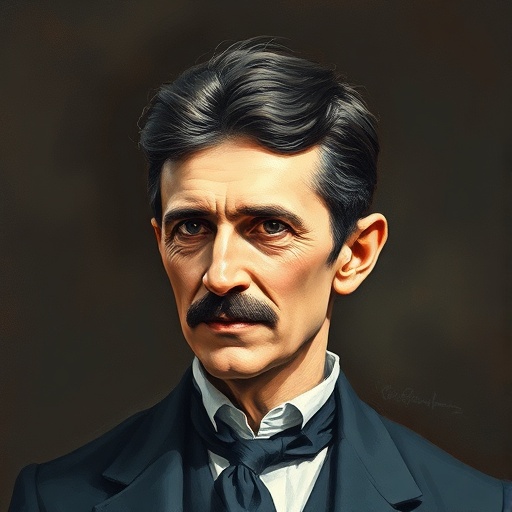
Nikola Tesla — "The world is not yet ready for my inventions."
The world is not yet ready for my inventions.
The world is not yet ready for my inventions.
Click any product to generate a realistic preview. Up to 3 at a time.
* Initial load can take up to 90 seconds — revising the preview in another color is nearly instant.
"My brain is only a receiver, in the Universe there is a core from which we obtain knowledge, strength and inspiration. I have not penetrated into the secrets of this core, but I know that it exists."
"I have an absolute aversion to pearls."
"Quick, Tesla! Where is it?"
"The desire that guides me in all I do is the desire to harness the forces of nature to the service of mankind."
"The harness of the forces of nature is the only means of true progress."
Serbian-American inventor and electrical engineer whose alternating-current designs powered the modern electrical grid; died poor and largely forgotten. Closely associated with George Westinghouse (his AC-power business partner) and Mihajlo Pupin (fellow Serbian-American physicist at Columbia). For an intellectual contrast, see Thomas Edison, American inventor and direct-current advocate — Edison's direct-current power-distribution scheme was displaced by Tesla-Westinghouse AC in the 1890s 'War of Currents'. Edison ran a public-relations campaign electrocuting animals to discredit AC — the most famous engineering-ethics rivalry in American history. Tesla's AC won and powers nearly every electrical grid on Earth.
Attributed, often cited to explain the lack of widespread adoption of some of his ideas.
Date: Early 20th Century
EducationalFound in 1 providers: grok
1 source checked
Some ideas arrive before the infrastructure, institutions, or understanding exists to support them. The inventor or thinker is working decades ahead of what society can build, fund, or even comprehend. Progress is real, but adoption lags behind discovery. The gap between what is technically possible and what the world can actually use or accept can span generations.
Tesla's AC power system, wireless energy transmission concept at Wardenclyffe Tower, and resonant frequency experiments were decades ahead of practical deployment. He died broke while his ideas powered civilization. Investors abandoned him, Edison's DC lobby fought him, and projects like global wireless electricity remained unfunded—not because they were wrong, but because the world lacked the will and infrastructure.
The late 19th and early 20th centuries saw explosive industrial growth, yet capital followed safe commercial bets. Edison's direct-current monopoly had powerful backing. Wireless communication and free energy transmission threatened entrenched utility business models. Patent wars, corporate suppression, and limited scientific literacy meant visionary concepts without immediate profit faced institutional resistance, leaving Tesla's most ambitious ideas unrealized during his lifetime.
AI-generated insights based on extensive research and information for context. Factual errors? Email [email protected].
Your cart is empty