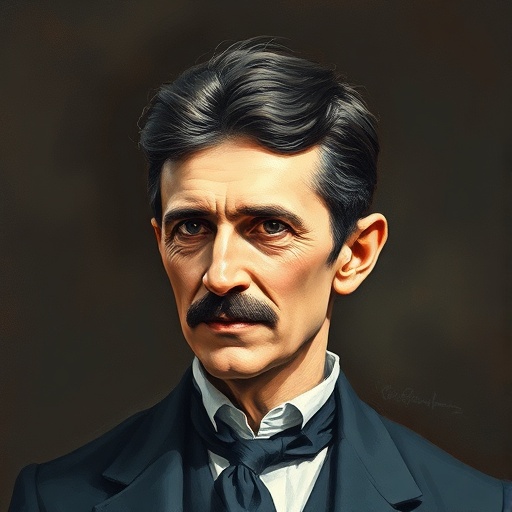
Nikola Tesla — "The desire that guides me in all I do is the desire to harness the forces of nat…"
The desire that guides me in all I do is the desire to harness the forces of nature to the service of mankind.
The desire that guides me in all I do is the desire to harness the forces of nature to the service of mankind.
Click any product to generate a realistic preview. Up to 3 at a time.
* Initial load can take up to 90 seconds — revising the preview in another color is nearly instant.
"My method is different. I do not rush into actual work. When I get an idea I start at once building it up in my imagination. I change the construction, make improvements, and operate the device entire…"
"I do not hesitate to state here for the world that there is no electrical principle or device which I have not conceived and substantially perfected in my own mind."
"I do not think there is any thrill that can go through the human heart like that of the inventor as he sees some creation of the brain unfolding to success… Such emotions make one forget food, sleep, …"
"I would give a thousand secrets of nature upon which I stumbled by accident, in exchange for this one which I extracted from nature, in spite of all the miracles and dangers which I faced."
"But instinct is something which transcends knowledge. We have, undoubtedly, certain finer fibers that enable us to perceive truths when logical deduction, or any other willful effort of the brain, is …"
Serbian-American inventor and electrical engineer whose alternating-current designs powered the modern electrical grid; died poor and largely forgotten. Closely associated with George Westinghouse (his AC-power business partner) and Mihajlo Pupin (fellow Serbian-American physicist at Columbia). For an intellectual contrast, see Thomas Edison, American inventor and direct-current advocate — Edison's direct-current power-distribution scheme was displaced by Tesla-Westinghouse AC in the 1890s 'War of Currents'. Edison ran a public-relations campaign electrocuting animals to discredit AC — the most famous engineering-ethics rivalry in American history. Tesla's AC won and powers nearly every electrical grid on Earth.
Found in 2 providers: grok,gemini
2 sources checked
A person's deepest motivation is using natural forces — electricity, physics, energy — to benefit humanity rather than for personal gain or profit. It means aligning one's entire life's work with a larger purpose: making nature's raw power serve practical human needs, whether that means light, heat, communication, or mechanical work that reduces human toil and suffering.
Tesla spent his life developing AC power, the Tesla coil, radio transmission, and wireless energy — all aimed at giving humanity cheap, abundant power. He famously refused to exploit his patents purely for wealth, dreaming of free global wireless electricity. His Wardenclyffe Tower project embodied this literally: transmitting power freely across the globe to anyone who needed it.
The late 1800s and early 1900s saw the electrification of civilization — Edison's DC versus Tesla's AC, industrial expansion, and the harnessing of Niagara Falls. Humanity was first taming electricity at scale. Scientific optimism ran high: inventors genuinely believed technology would end poverty and war. Tesla's era treated engineering heroes as civilization-builders, not mere entrepreneurs.
AI-generated insights based on extensive research and information for context. Factual errors? Email [email protected].
Your cart is empty