John von Neumann — "The world is so complicated that it cannot be described in any other way than by…"
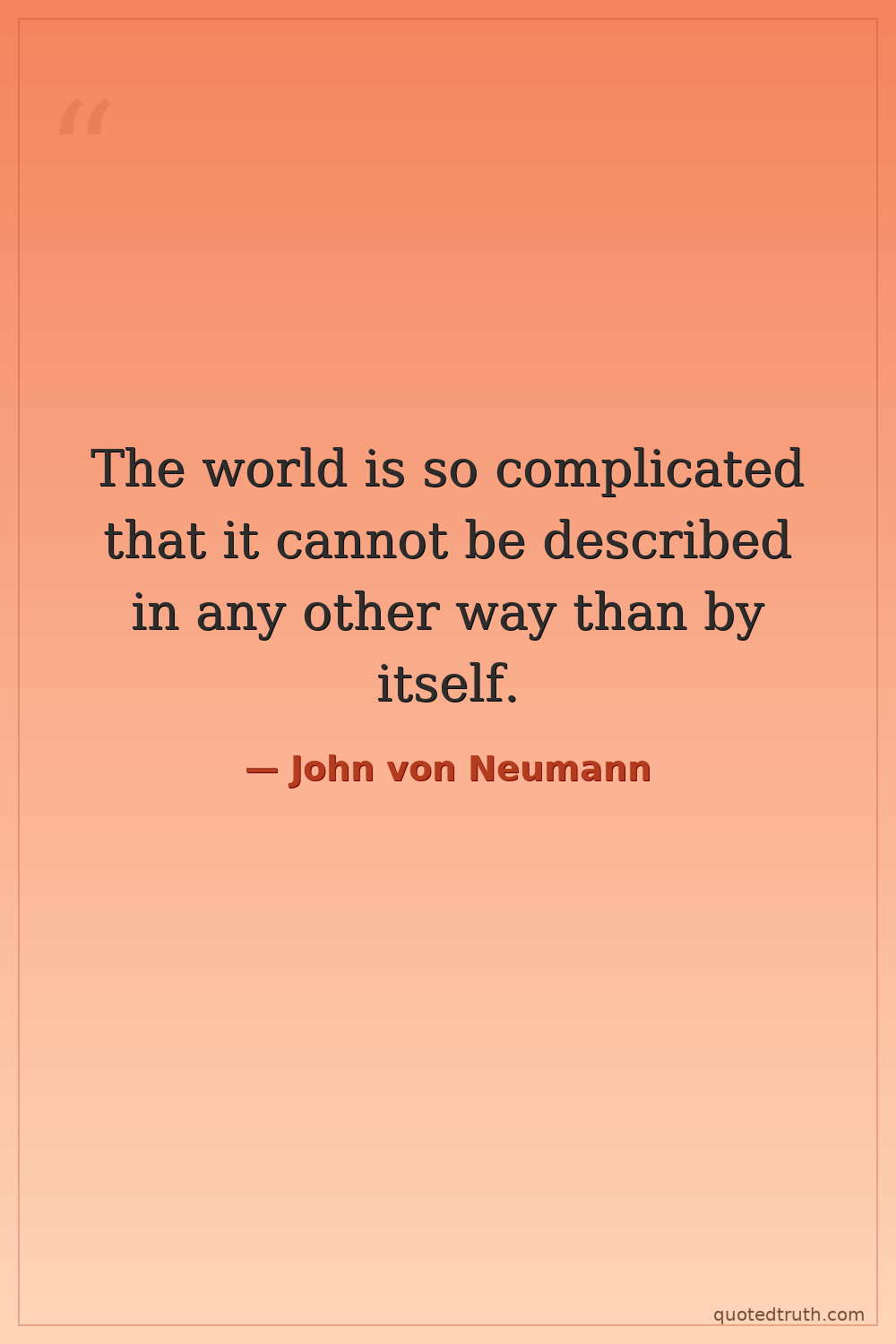
The world is so complicated that it cannot be described in any other way than by itself.
The world is so complicated that it cannot be described in any other way than by itself.
Click any product to generate a realistic preview. Up to 3 at a time.
* Initial load can take up to 90 seconds — revising the preview in another color is nearly instant.
"I'm told that the only difference between a mathematician and a physicist is that a mathematician thinks about mathematics and a physicist thinks about physics. And a physicist is always trying to get…"
"There's no sense in being precise when you don't even know what you're talking about."
"In the beginning was the word, and the word was 'bit'."
"Anyone who considers arithmetical methods of producing random digits is, of course, in a state of sin."
"It is just as important to know what not to do as it is to know what to do."
Found in 1 providers: grok
1 source checked
Reality is irreducibly complex — no model, theory, or abstraction can fully capture it without losing something essential. Any description of the world is a simplification, and simplifications omit detail by definition. The only perfectly accurate representation of the universe is the universe itself. This is a statement about the hard limits of modeling: you cannot compress infinite complexity into a finite description without sacrifice.
Von Neumann devoted his career to modeling reality — designing computer architecture to process information, formulating game theory to predict human behavior, and simulating nuclear detonations for the Manhattan Project. Yet he understood where abstraction breaks down. His work on cellular automata explored whether a system could fully replicate itself. This tension between his extraordinary modeling power and awareness of irreducible complexity makes the quote a direct reflection of his intellectual honesty.
Von Neumann's era saw scientists build the atomic bomb from equations, inaugurate digital computing, and develop quantum mechanics — a period of supreme confidence in human modeling power. Yet this same era produced Gödel's incompleteness theorems, Heisenberg's uncertainty principle, and early chaos theory, all suggesting hard limits to description and prediction. Von Neumann worked at this frontier, where models had never been more powerful, yet reality's irreducibility was becoming mathematically provable.
AI-generated insights based on extensive research and information for context. Factual errors? Email [email protected].
Your cart is empty