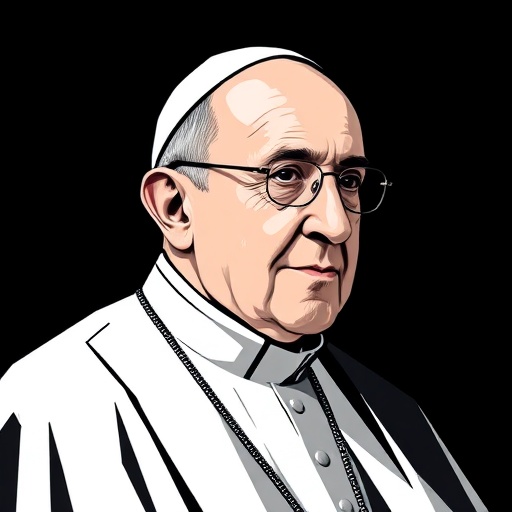
Pope Francis — "The world needs more tenderness."
The world needs more tenderness.
The world needs more tenderness.
Click any product to generate a realistic preview. Up to 3 at a time.
* Initial load can take up to 90 seconds — revising the preview in another color is nearly instant.
"Always keep in mind that the Church is not a museum of saints, but a hospital for sinners."
"The Church is not a museum of saints, but a hospital for sinners."
"This economy kills."
"There is no Catholic God."
"The world cannot be understood without the poor. The poor are the treasure of the Church."
First Latin American and Jesuit pope (2013-), who has steered the Catholic Church toward pastoral inclusion on LGBTQ pastoral care, divorced Catholics, and climate. Closely associated with Pope John XXIII (the Vatican II reformer pope) and Cardinal Walter Kasper (his theological ally on pastoral reform). For an intellectual contrast, see Cardinal Raymond Burke, American traditionalist cardinal, former head of the Vatican Apostolic Signatura — Burke is the public face of Catholic traditionalism that views Francis's pastoral approach as doctrinally dangerous — he has formally challenged Amoris Laetitia and other Francis reforms.
Found in 1 providers: grok
1 source checked
A call for compassion and gentleness in how people treat one another — not weakness, but the courage to remain caring and open-hearted in a hard world. It urges individuals, communities, and institutions to resist indifference and cruelty, to slow down enough to see the suffering around them, and to respond with human warmth rather than judgment, contempt, or detachment.
Born Jorge Mario Bergoglio in Buenos Aires, Francis chose a simple guesthouse over the Apostolic Palace as a deliberate act of closeness. He washed prisoners' feet, embraced the physically disabled publicly, and called mercy his defining theological theme. His Jesuit formation taught love through concrete action. For Francis, tenderness is not sentiment — it is a pastoral strategy and spiritual discipline rooted in direct personal encounter.
Francis became pope in 2013 as the world lurched toward polarization. Rising nationalism, the refugee crisis, social media cruelty, wars in Ukraine and Gaza, and a deepening mental health epidemic defined his papacy. Political discourse normalized contempt and dehumanization of opponents. His insistence on tenderness was countercultural — a direct challenge to the rage-driven public sphere and the cold, transactional style dominating modern leadership.
AI-generated insights based on extensive research and information for context. Factual errors? Email [email protected].
Your cart is empty