Pope Francis — "The world offers us comfort, but the comfort of the world is not the comfort of …"
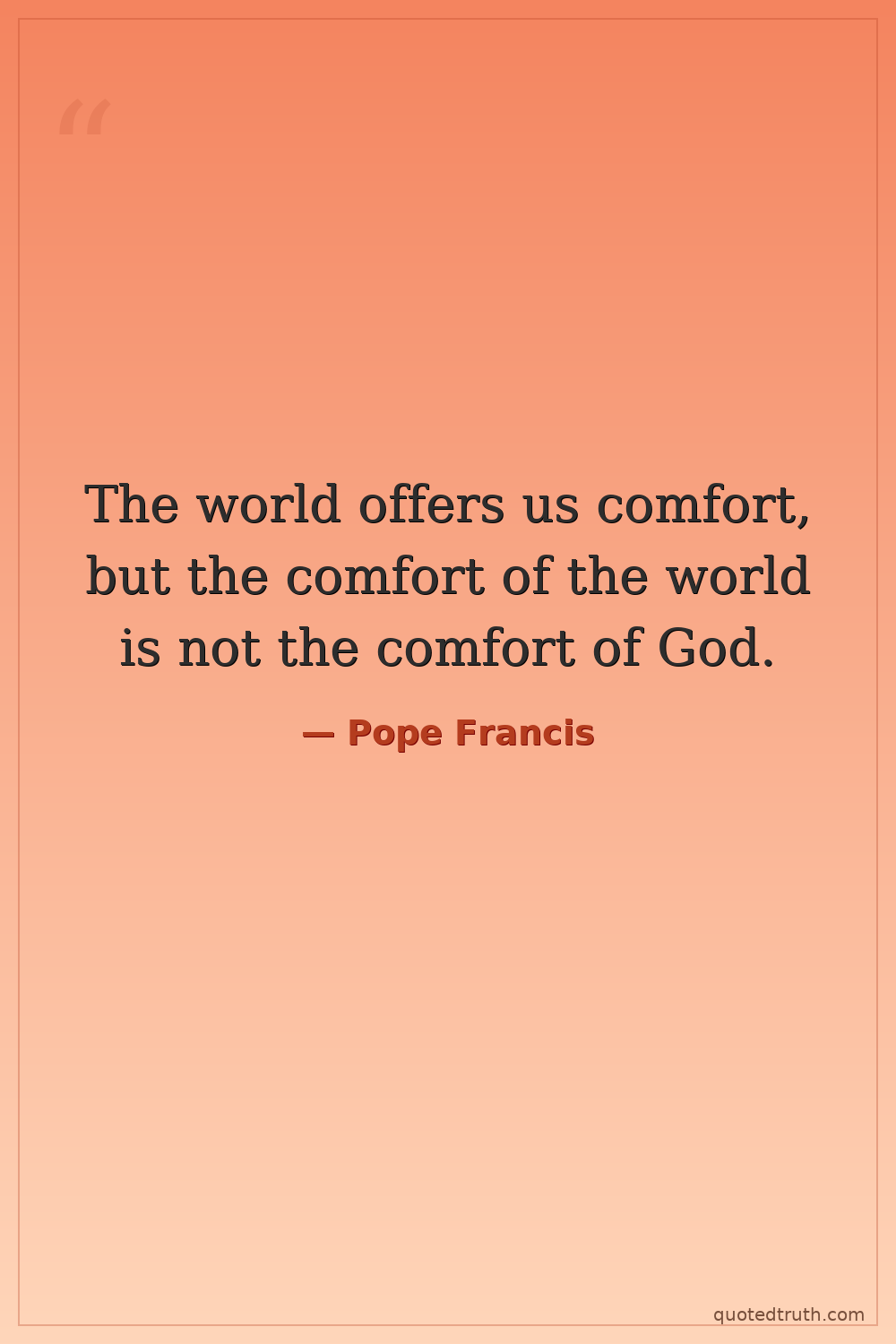
The world offers us comfort, but the comfort of the world is not the comfort of God.
The world offers us comfort, but the comfort of the world is not the comfort of God.
Click any product to generate a realistic preview. Up to 3 at a time.
* Initial load can take up to 90 seconds — revising the preview in another color is nearly instant.
"The measure of a society is its treatment of the poor and vulnerable."
"The family is in crisis."
"Mercy is not a beautiful idea, it is a concrete reality."
"I want to make a mess. I want trouble in the dioceses. I want us to get out of the comfort zone, out of the clericalism, out of the routine."
"I don't have a plan. I don't have a program. I don't have anything. I'm just trying to be a good shepherd."
First Latin American and Jesuit pope (2013-), who has steered the Catholic Church toward pastoral inclusion on LGBTQ pastoral care, divorced Catholics, and climate. Closely associated with Pope John XXIII (the Vatican II reformer pope) and Cardinal Walter Kasper (his theological ally on pastoral reform). For an intellectual contrast, see Cardinal Raymond Burke, American traditionalist cardinal, former head of the Vatican Apostolic Signatura — Burke is the public face of Catholic traditionalism that views Francis's pastoral approach as doctrinally dangerous — he has formally challenged Amoris Laetitia and other Francis reforms.
Found in 1 providers: grok
1 source checked
True comfort from the world means ease, pleasure, material security, or social acceptance—things that feel satisfying but remain temporary and shallow. God's comfort, by contrast, is deeper: peace amid suffering, meaning beyond circumstances, connection to something eternal. The quote warns against mistaking convenience or approval for genuine fulfillment. Real spiritual peace cannot be purchased, scrolled toward, or consumed—it comes through surrender to something larger than personal ease.
Pope Francis chose radical simplicity from the start of his papacy, rejecting the papal apartments for a guesthouse room and driving a used Ford Focus. Naming himself after St. Francis of Assisi, he built his pontificate around rejecting consumerism, warning against a throwaway culture, and championing the poor. His Jesuit formation emphasized discernment over comfort. He repeatedly tells clergy that a comfortable Church is a dead Church.
Francis became pope in 2013 as Western societies deepened their immersion in convenience culture—on-demand streaming, same-day delivery, smartphones eliminating boredom. Inequality grew sharply while consumer culture promoted comfort as a life goal. His papacy spanned the COVID-19 pandemic, which exposed how fragile worldly comfort truly is. Against this backdrop, his critique of comfort as a spiritual trap resonated globally, particularly as institutions including the Church reckoned with corruption and moral complacency.
AI-generated insights based on extensive research and information for context. Factual errors? Email [email protected].
Your cart is empty