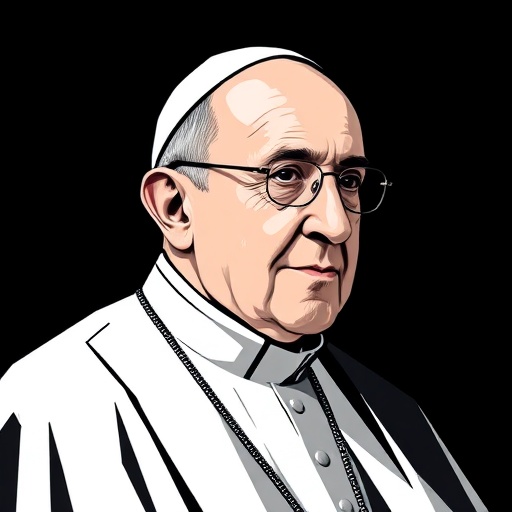
Pope Francis — "I don't have a plan. I don't have a program. I don't have anything. I'm just try…"
I don't have a plan. I don't have a program. I don't have anything. I'm just trying to be a good shepherd.
I don't have a plan. I don't have a program. I don't have anything. I'm just trying to be a good shepherd.
Click any product to generate a realistic preview. Up to 3 at a time.
* Initial load can take up to 90 seconds — revising the preview in another color is nearly instant.
"I'm a bit of a glutton."
"Sometimes when I see a clericalist, I suddenly become anticlerical."
"I don't think much about death, but I think about old age."
"If a person is gay and seeks God and has good will, who am I to judge them?"
"Ideologies divide, faith unites."
First Latin American and Jesuit pope (2013-), who has steered the Catholic Church toward pastoral inclusion on LGBTQ pastoral care, divorced Catholics, and climate. Closely associated with Pope John XXIII (the Vatican II reformer pope) and Cardinal Walter Kasper (his theological ally on pastoral reform). For an intellectual contrast, see Cardinal Raymond Burke, American traditionalist cardinal, former head of the Vatican Apostolic Signatura — Burke is the public face of Catholic traditionalism that views Francis's pastoral approach as doctrinally dangerous — he has formally challenged Amoris Laetitia and other Francis reforms.
Found in 1 providers: grok
1 source checked
The speaker rejects rigid institutional planning in favor of responsive, present-moment leadership. True guidance comes from attentiveness to people's actual needs rather than bureaucratic agendas. Authentic leadership means showing up fully, adapting to circumstances, and prioritizing relationship over strategy — the shepherd metaphor emphasizing protection, care, and direct presence rather than top-down administration.
Jorge Bergoglio became the first Jesuit pope in 2013, breaking from Vatican tradition by choosing simplicity — living in Casa Santa Marta rather than the Apostolic Palace, carrying his own luggage, embracing the poor personally. His pastoral identity formed in Buenos Aires slums. This spontaneous, unscripted approach defines his entire papacy, frustrating traditionalists while inspiring grassroots Catholics globally.
Francis became pope amid deepening Catholic institutional crises — clerical abuse scandals, Vatican financial corruption, Benedict XVI's unprecedented resignation. Global religion was fragmenting, with institutional trust collapsing and grassroots spiritual seeking rising. His rejection of programmatic leadership directly countered the perception of the Church as a cold bureaucracy, resonating in an era of widespread disillusionment with hierarchical institutions.
AI-generated insights based on extensive research and information for context. Factual errors? Email [email protected].
Your cart is empty