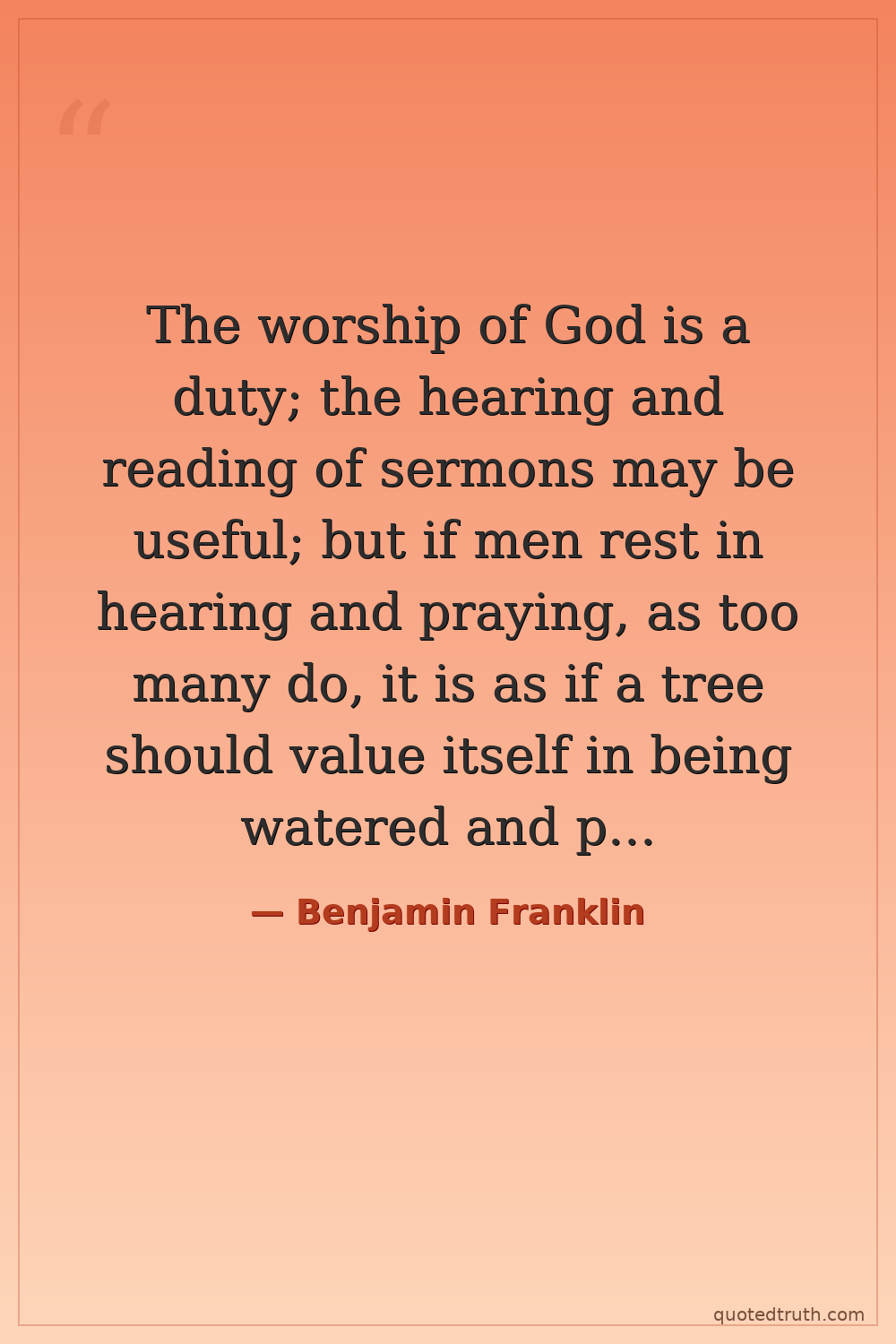
Benjamin Franklin — "The worship of God is a duty; the hearing and reading of sermons may be useful; …"

The worship of God is a duty; the hearing and reading of sermons may be useful; but if men rest in hearing and praying, as too many do, it is as if a tree should value itself in being watered and putting forth leaves, tho' it never produced any fruit.
Benjamin Franklin — Benjamin Franklin Early Modern · Electricity experiments, founding father

Get This Quote & Author's Image Illustrated On:

Click any product to generate a realistic preview. Up to 3 at a time.
* Initial load can take up to 90 seconds — revising the preview in another color is nearly instant.

Kitchen

Apparel

Other

About Benjamin Franklin (1706-1790)

Polymath Founding Father, diplomat, and Poor Richard's Almanack author who helped draft the Declaration of Independence and the Constitution. Closely associated with John Adams (fellow Founder, Massachusetts statesman) and Thomas Jefferson (fellow Declaration drafter). For an intellectual contrast, see Thomas Hutchinson, last royal governor of colonial Massachusetts — Franklin leaked Hutchinson's loyalist correspondence to Boston in 1772 to inflame revolutionary sentiment — Hutchinson represented the colonial-aristocrat crown-loyalty that Franklin's revolution was organized to dismantle.

Details

From a collection of lesser-known wisdom

Date: Unknown, likely 18th century

General

Verification

Unverifiable

Found in 1 providers: gemini

1 source checked

Understanding this quote

What it means

Religious rituals—attending sermons, praying—are inputs, not ends in themselves. True virtue requires producing tangible results: good works, practical benefit to others. Stopping at devotional acts without acting on them is like a tree that absorbs water and grows leaves but never bears fruit. It consumes resources while failing its actual purpose. Religion should be a catalyst for action, not a substitute for it.

Relevance to Benjamin Franklin

Franklin was a Deist who rarely attended church yet founded Philadelphia's hospital, library, and fire company. He designed his 13 Virtues—all behavioral, none doctrinal. He wrote that 'doing good to men is the only service of God in our power.' This quote mirrors his lifelong conviction: morality is proven through civic contribution and useful labor, not devotional performance.

The era

Colonial America was intensely devout, shaped by Puritan traditions and the Great Awakening revivals of the 1730s–40s, which sparked mass conversion experiences and emotional public prayer. Many colonists equated religious fervor with moral virtue. Franklin, writing during the Enlightenment, pushed back: reason and practical civic improvement—not piety—defined true virtue. His era wrestled between inherited religious frameworks and emerging secular humanism built on evidence and useful works.

AI-generated insights based on extensive research and information for context. Factual errors? Email [email protected].
Your Cart

Your cart is empty