What it means
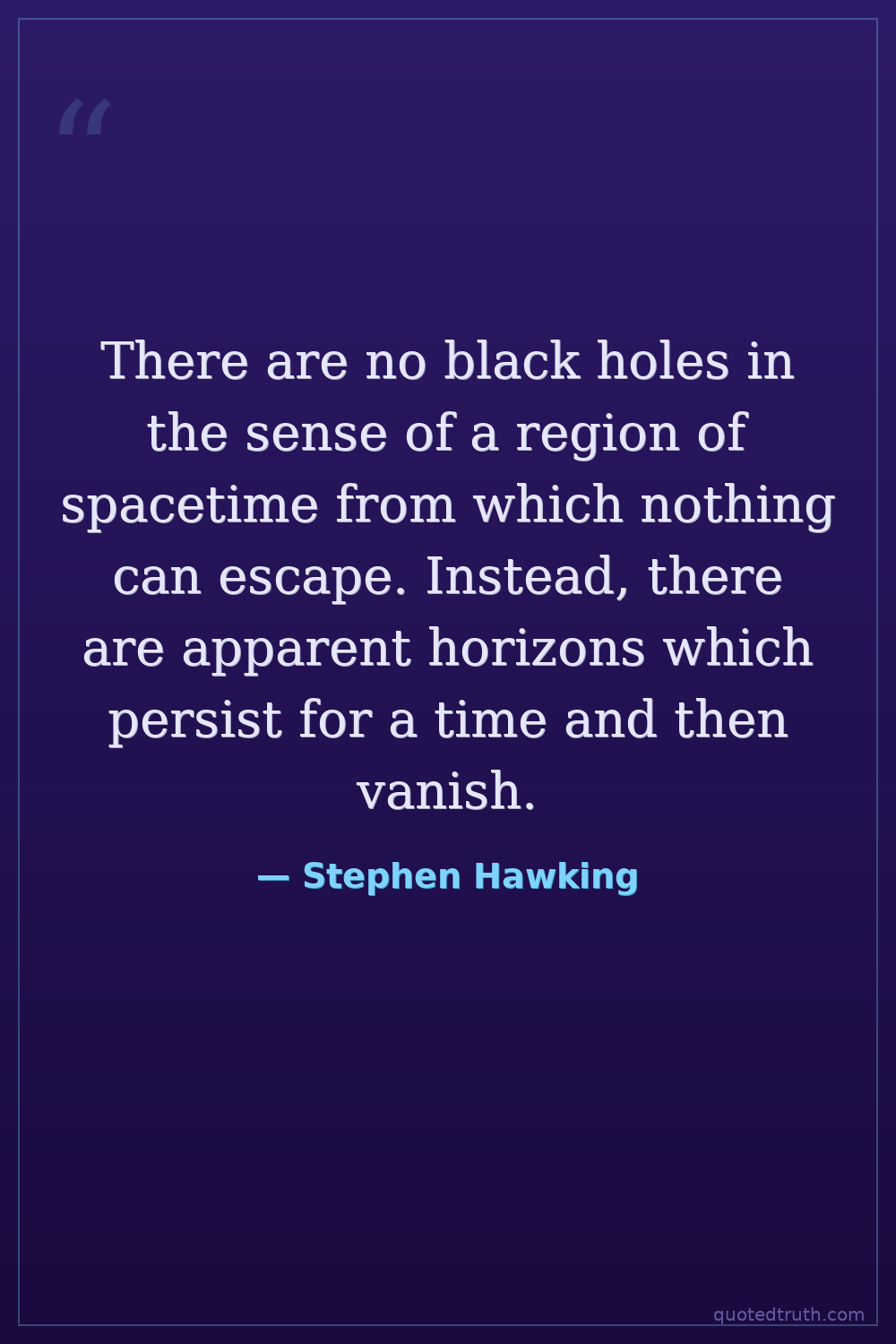
Hawking is dismantling his own earlier concept of black holes. The classical view held that event horizons are permanent one-way boundaries — once inside, nothing escapes. Here he argues those absolute barriers don't exist. Instead, apparent horizons temporarily confine matter and energy before eventually dissipating. This resolves a deep paradox: information swallowed by a black hole isn't destroyed forever — it can eventually leak out, preserving the fundamental laws of physics.
Relevance to Stephen Hawking
Hawking built his reputation on black hole theory — his 1974 discovery that black holes emit thermal radiation bearing his name was career-defining. This 2014 statement shows rare intellectual courage: he publicly revised his own foundational work to address the firewall paradox. Despite being confined to a wheelchair by ALS since his twenties, he consistently prioritized theoretical truth over personal legacy, demonstrating the fearless curiosity that made him the most celebrated physicist of his generation.
The era
In 2012, physicists Polchinski, Marolf, Shenker, and Wall proposed the firewall paradox: quantum mechanics seemed to demand a wall of lethal radiation at black hole horizons, directly contradicting general relativity. It split the physics community and suggested Einstein's gravity and quantum theory couldn't both be correct. Hawking's 2014 response arrived amid this intense crisis — a period when string theory, loop quantum gravity, and quantum information theory all competed urgently to reconcile the irreconcilable.
AI-generated insights based on extensive research and information for context. Factual errors? Email [email protected].