Niels Bohr — "There are trivial truths and great truths. The opposite of a trivial truth is pl…"
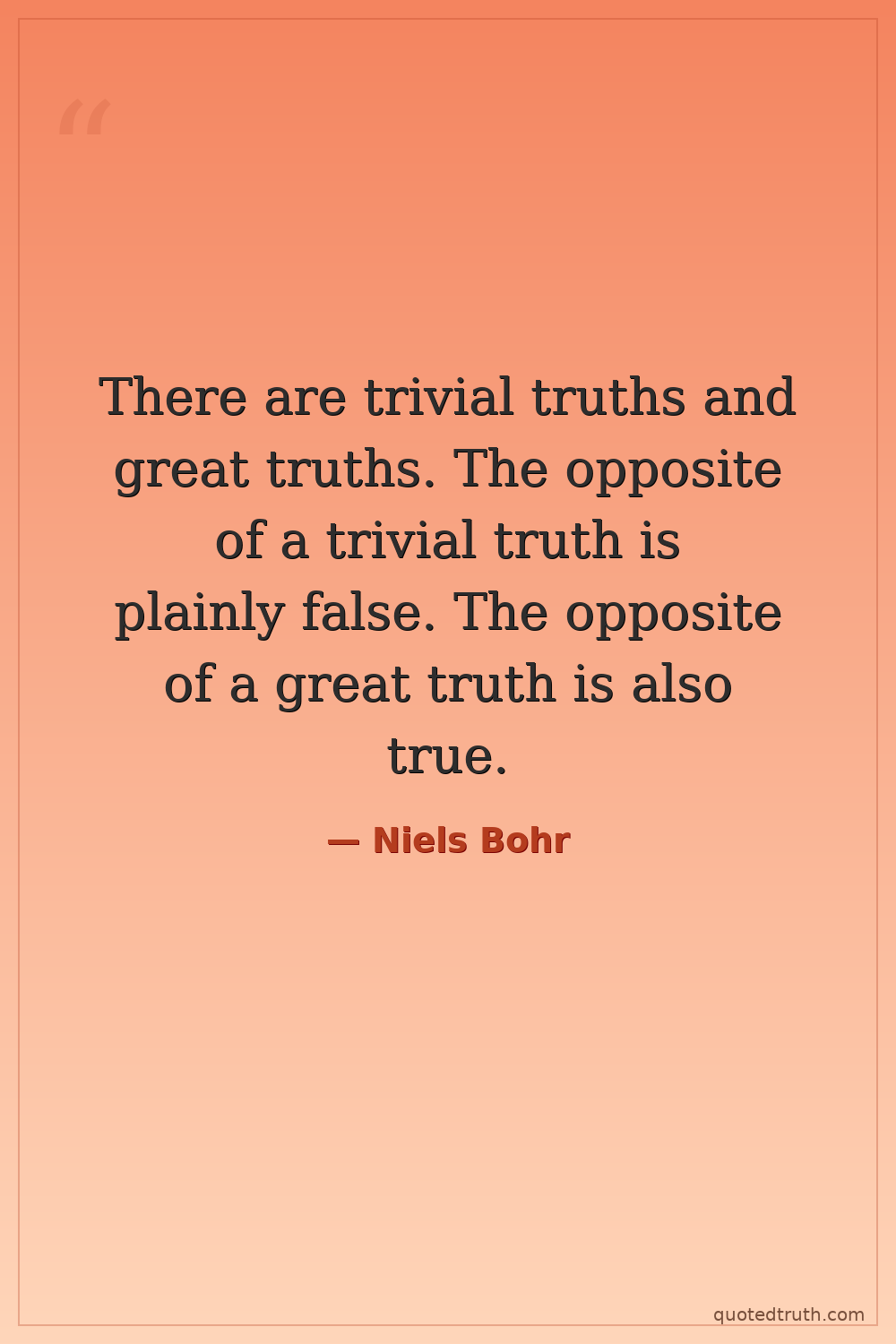
There are trivial truths and great truths. The opposite of a trivial truth is plainly false. The opposite of a great truth is also true.
There are trivial truths and great truths. The opposite of a trivial truth is plainly false. The opposite of a great truth is also true.
Click any product to generate a realistic preview. Up to 3 at a time.
* Initial load can take up to 90 seconds — revising the preview in another color is nearly instant.
"The atom is not a mechanical system, but a system of relationships."
"The world is full of wonders, and science is the key to unlocking them."
"The opposite of a shallow truth is a falsehood. The opposite of a profound truth may well be another profound truth."
"The great lesson of quantum theory is that there is no deep reality."
"The fact that religions can exist, says that there is something in the human mind which is not satisfied by physics."
Found in 1 providers: grok
1 source checked
Some statements are simple and binary — if you say water boils at 100°C, the opposite is just wrong. But deep truths about existence, ethics, or physics operate differently: both a claim and its apparent contradiction can be valid simultaneously. Reality at its most fundamental level resists either/or framing. Genuine insight holds paradox rather than collapsing it. Wisdom means recognizing when two opposing ideas are both pointing at something real.
Bohr's greatest contribution was complementarity — the principle that an electron is simultaneously a wave and a particle, two mutually exclusive descriptions that are both true. His Copenhagen Interpretation of quantum mechanics embraced paradox as fundamental, not as a failure of understanding. He spent decades debating Einstein over determinism in physics. His entire career was built on the idea that contradictions at the deepest level reveal truth rather than signal error.
The early 20th century shattered classical physics. Quantum mechanics emerged between 1900 and 1930, revealing that electrons lack definite positions, that observation alters outcomes, and that determinism breaks down at small scales. Scientists struggled to reconcile these findings with centuries of Newtonian certainty. Bohr worked during a period when the very framework of true and false in physics was being radically dismantled, making his reflection on the nature of truth professionally urgent and deeply personal.
AI-generated insights based on extensive research and information for context. Factual errors? Email [email protected].
Your cart is empty