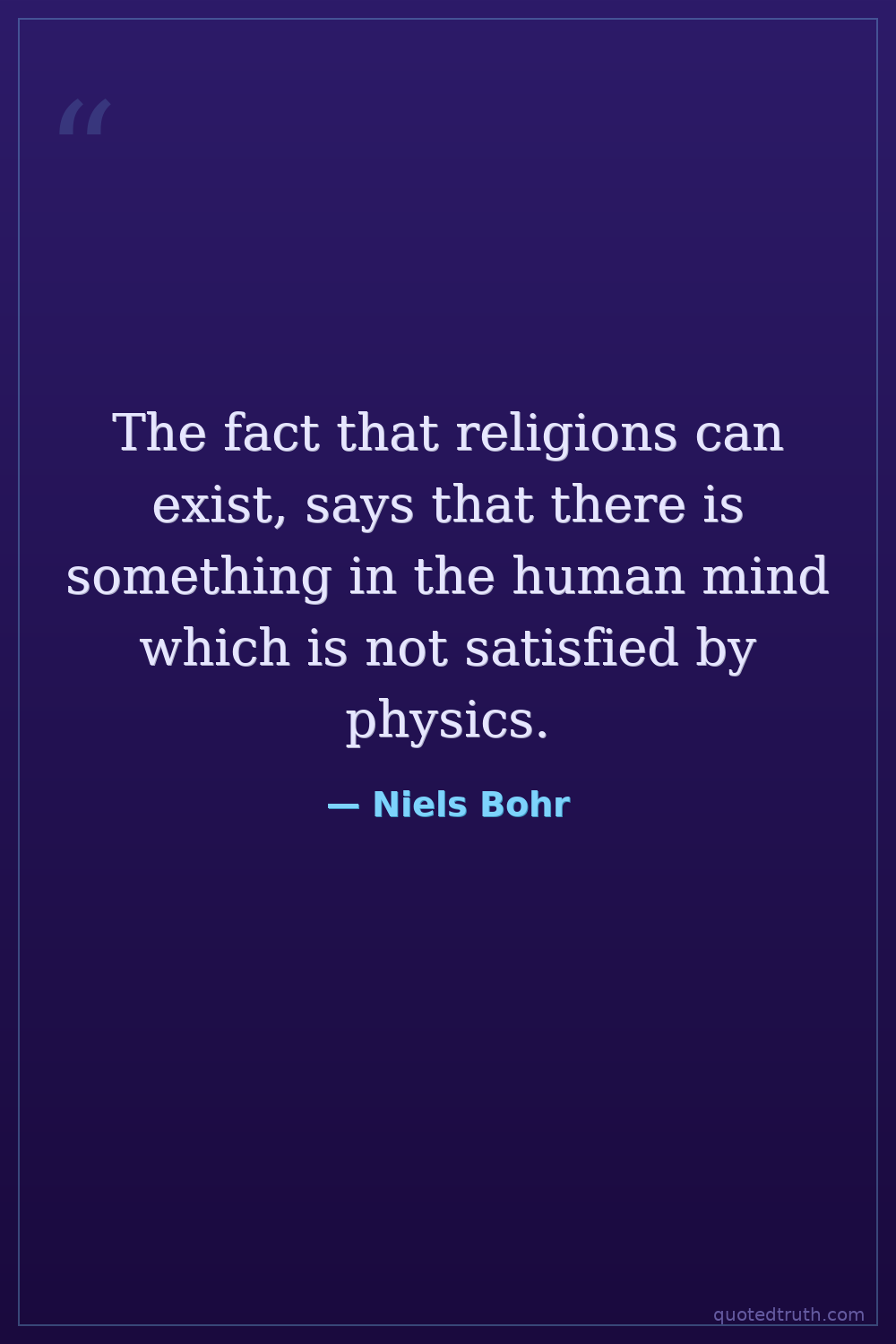
Niels Bohr — "The fact that religions can exist, says that there is something in the human min…"
The fact that religions can exist, says that there is something in the human mind which is not satisfied by physics.
The fact that religions can exist, says that there is something in the human mind which is not satisfied by physics.
Click any product to generate a realistic preview. Up to 3 at a time.
* Initial load can take up to 90 seconds — revising the preview in another color is nearly instant.
"There are trivial truths and great truths. The opposite of a trivial truth is plainly false. The opposite of a great truth is also true."
"We must be clear that, when it comes to atoms, language can be used only as in poetry. The poet, too, is not nearly so concerned with describing facts as with creating images and establishing mental c…"
"The task is not so much to see what no one has yet seen, but to think what nobody has yet thought, about that which everybody sees."
"The goal of science is to explain the world, not to describe it."
"Truth and clarity are complementary."
Found in 1 providers: grok
1 source checked
Bohr is pointing out that the very existence of religions across cultures reveals a human need that science cannot fulfill. Physics explains how matter and energy behave, but people still seek meaning, purpose, morality, and comfort about death. That persistent hunger for something beyond measurable reality suggests the mind craves answers physics was never designed to provide, regardless of how complete our scientific picture becomes.
Bohr spent his career probing the strangest layer of reality through quantum mechanics and his atomic model, yet he famously embraced complementarity, the idea that opposing truths can both be valid. A Danish physicist raised in a philosophically rich household, he often reflected on the limits of scientific language. This remark fits his lifelong insistence that physics describes nature but cannot exhaust human experience or replace deeper existential questions.
Bohr worked through the early twentieth century, when quantum theory shattered classical certainty and two world wars shook faith in progress. Many intellectuals declared religion obsolete as science advanced, while others wrestled with meaning after mass atrocities and the atomic bomb, which Bohr himself helped shape. In that climate of upheaval, his observation acknowledged that scientific triumph had not erased humanity's spiritual longing, a tension defining the modern age.
AI-generated insights based on extensive research and information for context. Factual errors? Email [email protected].
Your cart is empty