What it means
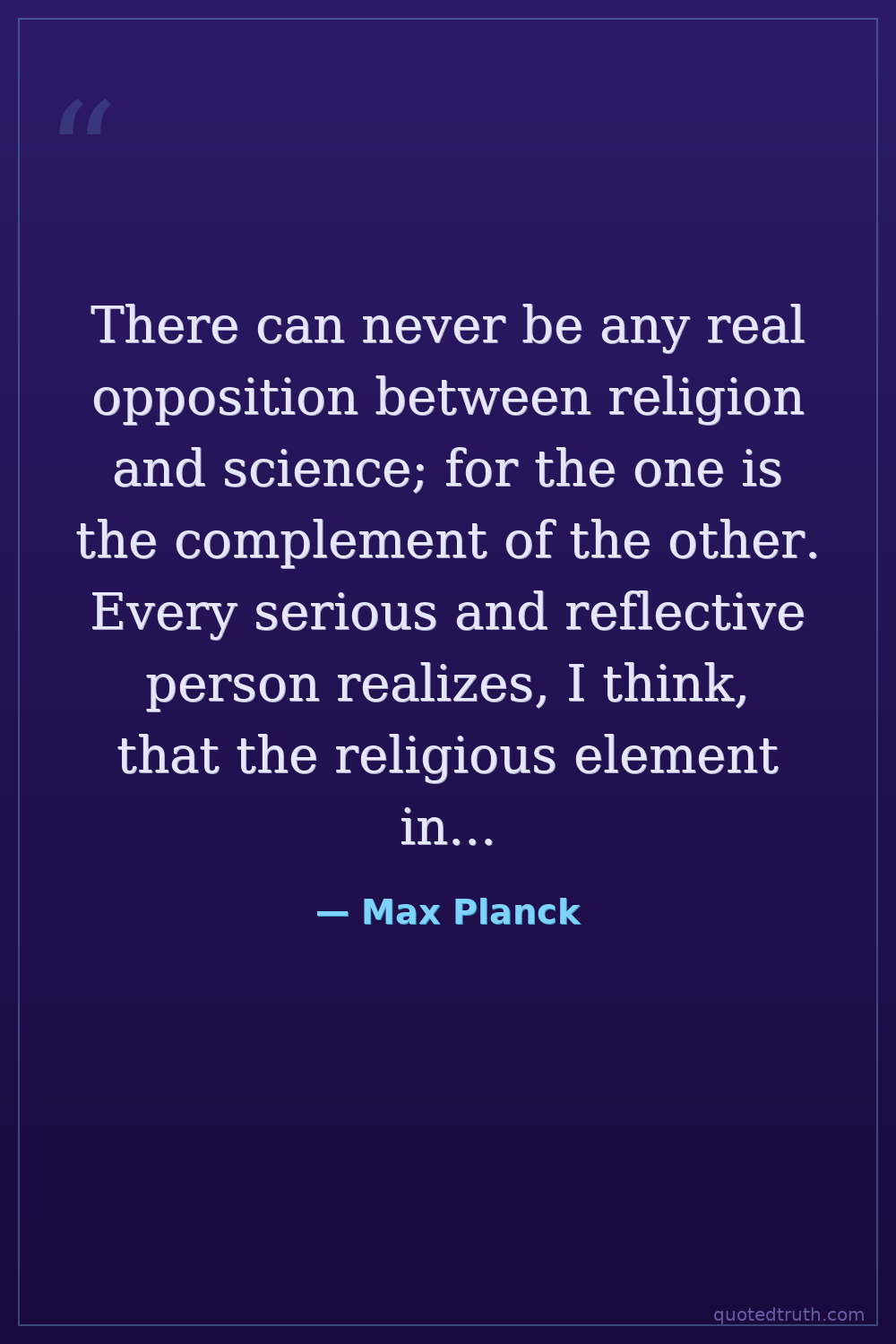
Planck argues that faith and science aren't enemies but partners that complete each other. He claims any thoughtful person feels a spiritual side that deserves nurturing alongside rational inquiry, because a balanced human being needs both working in sync. He notes that history's greatest minds often held deep religious convictions privately, even when they didn't advertise them publicly, suggesting inner spirituality and rigorous thinking naturally coexist in serious people.
Relevance to Max Planck
Planck founded quantum theory in 1900 yet remained a devout Lutheran throughout his life, serving as a church elder in Berlin. He publicly defended religion in lectures like Religion and Natural Science (1937), insisting both pursued truth from different angles. Having lost two daughters in childbirth and a son executed by the Nazis for plotting against Hitler, Planck drew genuine comfort from faith, making this reconciliation deeply personal rather than abstract philosophy.
The era
Planck spoke during an era when science seemingly displaced religion: Darwin, Freud, and Einstein had reshaped reality, while logical positivists dismissed theology as meaningless. Germany's churches were pressured under Nazi rule, and secular ideologies like Marxism and fascism competed for souls. Two world wars shattered Enlightenment optimism. Planck, watching colleagues flee or collaborate, insisted science couldn't answer ultimate meaning questions, pushing back against both militant atheism and the instrumentalization of science by totalitarian regimes.
AI-generated insights based on extensive research and information for context. Factual errors? Email [email protected].