What it means
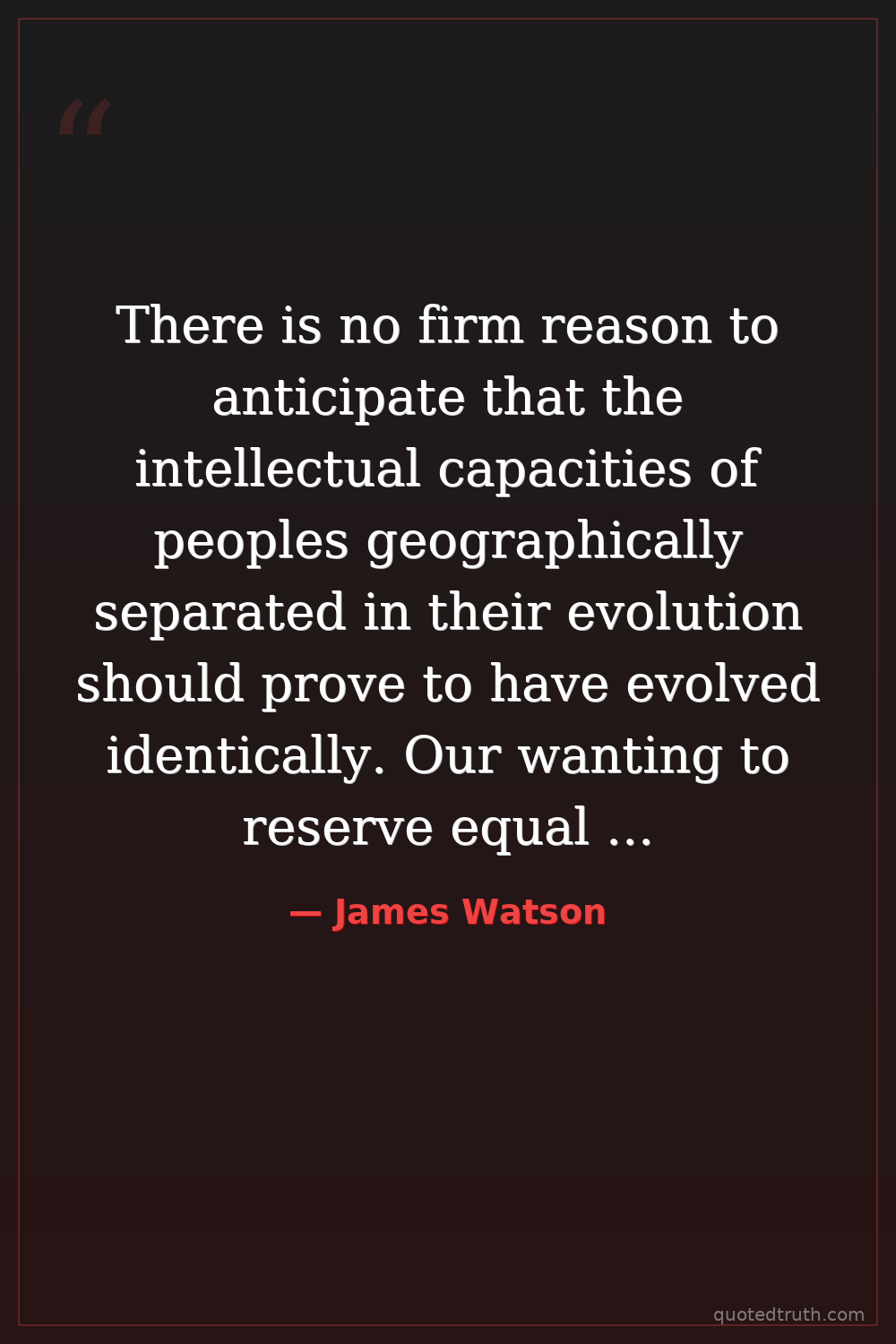
Watson argues that human populations evolving in different geographic regions could plausibly have developed different cognitive abilities, and that simply hoping or insisting all groups possess equal intellectual capacity does not make it biologically true. He frames equal reasoning power as a wish rather than an established fact, suggesting evolutionary pressures may have produced measurable differences in intelligence between population groups.
Relevance to James Watson
Watson co-discovered DNA's double helix in 1953 with Crick, winning the 1962 Nobel Prize, and later directed the Human Genome Project. His career-long focus on genetic determinism shaped this view. Statements like this cost him his Cold Spring Harbor leadership in 2007 and his honorary titles in 2019, exiling one of biology's most celebrated figures over claims most geneticists reject as unsupported by genomic evidence.
The era
Watson made these remarks during the post-genome era, when sequencing data was being weaponized in revived race-and-IQ debates online. Mainstream genetics had reached consensus that population genetic variation does not map onto cognitive ability, and institutions were actively distancing themselves from scientific racism. His statements landed amid heightened sensitivity around racial justice movements, prompting universities, publishers, and laboratories to formally repudiate hereditarian claims about intelligence.
AI-generated insights based on extensive research and information for context. Factual errors? Email [email protected].