What it means
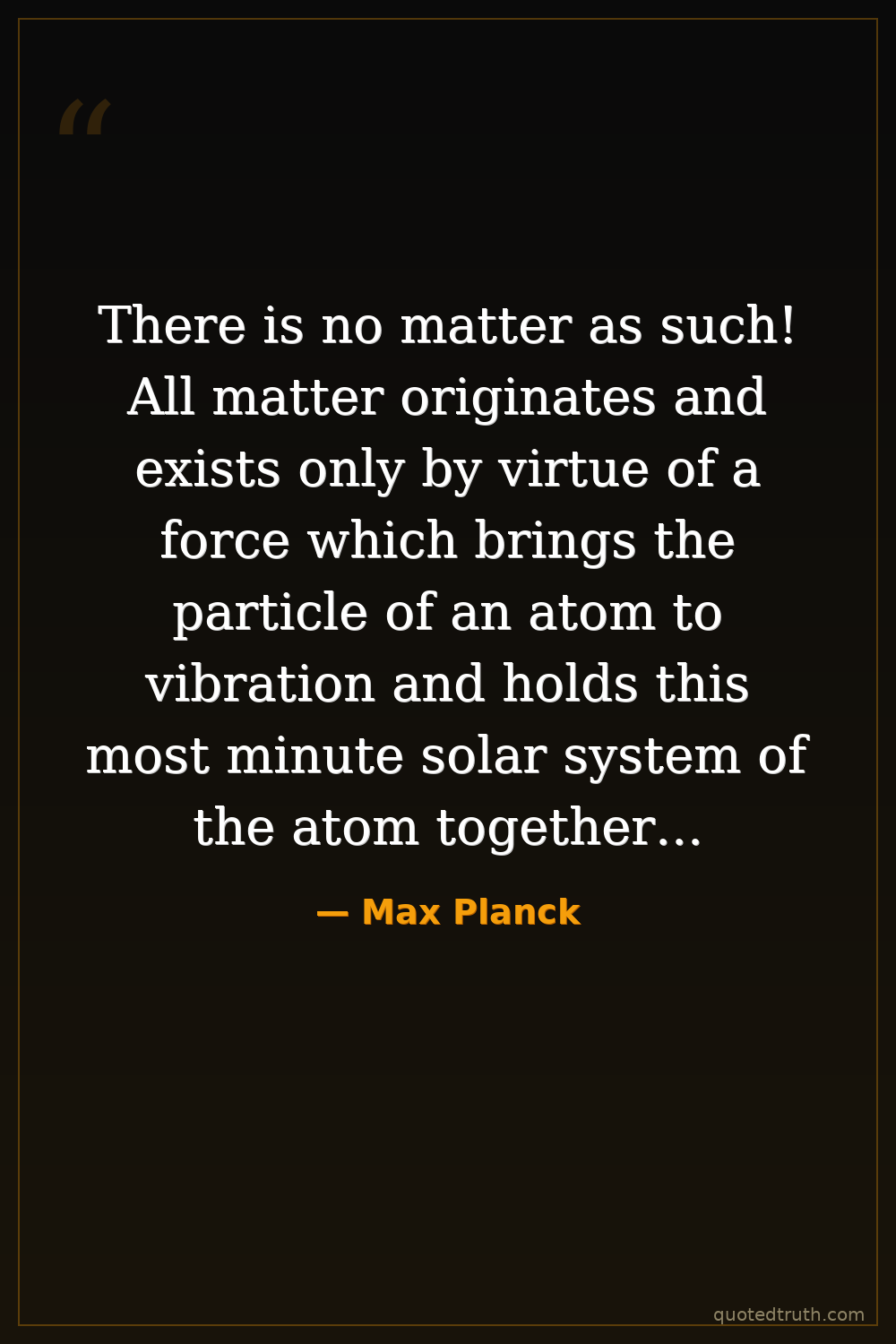
Planck argues that physical matter is not fundamental or self-existing. What we call solid stuff is really patterns of energy and force holding atomic particles in motion. Behind that organizing force, he claims, stands a conscious, intelligent mind that is the true source and foundation of everything material. In short, reality is mental or mind-like at its deepest level, and matter is a downstream effect rather than the starting point.
Relevance to Max Planck
Planck founded quantum theory in 1900 by proposing energy comes in discrete packets, shattering the classical view of matter as smooth and mechanical. His Nobel-winning work revealed atoms as dynamic systems of vibrating particles. A devout Lutheran who lectured on science and religion, he openly rejected materialism and believed a rational mind underlies nature. This quote distills both his physics and his lifelong conviction that science and spiritual conviction were compatible, even complementary.
The era
Planck spoke in early-twentieth-century Germany, when quantum mechanics and relativity were dismantling the Newtonian clockwork universe. Scientific materialism dominated intellectual life, while two world wars, the rise of Nazism, and the loss of his son Erwin to Hitler's regime shook his generation. Debates raged over whether physics eliminated God or pointed toward deeper mystery. Planck's public lectures pushing back against pure materialism resonated in a culture wrestling with meaning, faith, and the limits of reductionist science.
AI-generated insights based on extensive research and information for context. Factual errors? Email [email protected].