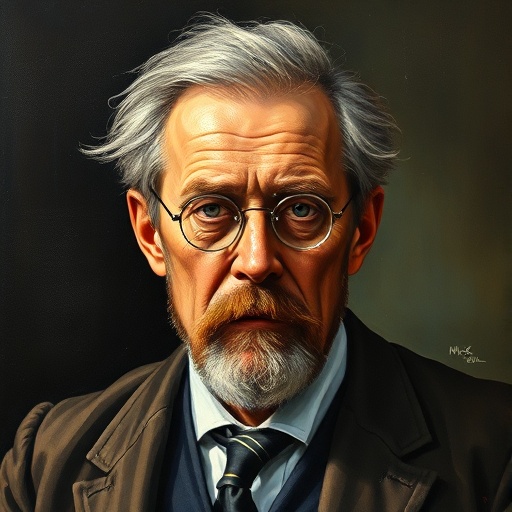
Max Planck — "The true scientist is a man who is always asking questions, and never satisfied …"
The true scientist is a man who is always asking questions, and never satisfied with the answers.
The true scientist is a man who is always asking questions, and never satisfied with the answers.
Click any product to generate a realistic preview. Up to 3 at a time.
* Initial load can take up to 90 seconds — revising the preview in another color is nearly instant.
"An experiment is a question which science poses to Nature, and a measurement is the recording of Nature's answer."
"The scientist does not study nature because it is useful; he studies it because he delights in it, and he delights in it because it is beautiful. If nature were not beautiful, it would not be worth kn…"
"No burden is so heavy for a man to bear as a succession of happy days."
"The measure of a man is what he does with power."
"We have no right to assume that any physical laws exist, or if they have existed up to now, that they will continue to exist in a similar manner in the future."
Found in 1 providers: grok
1 source checked
Real scientists stay curious and skeptical. They keep probing, questioning, and testing rather than accepting conclusions as final. Every answer opens new questions, and certainty is treated as a warning sign rather than a goal. Genuine inquiry means treating knowledge as provisional, always subject to revision when better evidence or deeper understanding emerges. Complacency and intellectual comfort are the enemies of discovery; restless questioning is the engine that drives progress.
Planck embodied this relentless questioning. A trained classical physicist, he was forced by his own blackbody radiation data to propose energy quanta in 1900, shattering the continuous-energy worldview he had defended. He admitted new scientific truths triumph only as older scientists die off. Despite personal tragedies, including losing sons to war and Nazi execution, he kept probing nature's foundations, mentoring Einstein's acceptance and refusing intellectual stagnation even into his eighties.
Planck worked during physics' most turbulent modern upheaval, roughly 1900 to 1947. Newtonian certainty crumbled as quantum mechanics, relativity, and atomic theory rewrote reality. Two world wars devastated Germany, Nazism corrupted its universities, and Planck personally confronted Hitler to defend Jewish colleagues. Scientific questioning carried moral weight when dogma, both political and academic, demanded obedience. The era rewarded those who refused settled answers and punished those who asked uncomfortable ones.
AI-generated insights based on extensive research and information for context. Factual errors? Email [email protected].
Your cart is empty