Pope Urban II — "Therefore, I exhort and implore you—not I, but the Lord—to go as soldiers of Chr…"
Therefore, I exhort and implore you—not I, but the Lord—to go as soldiers of Christ.
Therefore, I exhort and implore you—not I, but the Lord—to go as soldiers of Christ.
Click any product to generate a realistic preview. Up to 3 at a time.
* Initial load can take up to 90 seconds — revising the preview in another color is nearly instant.
"Let this be your war-cry in battle: 'God wills it! God wills it!'"
"All who are burdened with debt and wish to escape it, let them join this holy expedition."
"A people, a truly alien people, utterly estranged from God, has invaded the lands of the Christians and has depopulated them by sword, plunder, and fire."
"Let us avenge the injuries of God."
"Go forth, therefore, and cleanse the Holy Sepulchre from the wicked race."
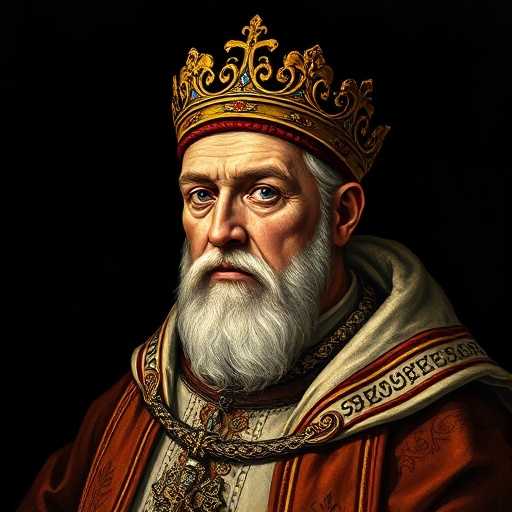
Pope (1088-1099) whose Council of Clermont speech (November 1095) launched the First Crusade — the founding event of nine centuries of Christian-Muslim military conflict. Closely associated with Pope Gregory VII (his predecessor on papal-imperial reform). For an intellectual contrast, see Saladin, Kurdish-Muslim Sultan of Egypt and Syria (1138-1193) — Saladin recaptured Jerusalem in 1187, undoing the First Crusade Urban II launched 92 years earlier. Saladin's chivalrous treatment of Christian prisoners became the canonical Muslim counter-image to Crusader brutality. The cleanest before/after pairing of the Crusades' moral arc.
Found in 1 providers: grok
1 source checked
The quote calls listeners to take up arms as an act of divine obedience, not personal loyalty to a pope. By insisting 'not I, but the Lord,' the speaker strips himself of authorship and frames military action as God's direct command — making refusal spiritually dangerous. It fuses religious duty with martial identity, recasting warfare not as violence but as sacred service, transforming soldiers into instruments of the highest possible authority.
Urban II, a Cluniac monk turned pope, spent his pontificate asserting Church supremacy over secular rulers. The rhetorical move of attributing the call to God rather than himself was characteristic — he drew on Augustinian just war theology and positioned himself as divine messenger rather than political actor. He delivered this at Clermont in 1095, recruiting fighters in response to Byzantine Emperor Alexios I's appeal. Urban died weeks before Jerusalem fell in 1099, never seeing the crusade's culmination.
In 1095, Seljuk Turks controlled Jerusalem and had crushed Byzantine forces at Manzikert in 1071, prompting Emperor Alexios I to seek Western military aid. Europe's feudal knights — trained for combat but constrained by the Church's Peace of God movement — had excess martial energy with no sanctioned outlet. Urban channeled it toward a unified holy cause, offering plenary indulgence to participants and framing the campaign as both spiritual pilgrimage and righteous war.
AI-generated insights based on extensive research and information for context. Factual errors? Email [email protected].
Your cart is empty