What it means
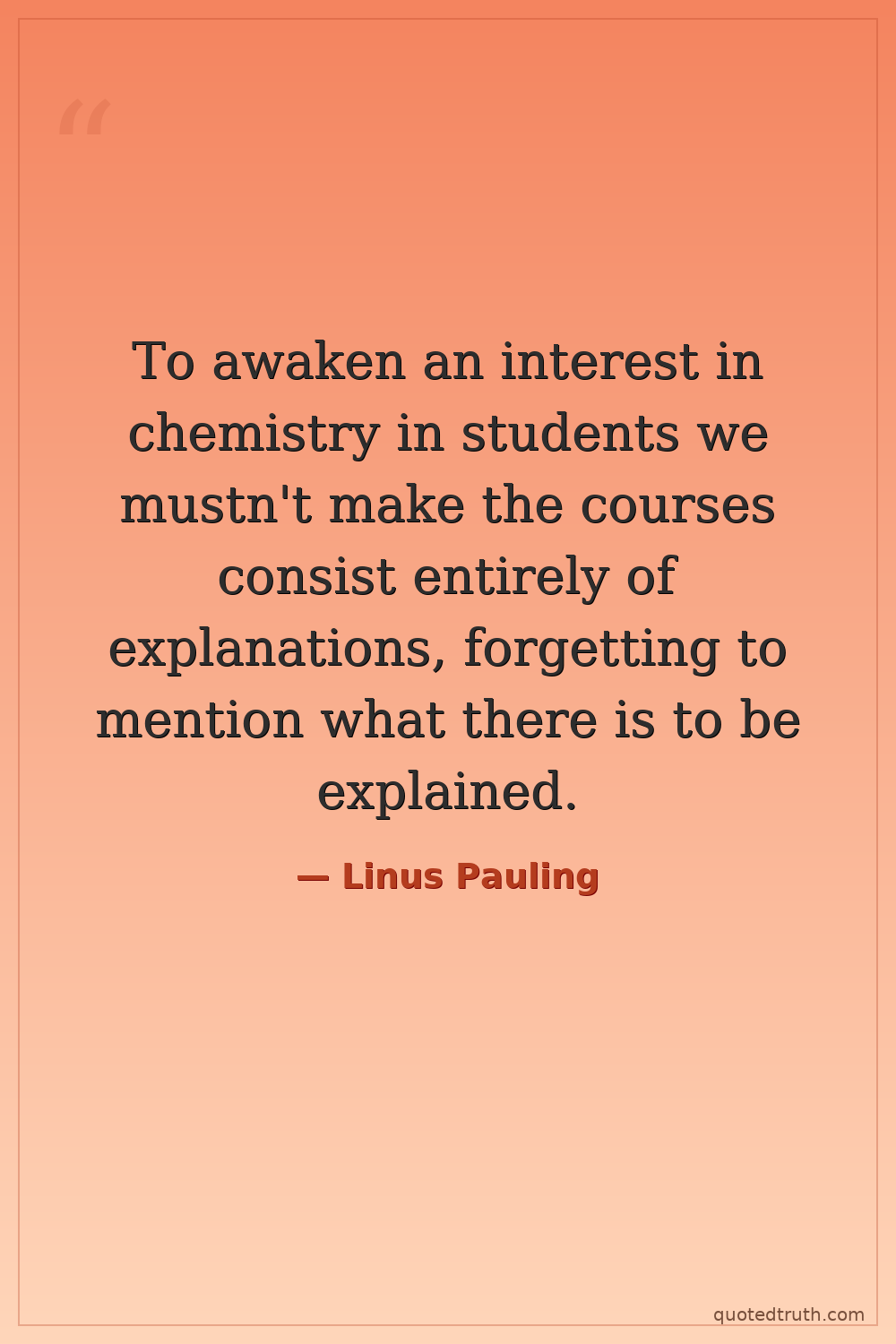
Pauling argues that chemistry education fails when it becomes purely mechanical explanation divorced from the fascinating phenomena those explanations address. Effective teaching must first present the mystery — the question worth asking — before delivering the answer. Students engage when they encounter a real problem worth solving, not when handed dry solutions to questions they never thought to ask. Show the phenomenon first; the explanation then earns its place.
Relevance to Linus Pauling
Pauling spent decades at Caltech bridging research and teaching, and his landmark work 'The Nature of the Chemical Bond' embodied this philosophy — it began with the puzzling reality of molecular structure before building theory. As a scientist driven by genuine curiosity, he understood that wonder must precede rigor. His Nobel-winning quantum chemistry work was grounded in asking 'why do atoms bond this way?' first, then constructing frameworks around observed chemical reality.
The era
Pauling lived through the post-Sputnik science education boom of the late 1950s–60s, when the U.S. poured funding into STEM curricula after the Soviet satellite shock. The resulting programs, including CBA and CHEM Study, often emphasized rigorous theory over engaging phenomena. In that climate, Pauling's critique was pointed: standardized curricula were producing students who could recite mechanisms but had lost the curiosity that makes chemistry feel alive and worth pursuing.
AI-generated insights based on extensive research and information for context. Factual errors? Email [email protected].