What it means
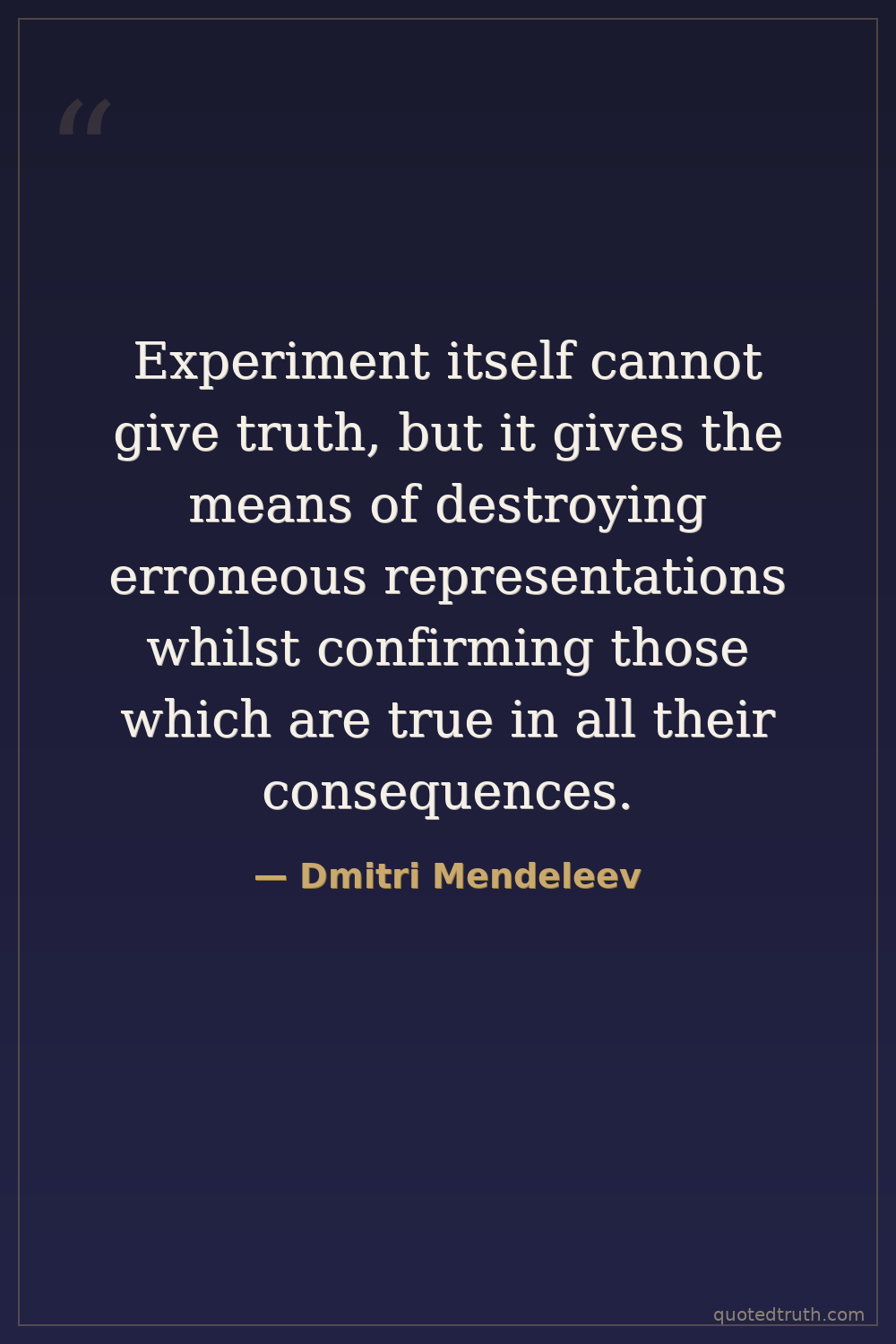
Running an experiment doesn't hand you truth on a silver platter. What it does is test ideas against reality: wrong assumptions get knocked down, and right ones survive every check you throw at them. Truth emerges through elimination and repeated confirmation, not from a single dramatic result. The lab is a filter, not an oracle, and conclusions earn their standing only by withstanding consequences across many tests.
Relevance to Dmitri Mendeleev
Mendeleev built the periodic table by patterning known elements, then predicted gallium, scandium, and germanium with specific properties before they were found. Each later discovery matched his table, validating it, while gaps and corrections refined it. He lived this principle: bold theoretical structures only earn credibility when experiments either eliminate them or keep confirming their predictions across new substances and measurements over decades.
The era
Mendeleev worked in late 19th-century Russia, an era when chemistry was shifting from descriptive cataloguing to predictive science. Atoms were still debated, spectroscopy was revealing new elements yearly, and rival classification schemes competed. European labs, especially in Germany and France, were industrializing experimental method. His insistence that experiments destroy errors rather than manufacture truth captured the maturing scientific mindset that distinguished modern chemistry from earlier alchemical and purely empirical traditions.
AI-generated insights based on extensive research and information for context. Factual errors? Email [email protected].