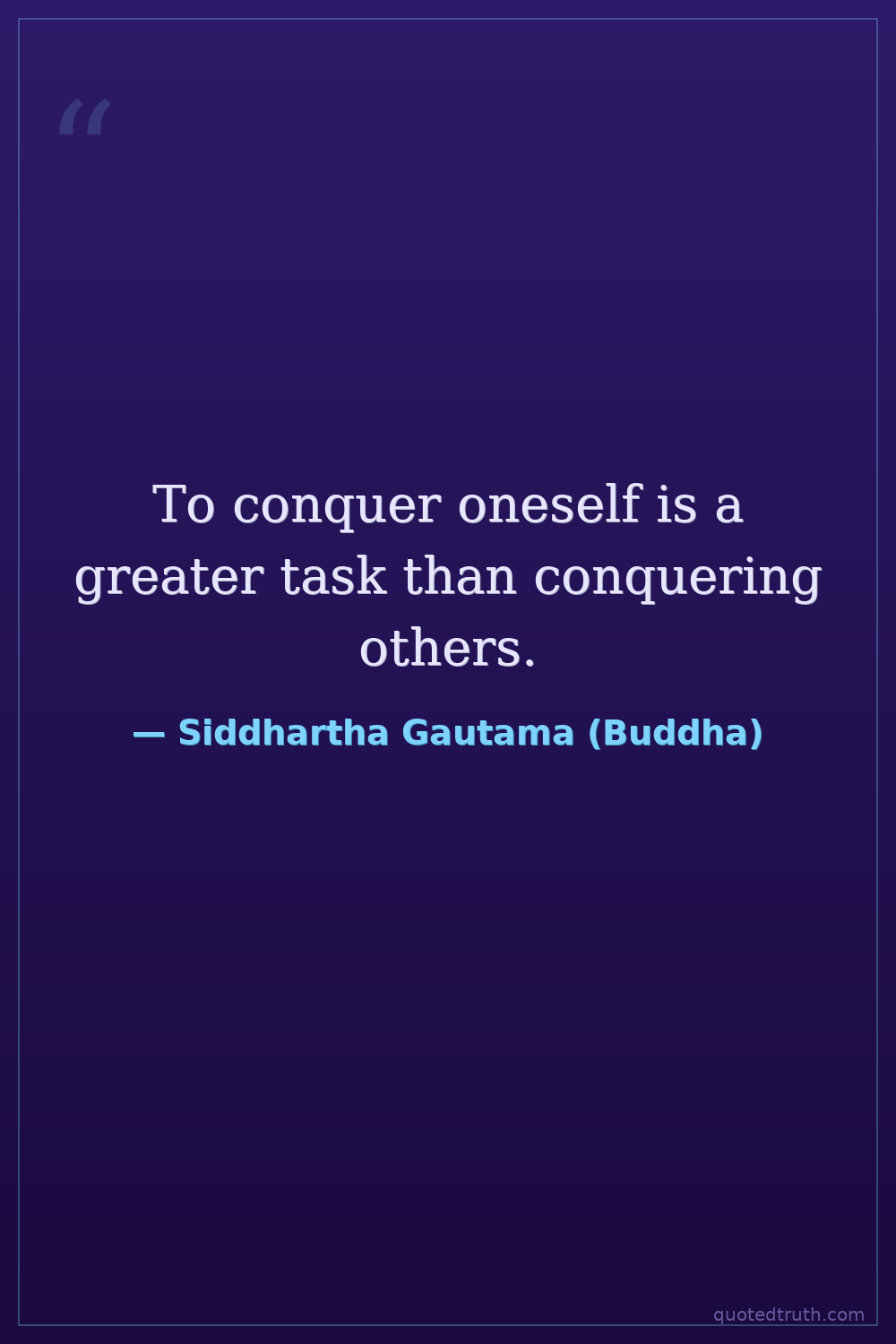
Siddhartha Gautama (Buddha) — "To conquer oneself is a greater task than conquering others."
To conquer oneself is a greater task than conquering others.
To conquer oneself is a greater task than conquering others.
Click any product to generate a realistic preview. Up to 3 at a time.
* Initial load can take up to 90 seconds — revising the preview in another color is nearly instant.
"Even as a tree, though cut down, sprouts again if its roots are undamaged and strong, so also, if the roots of craving are not destroyed, suffering ever springs up again and again."
"When watching after yourself, you watch after others. When watching after others, you watch after yourself."
"One who drinks deeply of the Dharma with a clear and open mind, rests well."
"The only way to ease our pain is to experience it fully."
"If you find no one to support you on the spiritual path, walk alone. There is no companionship with the immature."
Found in 2 providers: grok,gemini
2 sources checked
Mastering your own impulses, fears, cravings, and reactions is harder and more valuable than defeating any external enemy or rival. Outer victories depend on luck, circumstance, and force, but ruling your own mind requires constant honesty and discipline. The person who can stay calm under provocation, resist temptation, and choose their response has achieved something no army or accomplishment can match, because the battlefield never lets up.
Siddhartha abandoned his royal inheritance, wife, and child to seek liberation from suffering, spending six years in extreme asceticism before settling on the Middle Way. His awakening under the Bodhi tree came not from defeating rivals but from seeing through his own craving, aversion, and delusion. Teaching that the root of suffering lies inside the mind, he made self-mastery the core of the Eightfold Path, pointing followers inward rather than toward conquest.
In 5th-century BCE northern India, kings like Bimbisara and Ajatashatru expanded territory through warfare, and the Vedic culture prized ritual power, caste status, and martial glory. A wave of renunciants, the shramanas, rejected this order and turned inward instead, questioning sacrifice and social hierarchy. Siddhartha emerged from that movement, reframing true greatness as inner discipline rather than outer dominance, which directly challenged the warrior-king ideal of his time.
AI-generated insights based on extensive research and information for context. Factual errors? Email [email protected].
Your cart is empty