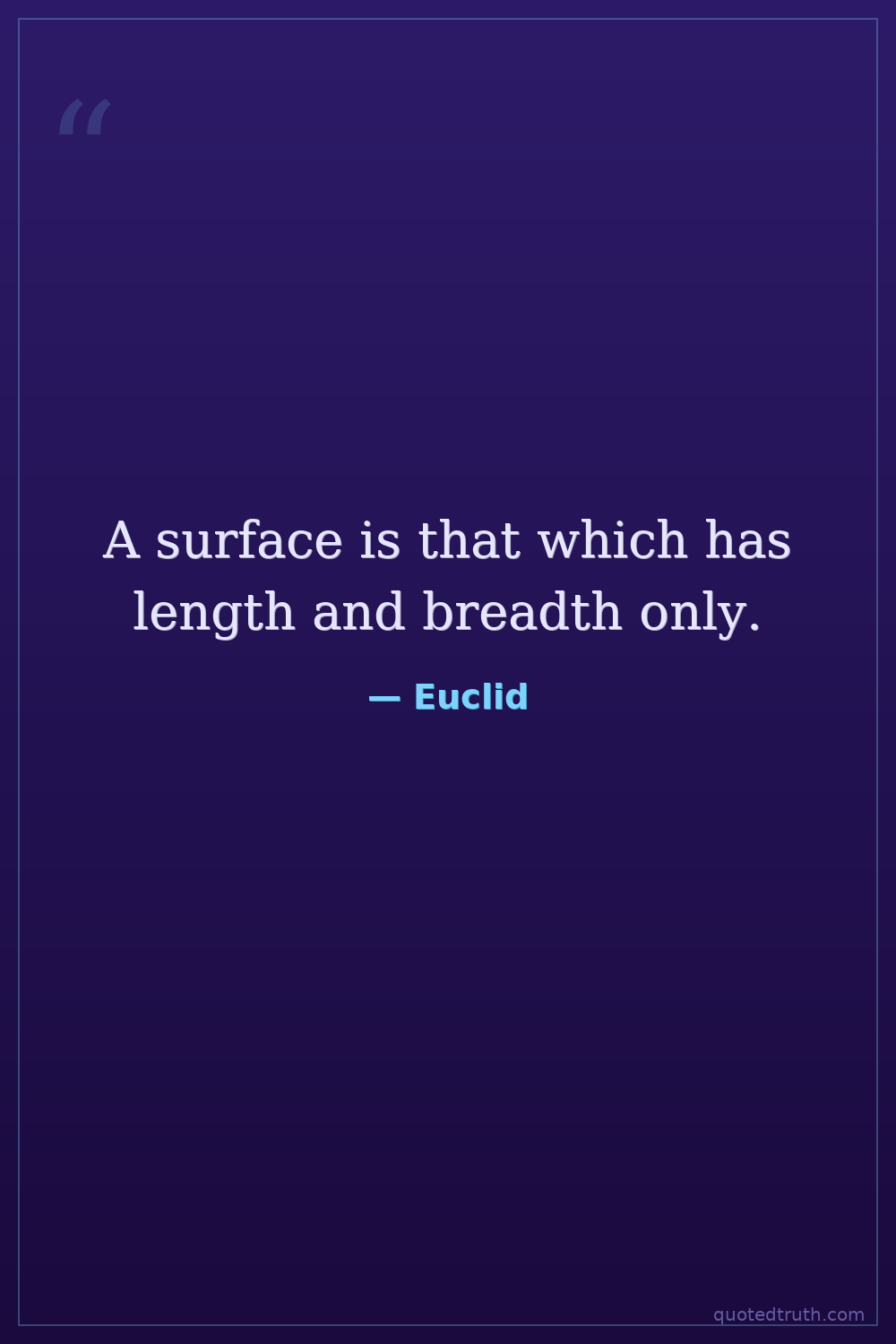
Euclid — "A surface is that which has length and breadth only."
A surface is that which has length and breadth only.
A surface is that which has length and breadth only.
Click any product to generate a realistic preview. Up to 3 at a time.
* Initial load can take up to 90 seconds — revising the preview in another color is nearly instant.
"A boundary is that which is an extremity of anything."
"What advantage shall I get by learning these things?"
"The only purpose of the 'Elements' is to demonstrate mathematically certain fundamental propositions."
"A prime number is that which is measured by a unit alone."
"To produce a finite straight line continuously in a straight line."
Found in 3 providers: grok,deepseek,gemini
3 sources checked
A surface occupies two dimensions—length and width—but has no thickness or depth. It's a purely flat, abstract boundary that separates space without occupying any of it. Think of it as an idealized plane: infinitely thin, with no volume. This definition distinguishes surfaces from solid objects (which have depth) and from lines (which have only length), establishing the precise hierarchy of geometric dimensions.
Euclid wrote this in Book I of his Elements (~300 BCE), where he systematically defined points, lines, and surfaces before building all geometry from axioms. His genius was constructing knowledge from minimal, undeniable foundations. This definition exemplifies his precise, stripped-down thinking—nothing stated beyond what's necessary. Working at Alexandria's great Library, Euclid believed geometry's power lay in rigorous definitions that left no room for ambiguity or assumption.
In 300 BCE Alexandria, Greek mathematics was transforming from practical land-measurement into abstract science. Egyptian and Babylonian traditions calculated areas empirically; Euclid demanded logical proof. Under Ptolemy I's patronage, the Library of Alexandria gathered scholars to systematize knowledge. Greek philosophy prized clarity and logical order—Plato had argued geometric forms were the truest reality. Defining surfaces precisely was part of building mathematics as a purely rational, universal discipline untethered from physical objects.
AI-generated insights based on extensive research and information for context. Factual errors? Email [email protected].
Your cart is empty