What it means
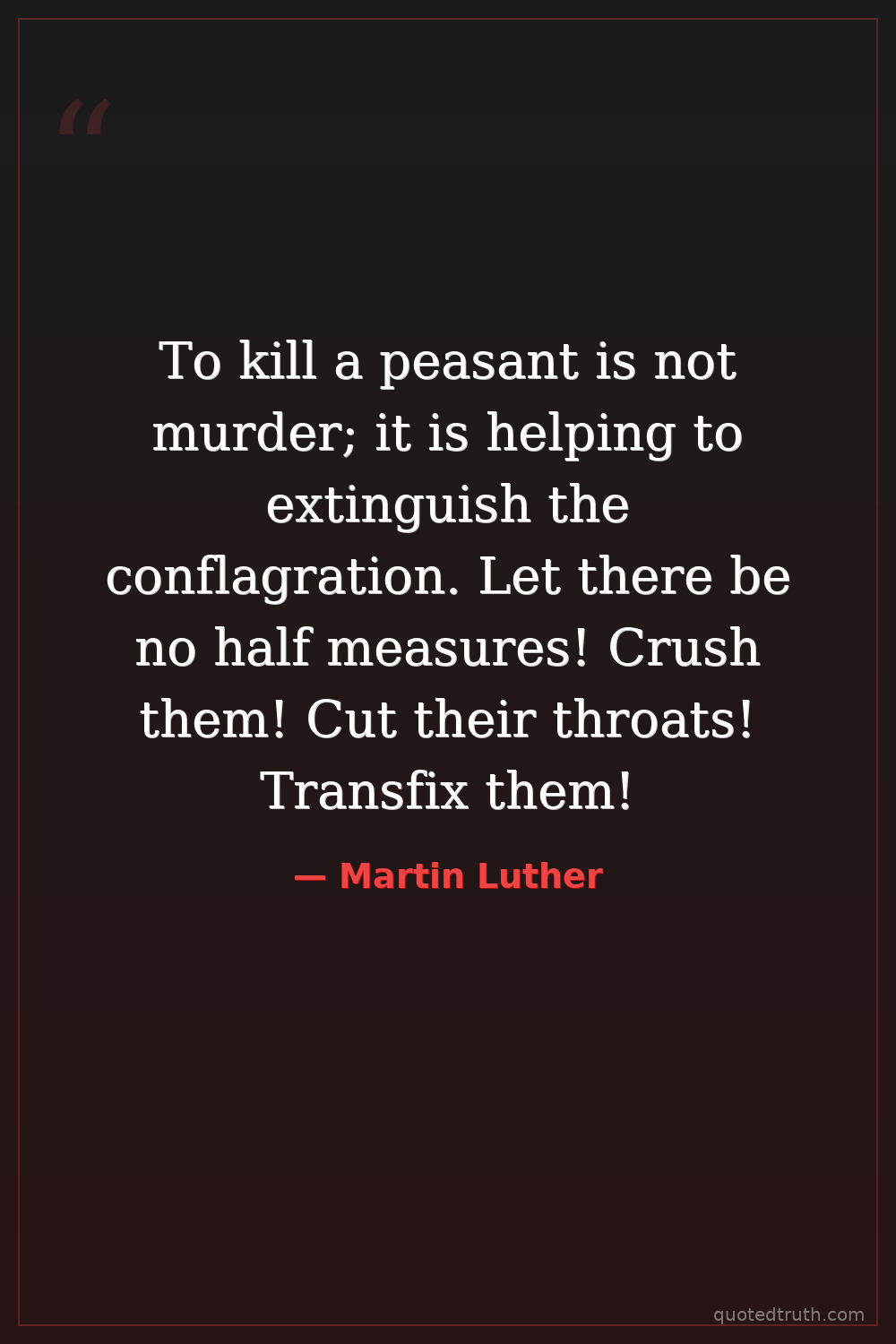
This is a brutal call to violently suppress rebelling peasants without mercy or restraint. The speaker frames killing them not as murder but as a civic duty, comparing the revolt to a spreading fire that must be extinguished completely. He demands total force, rejecting any compromise or moderate response, and urges authorities to slaughter, stab, and destroy the rebels thoroughly rather than negotiate.
Relevance to Martin Luther
Luther wrote this in his 1525 tract 'Against the Murderous, Thieving Hordes of Peasants' after the German Peasants' War erupted. Though his reforms inspired the rebels' demands for liberty, Luther depended on German princes for protection of his movement and violently repudiated the uprising. It reveals his authoritarian streak, his doctrine of obedience to secular rulers, and how he separated spiritual freedom from social or political liberation.
The era
The 1524-1525 German Peasants' War was Europe's largest popular revolt before the French Revolution, with around 300,000 peasants demanding relief from serfdom, citing Reformation ideas. Roughly 100,000 were slaughtered by princely armies. The early modern era saw fractured authority between Catholic Church, Holy Roman Emperor, and local princes, with Luther's Reformation accelerating this upheaval while reshaping European politics, religion, and class relations.
AI-generated insights based on extensive research and information for context. Factual errors? Email [email protected].