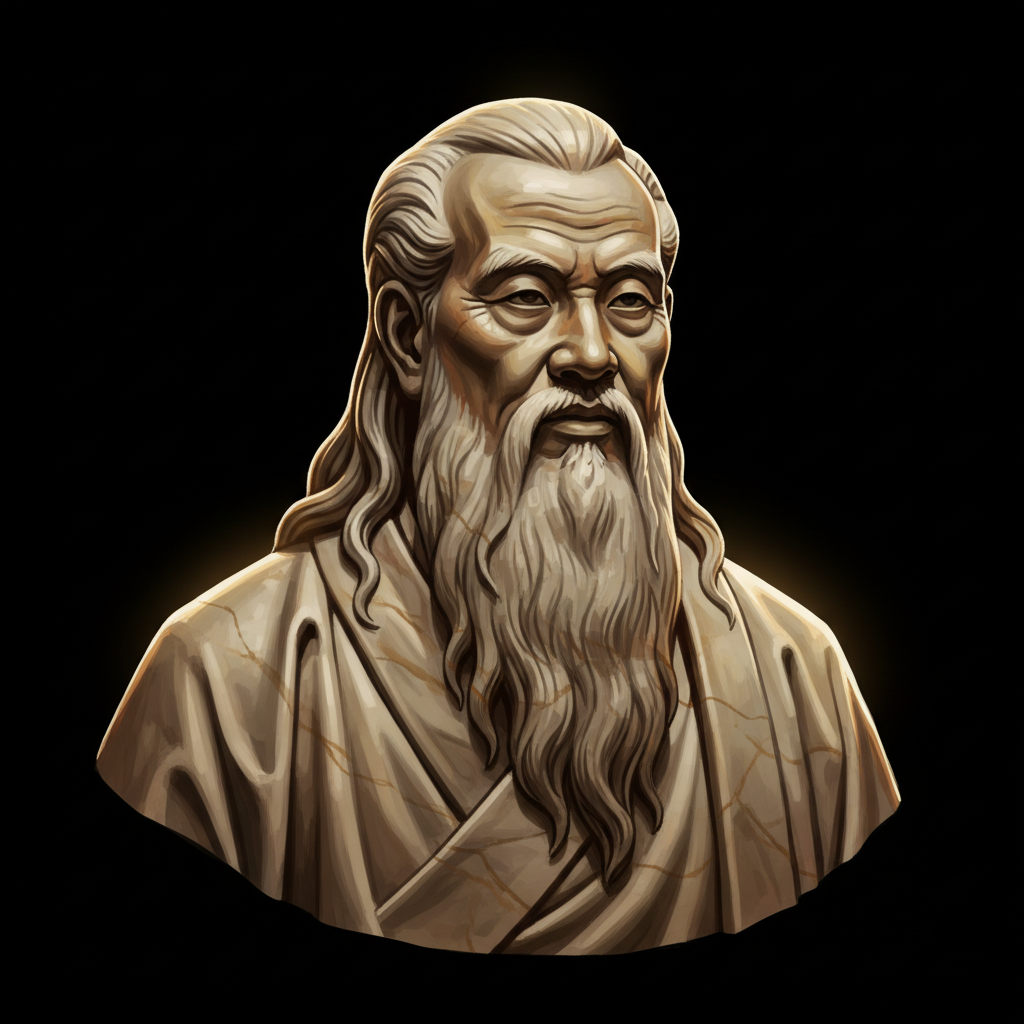
Laozi — "To lead people, walk behind them."
To lead people, walk behind them.
To lead people, walk behind them.
Click any product to generate a realistic preview. Up to 3 at a time.
* Initial load can take up to 90 seconds — revising the preview in another color is nearly instant.
"When nothing is done, nothing is left undone."
"A great nation is like a great man: When he makes a mistake, he realizes it. Having realized it, he admits it. Having admitted it, he corrects it. He considers those who point out his faults as his mo…"
"He who knows others is wise; he who knows himself is enlightened."
"The great square has no corners. The great vessel is never full. The great sound is inaudible. The great image has no form."
"Pursue without interfering."
Reputed founder of Taoism and author of the Tao Te Ching, whose wu wei (effortless action) shaped East Asian philosophy. Closely associated with Zhuangzi (later Taoist who extended Laozi's framework). For an intellectual contrast, see Confucius, near-contemporary Chinese sage of social ritual and duty — Confucius systematized social order through ritual and hierarchy; Laozi argued that all such systems were the disease, not the cure — the two founding poles of Chinese moral philosophy.
Found in 1 providers: grok
1 source checked
True leadership works by serving and supporting, not dominating from the front. A good leader lets others go first, makes space for their initiative, and guides quietly from behind so people feel ownership over their actions. Pushing, commanding, or grabbing the spotlight breeds resistance; stepping back builds trust and loyalty. The leader who seems invisible often wields the deepest influence, because the group believes it accomplished the work on its own.
Laozi, the reputed founder of Taoism and author of the Tao Te Ching, championed wu wei, or effortless action, and humility as the root of power. Legend holds he worked as an archivist in the Zhou court, observing rulers whose forceful reigns collapsed. His teachings repeatedly praise water, valleys, and low places for their quiet strength, and this saying mirrors his core conviction that the sage rules by yielding rather than by asserting dominance.
Laozi lived during the late Zhou dynasty, around the 6th century BCE, an era of fracturing feudal authority that soon spiraled into the Warring States period. Rulers competed through armies, taxes, and harsh legalist controls, and philosophers traveled courts offering competing models of governance. Against this backdrop of ambition and bloodshed, Taoism proposed a radical alternative, urging leaders to restrain themselves, soften their grip, and trust natural order rather than impose ever-heavier decrees on exhausted populations.
AI-generated insights based on extensive research and information for context. Factual errors? Email [email protected].
Your cart is empty