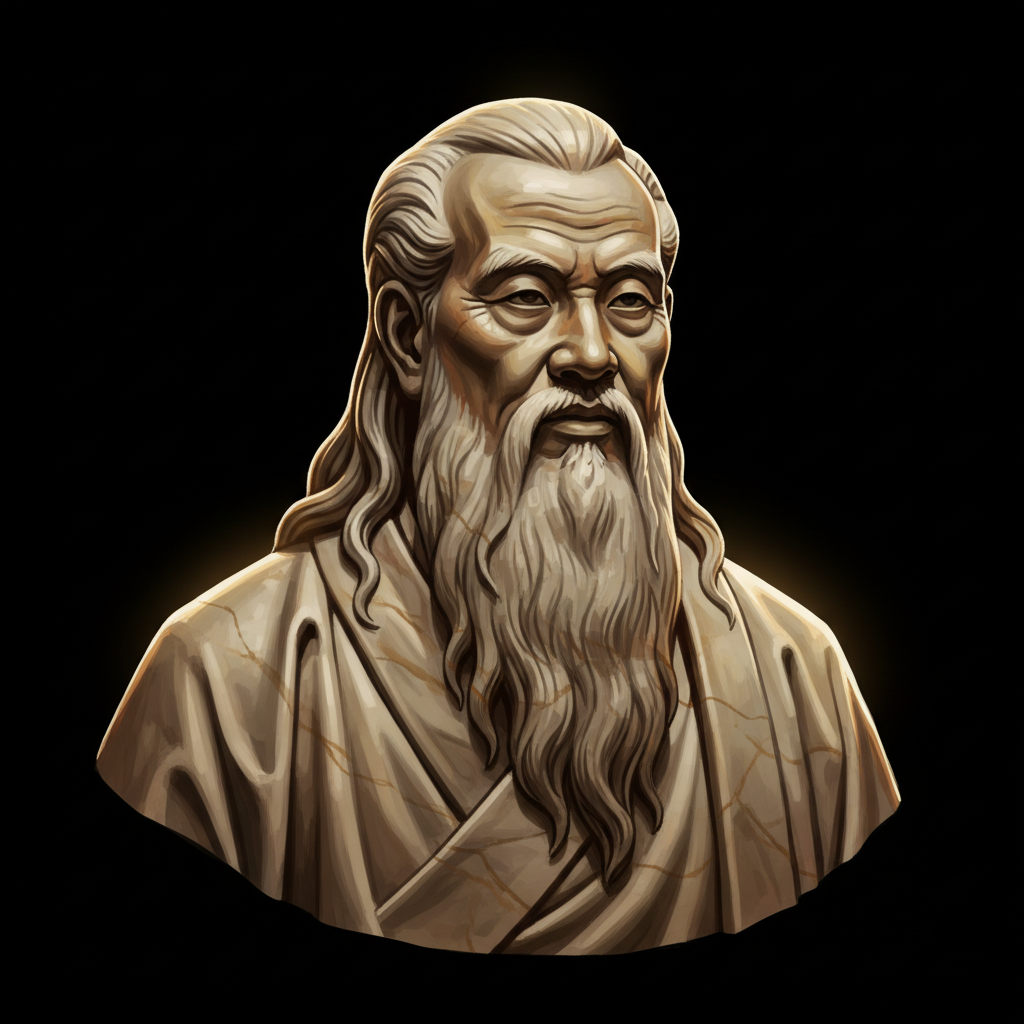
Laozi — "He who knows others is wise; he who knows himself is enlightened."
He who knows others is wise; he who knows himself is enlightened.
He who knows others is wise; he who knows himself is enlightened.
Click any product to generate a realistic preview. Up to 3 at a time.
* Initial load can take up to 90 seconds — revising the preview in another color is nearly instant.
"He who knows does not speak. He who speaks does not know."
"The sage puts his own person last, and yet is found in the foremost place."
"Therefore the sage manages affairs without doing anything, and conveys his instructions without the use of speech."
"When the great Tao is lost, there is 'benevolence' and 'righteousness'."
"The sage, because he does not contend, is therefore without reproach."
Reputed founder of Taoism and author of the Tao Te Ching, whose wu wei (effortless action) shaped East Asian philosophy. Closely associated with Zhuangzi (later Taoist who extended Laozi's framework). For an intellectual contrast, see Confucius, near-contemporary Chinese sage of social ritual and duty — Confucius systematized social order through ritual and hierarchy; Laozi argued that all such systems were the disease, not the cure — the two founding poles of Chinese moral philosophy.
Found in 1 providers: grok
1 source checked
Understanding other people requires intelligence and observation—reading their motives, predicting their actions, navigating social complexity. But turning that same attention inward, honestly examining your own fears, biases, desires, and blind spots, demands something deeper. Self-knowledge is harder because you cannot step outside yourself to observe objectively. The saying ranks inner awareness above outer cleverness, suggesting that mastering external understanding still leaves the greater work undone until you genuinely see yourself.
Laozi, traditionally a court archivist in the Zhou dynasty, reportedly withdrew from public life disillusioned by political decay, writing the Tao Te Ching before vanishing westward. His path from scholar surrounded by others' affairs to hermit seeking inner truth mirrors this saying exactly. Taoism he founded prizes wu wei, inner stillness, and alignment with one's nature over social ambition, making self-knowledge the true enlightenment while worldly cleverness remains merely useful wisdom.
Laozi lived during the late Zhou dynasty's unraveling, roughly the 6th century BCE, as feudal states warred and Confucian scholars promoted rigid social hierarchy, ritual, and outward virtue. Thinkers competed to advise rulers on governing others effectively. Against this backdrop of political maneuvering and external moralism, Laozi's emphasis on inward enlightenment was radical—rejecting the era's obsession with managing people and kingdoms in favor of quietly understanding oneself and the Tao underlying everything.
AI-generated insights based on extensive research and information for context. Factual errors? Email [email protected].
Your cart is empty